

At the HR Forum Banking, the question of the future viability of employees was one of the most discussed topics of the day. What remains for people when machines take over more and more? And how do banks need to empower their workforce to deal constructively with this shift?
The empirical framework for the discussions was provided by a research team from the Institute for Employment and Employability, which systematically analyzed the banking sector over three years. Led by Prof. Dr. Jutta Rump, Managing Director of the institute, came to a crucial understanding: not every form of digitalization means job loss.
Three degrees of AI in banking


The researchers differentiate between rule-based automation, intelligent automation with adaptive AI – and AI as an assistance system. The latter in particular, i.e. tools like ChatGPT or Claude, do not replace, but complement: “The assistant in artificial form sits with me in the driver’s seat,” says Rump. The substitution potential – i.e. how many tasks can be completely or partially transferred to the machine through automation or the use of AI – varies greatly. The potential is highest in the passive back office area – the bank’s internal area without direct customer contact – where it is 55 percent overall. However, the potential for substitution is significantly lower where interaction is the main focus: in private customer service, asset management or in corporate customer business. The fact that these numbers do not reflect what is technically feasible, but rather what is achievable from a regulatory and legal perspective, is not a side note: “Technically, much more is possible, but the legal framework is a limiting factor.”
A second finding was at least as important as the automation potential: demographics. In many banks, half of the positions currently filled will become vacant due to retirement within the next five years – regardless of AI and automation. The demographic development “drapes itself over this development like a warm blanket,” as the researchers put it succinctly. Anyone who only calculates substitution potential without taking demographic reality into account is thinking structurally too short-sighted. Technological possibilities, legal limits and age structure must be consistently considered.
What the numbers mean: three voices from practice
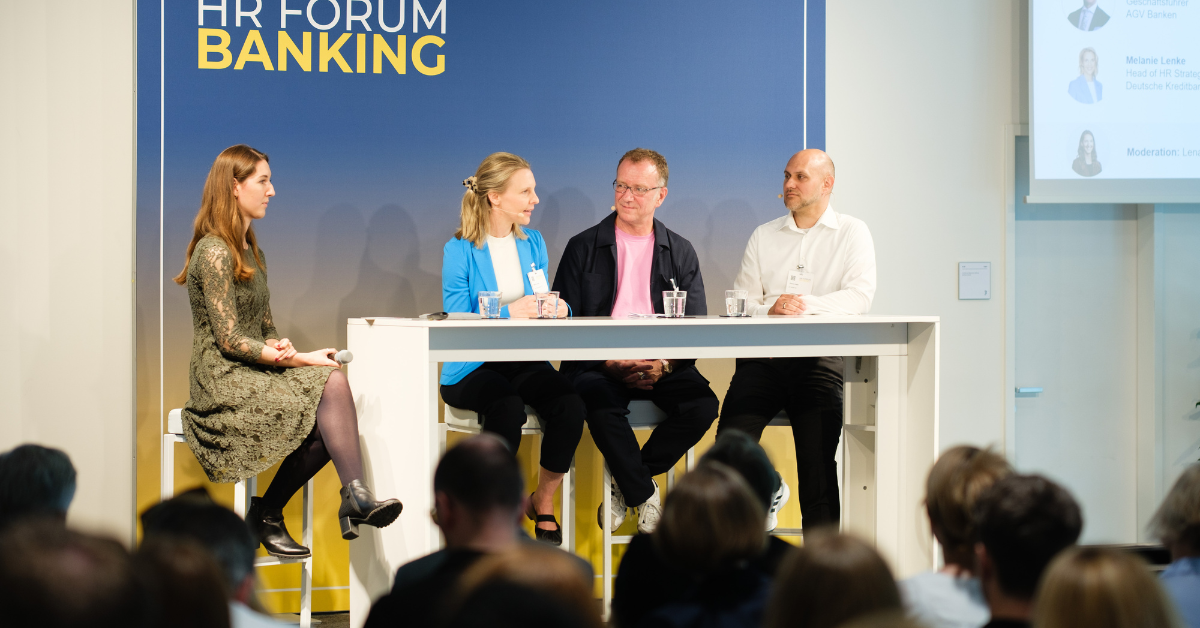
What these findings mean specifically for people and organizations – the panel “New Skills – New Corporate Learning? How to make employees fit for the future” provided the right resonance space. Melanie Lenke from Deutsche Kreditbank (DKB), Florian Heß from DZ Bank and Ulf Grimmke from the Employers’ Association of the Private Banking Industry (AGV Banken) discussed the topic – three representatives who examined the topic from an operational, cultural and industry policy perspective.
Moderator Lena Onderka, human resources editor, provided the most personal introduction. She openly admitted that she had known about ChatGPT since 2023, but had barely used it – no hackathons, no intensive experimentation. It was only a sentence from Miriam Oehme, human resources manager at Biotest, that really woke her up: “Anyone who doesn’t learn how to use AI now will no longer be employable in the future.” This honest self-assessment was representative of many employees in German companies – and set the tone for a discussion that consciously remained at the level of reality, not technological optimism.
Create structures, reduce hurdles
The three panel participants first described how AI competency development is organized in their companies. At DKB, an interdisciplinary team from HR, IT and governance works to train employees in a target group-specific and practical way. Melanie Lenke emphasized that formats work when they specifically address the employees’ everyday work.
DZ Bank pursues an approach that consciously focuses on positive experiences: Under the slogan “More joy and fulfillment,” employees should use concrete everyday examples to experience the added value that using AI tools can bring. DZ Bank representative Florian Heß emphasized that managers have a dual role: they are both users and companions of their teams during change.
From the association’s perspective, Ulf Grimmke warned that AI competence should not be treated as a voluntary experiment, but should be anchored structurally as an integral part of professional development – otherwise the entire sector would be at risk of gradually falling behind.
The five most important future competencies – the heart of the panel
The core of the discussion was the question of what skills employees will really need in the future. The answers from the three experts showed a remarkable agreement: it is less about specific tool knowledge than about basic attitudes and skills that outlast technological change.
Florian Heß named curiosity as a central prerequisite – the willingness to get involved with new tools and ways of working. Melanie Lenke added the ability to learn as a permanently necessary basic attitude that must not be tied to individual projects or training measures, as well as resilience as the ability to deal with the speed and uncertainty of change without falling into rigidity. Ulf Grimmke brought in two skills that are particularly relevant in the context of AI: validation skills – i.e. the ability to critically question and classify AI-generated results instead of accepting them uncritically – and transformation skills, the ability to actively shape changes instead of passively suffering them. In addition, analytical thinking and methodological skills were highlighted as tool-independent basic skills that will continue to be effective even if the technologies change again.
According to the panel participants, these five core competencies – curiosity, ability to learn, resilience, validation and transformation skills – mark the framework within which any meaningful further training strategy must operate. In doing so, they point to an important shift in corporate learning: the focus is not on training individual applications, but rather on strengthening attitudes and ways of thinking that enable people to deal with the unknown independently.
The unsolved problem of young talent
The most uncomfortable part of the discussion was the question of how banks deal with the loss of classic entry-level positions. AI is increasingly taking over precisely those tasks that previously gave young professionals the opportunity to learn the basics and develop step by step. Ulf Grimmke summed up the dilemma: If you don’t train juniors today, you won’t have any experienced specialists in ten years – the young talent pipeline shouldn’t be allowed to dry up in silence.
The DKB is responding by realigning the content of the trainee program: at least one station related to technology or data will be mandatory in the future. DZ Bank is increasingly relying on mentoring in AI-related units in order to offer newcomers orientation and learning space even in the changed environment.
And yet, in the end, all three openly admitted: There are still no definitive answers to the youth dilemma. What the panel at the HR Forum Banking made clear is that the industry is asking the right questions – and that the most credible moments often arise where experts identify the limits of their own knowledge.
Info
The HR Forum Banking will take place again next year, on May 11, 2027 in the FAZ Tower in Frankfurt am Main. Register now.
We would like to thank our partners Mercer, zeb, Görg and AGV Banken.


Rebecca Scheibel is the online editorial director and responsible for the digital channels of human resources.

Tonia Schöler is a volunteer at Human Resources.