



Many companies associate artificial intelligence with the hope of more efficient payroll. Processes should run faster, costs should be reduced and employees should be relieved of routine activities. But how far is the practice actually? A current study “From compliance pressure to AI potential: Payroll outsourcing as a strategy for the future” by IW Consult on behalf of SPS Germany provides answers to this. The study examined how companies organize their payroll today, where the greatest pressure to transform exists and what role AI, cloud and outsourcing play in this.
High expectations for AI
The results of the survey show that there is still a gap between expectations and reality. 28 percent of companies are already using AI in their payroll. However, so far it has only reached four percent in normal productive operation. The majority of applications take place in pilot projects or are limited to individual fields of application.
In contrast, there are high expectations of the technology: 71 percent of the companies surveyed expect positive effects from digitalization and automation. 45 percent see advantages in dealing with compliance, data protection and regulation. 40 percent expect relief from cost pressure and efficiency requirements. Companies see the greatest operational contribution of AI in process monitoring and error detection. AI-supported self-services for employees and forecasts are also frequently mentioned.

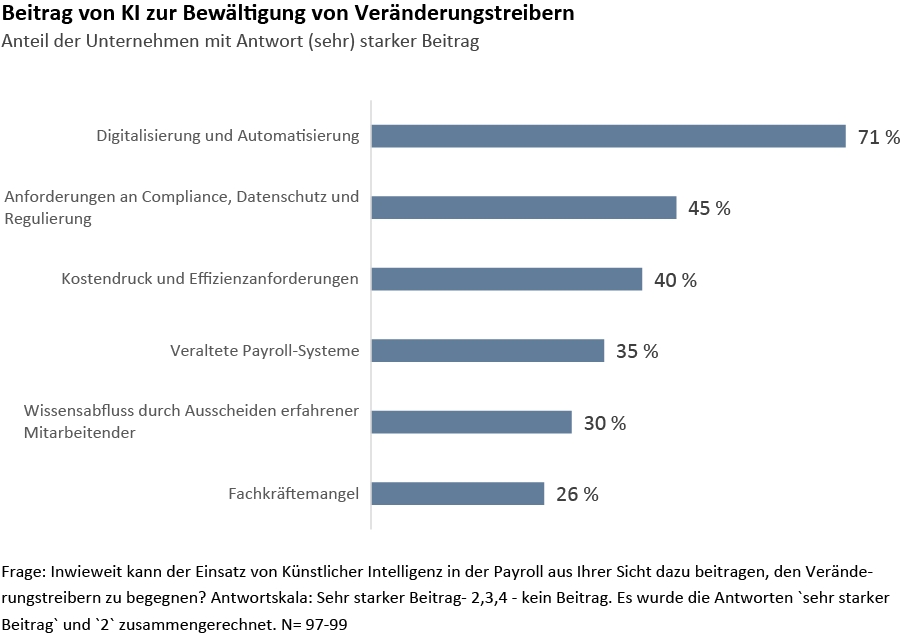
At the same time, it is striking that the potential for dealing with a shortage of skilled workers or outdated systems is assessed much more cautiously. Companies see AI more as a lever for optimizing existing processes than as an all-purpose solution for structural problems.
Old systems slow down new solutions
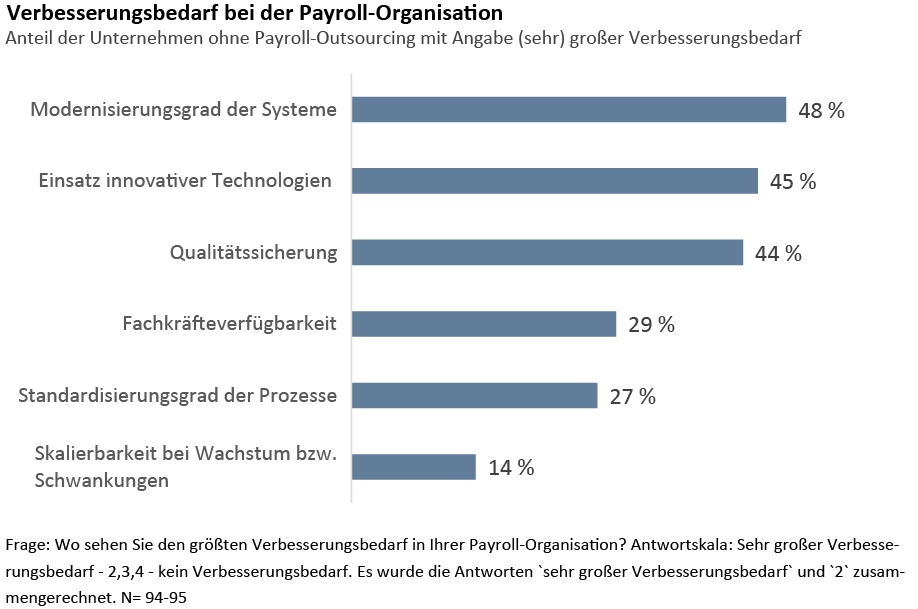
A look at their systems and processes shows why many companies are not yet further along in the use of AI. Payroll is still predominantly organized internally – regardless of the size of the company. At the same time, the pressure on the existing structures is growing. Around three out of four companies see a need for improvement in their payroll. Modernizing payroll systems is the most urgent task (48 percent), followed by the use of new technologies (45 percent), quality assurance (44 percent) and availability of skilled workers (29 percent).


Many companies also lack a clear direction when it comes to cloud solutions. 38 percent have no strategy, 29 percent are already using cloud solutions, another 21 percent are still in the transformation process or are planning to migrate in the coming years. 12 percent want to continue working on on-premise systems.
Pressure to modernize meets a shortage of personnel
There is a clear difference: companies with cloud solutions report a need for modernization much less often than organizations without a cloud setup. In many payroll areas, AI encounters structures that are only partially suitable for scaling and automation. Outdated systems, low standardization and unclear cloud strategy prevent the recognized pressure for action from being consistently translated into transformation.
In addition to technological issues, personnel pressure is growing. 51 percent of companies see the loss of knowledge due to the departure of experienced employees as a strong driver of change. Payroll processes often still depend on the knowledge of individual specialists. Companies are faced with the central question: How can payroll be made future-proof – technologically and organizationally?
Info
The survey was carried out by iw consult, a subsidiary of the German Economic Institute, on behalf of SPS Germany. People from the finance and human resources departments of 100 companies with more than 1,700 employees in Germany were surveyed. The organization of payroll, the use of artificial intelligence, cloud strategies, outsourcing models and key drivers of change in the payroll environment were examined.
Outsourcing creates scope for action
When internal structures reach their limits, alternative models come into focus. Around one in four companies surveyed uses payroll outsourcing at least partially. 83 percent of companies with outsourced payroll report significant improvements – in the modernization of systems, in the need for skilled workers as well as in quality assurance and the level of standardization.
This matters because many companies continue to organize their payroll internally as regulatory requirements increase, expertise becomes scarcer, and technology projects compete with day-to-day operations. External models are becoming increasingly relevant where internal resources are lacking, the existing system landscape is reaching its limits or transformation projects need to be implemented more quickly.
Author


Marianne Gause, Director Sales & Account Management Payroll Continental Europe bei SPS Germany GmbH
Marianne Gause heads the payroll outsourcing business at SPS in Germany and Switzerland. She has been working in the payroll environment for more than 20 years and brings extensive experience from leadership roles at payroll service providers.