
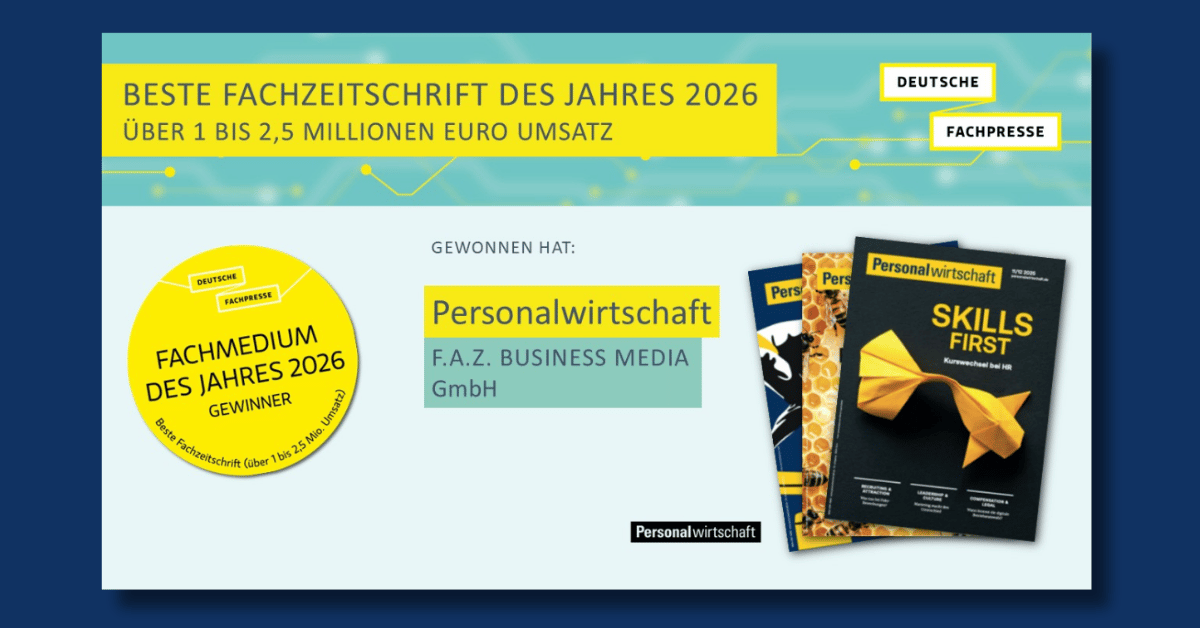
Human Resources was named “Special Media of the Year 2026”. Behind this success is a dedicated editorial team. In our “Three Questions for…” series, we introduce you to the people who work every day to provide you with relevant information.
What does the title “Special Media of the Year” mean to you personally – and what does human resources management stand for in your eyes? In your opinion, what are the ingredients for excellent HR journalism?
If you put a lot of energy into a project, it’s always nice when it’s well received. Not just among readers, but also among other journalists. It gives you a little more guidance as to whether you are going in the right direction with the further development of your magazine. And it’s nice to know that we do.
For me, human resources management stands for informative journalism about the world of work. Anyone who reads us is provided with all the important developments in HR work and receives groundbreaking information to move successfully into the future.
For me, good HR journalism is characterized by the fact that we present current developments in a critical, diverse and entertaining way. There should be no room for simplifications and superficial reporting, but instead there should be innovative HR approaches and well-founded classifications of emotionally charged topics.


Which encounter, which HR project or which interview made a lasting impression on you?
Interviews that have a lasting impact on me are always those that change my perspective on the world, on myself, or on a topic. During my time in human resources management, for example, there was an interview on the topic of discrimination against people with a migration background, in which the interviewee told me firmly but kindly that I should please not talk about “integration of people with a migration background”. After all, many of them have lived here since their childhood. In another interview, the person I spoke to told me in detail about his experience with depression and thus – without knowing it – held up a mirror to how I had behaved inappropriately towards a person with depression in my private environment.
What do you do when the editorial deadline passes?
I would now like to say: I’ll stop for a moment and celebrate this with a certain ritual. But the reality is: I just carry on working normally. Only when I hold the printed edition in my hands do I briefly enjoy what we have created. But I’ve mostly moved on mentally