
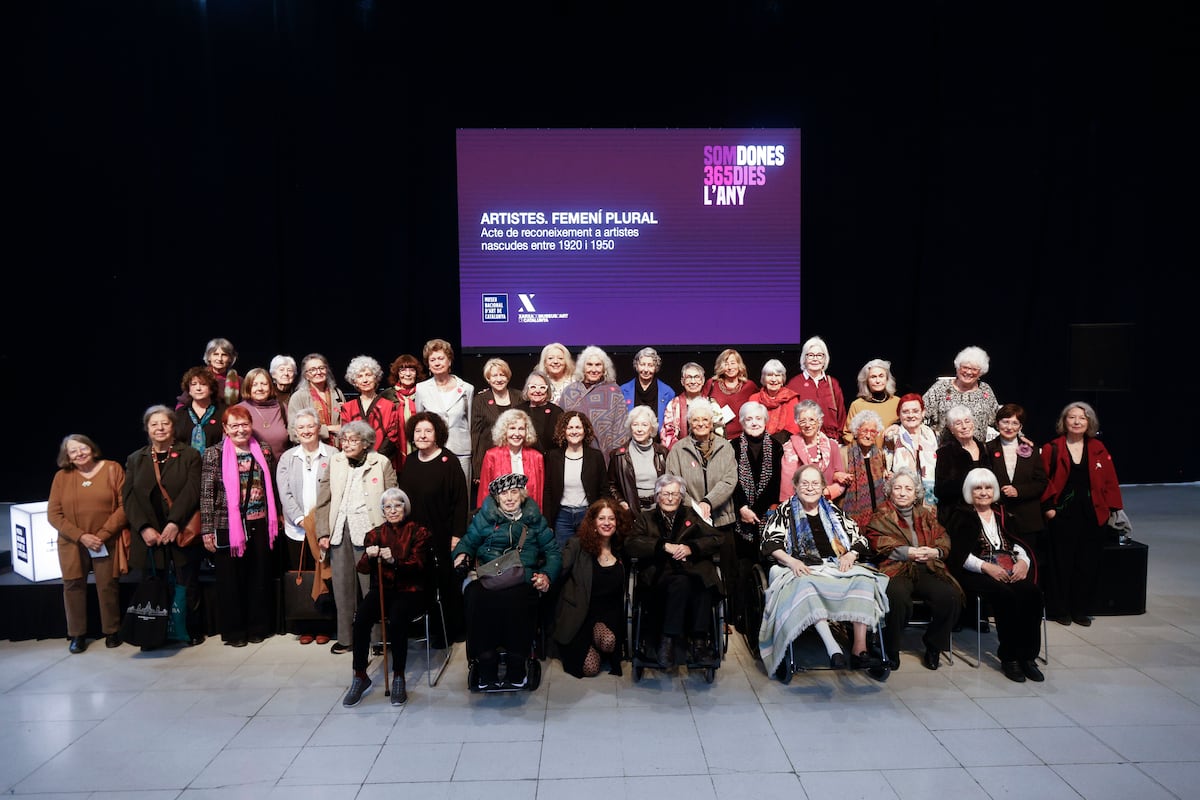
About fifty artists born between the years 1920 and 1950 received a tribute this Saturday at the Museu Nacional d’Art de Catalunya (MNAC), in an event organized by the same national museum and the Xarxa de Museus d’Art de Catalunya at the gates of 8M. All of them are part of the project artists Feminine Plural, promoted by this network with the aim of making visible the artistic trajectories that have been largely silenced or undervalued by the hegemonic narratives of art history.
The initiative also wants to constitute an action of symbolic reparation and collective memory, aimed at restoring the place that these creators deserve in the shared cultural story. Among those honored, where there were faces very little known to the general public, but also others who have had more projection especially in recent years, include Mari Chordà, Pilarín Bayés, Roser Capdevila, Sílvia Gubern, Teresa Gancedo, Pia Crozet, Tere Vila Matas or Kima Guitart.
The illustrator Pilarín Bayés, a very active cartoonist at 84 years old, who has illustrated hundreds of stories and a historical collaborator of the magazine strong horse, She has expressed feeling “enormous happiness” for the recognition and for meeting “so many colleagues from the art world.” For her part, Roser Capdevila, mother of the popular The three twins, has stated that “it is time for women to occupy an important place in art society.”
All the participants, women who opted to follow their artistic drive against the grain, in turbulent times and with family structures that wanted them at home, have received recognition from the Minister of Culture, Sònia Hernández, who participated in this event just before Women’s Day. She highlighted that “they have contributed decisively to the country’s artistic heritage, while opening the door to so many other women of later generations to do so.”
Furthermore, the head of Culture has advanced that this tribute “is not a full stop”, but rather “a work in progress, a living and porous project that will continue to grow with new participations.” Within the framework of Artists. Feminine Plural Continuous research, identification, documentation and recording of interviews with artists present in the collections of the Network’s member museums has been carried out, highlighting their works and contextualizing them from a critical and gender perspective.
This research has been entrusted to the art historian Elina Norandi, who has coordinated the study and historiographic review work. Today’s event has become a meeting and visibility space that places artists at the center and reaffirms the commitment of the National Museum and the Network to the construction of a more fair, plural and inclusive history of art. The project, which will continue to expand with new artists, can be consulted in the section Voice and Memory of the network’s website.
The recognized artists are: Maria Isabel Adalid, Maria Jesús Andreu, Maria Rosa Andrés, Pilarín Bayés, Josefina Brunés, Carolina Camañes, Roser Capdevila, Elisenda Capdevila-Gaya, Marta Casas, Xaro Castillo, Eugènia Ciuró, Mari Chordà, Montse Clavé, Lluïsa Clols, Dolors Cols, Carme Coma, Montserrat Costa, Martha Crockett, Pia Crozet, Sefa Ferré, Teresa Gancedo, Sílvia Gubern, Kima Guitart, Teresa Jordà Vitó, Lluïsa Jover, Ana Lentsch Madola, Rosa Mirambell, Toni Miserachs, Mercè Modol, Glòria Morera, Adelaida Murillo, Núria Picas, Núria Pié Barrufet, Elsa Plaza, Dolors Puigdemont, M. Assumpció Raventós, Carme Riera, Elisenda Sala, Maria Teresa Sanromà, Pilar Segura, Montserrat Senserrich, Marta Sentís, Mariel Soria, Dominica Sánchez, Montserrat Torras, Maria José Vela, Marika Vila, Tere Vila Matas, Antolina Vilaseca and Marga Ximénez.