

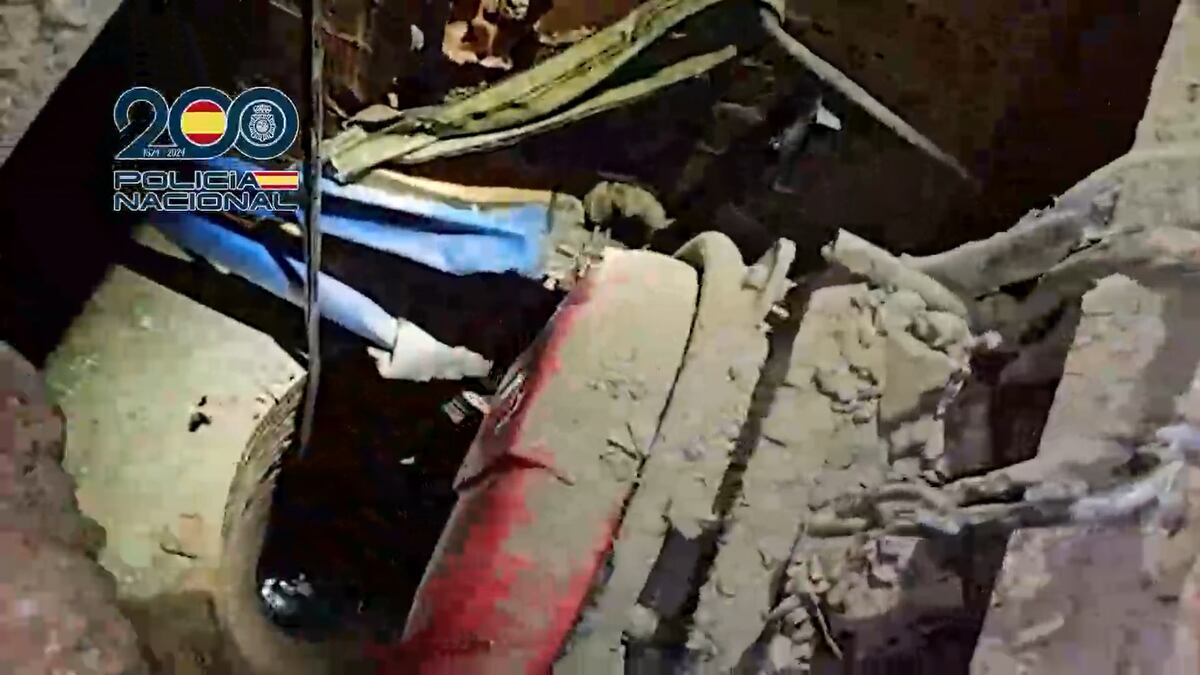
Excavated in stone and vaulted, it looks like a mine and is partially flooded by groundwater. The video provided this Friday by the Ministry of the Interior of the last narcotunnel located in Ceuta shows its complexity and dimensions (approximately 1.20 meters high and 80 centimeters wide), through which two tons of hashish could transit a week from Morocco to Spain.
The images released by the National Police on their official profile on the social network X take a 67-second walk through this underground structure. A high-pitched beep, from the underground agents’ gas detectors, accompanies the visit. The sound of falling water becomes more intense.
The gallery does not run in a straight line, but rather shows a curvature. During the tour, it is observed that the structure has struts to prevent landslides and how water seeps through the walls. In the last part, it flows abundantly.
Access to the passage was in a warehouse in the El Tarajal industrial estate, just a dozen meters from the border fence with Morocco and, to find it, the agents had to move a large refrigerator behind which there was a door that gave access to a second warehouse that was soundproofed. There, Udyco agents discovered obvious signs that an area of the ground had been “touched,” that is, that work had recently been done there.
After lifting a layer of cement, the agents found a trapdoor that gave access to a passage organized into three different layers. The first level was the access gallery, 19 meters deep. The second or intermediate one was baptized by the agents as “narcodespensa.” It is a large hole in which “bales of hashish were stacked on pallets before being extracted outside.” The third and last was the passage that led to Morocco. Its total length and exit point have not yet been determined.
Morocco is collaborating with the investigation, according to police sources. Just a week after being discovered, police officers held a meeting with Moroccan authorities who will investigate the use of this infrastructure on the other side of the border. Morocco has blocked off part of the tunnel that runs through its territory to prevent it from being used.
The plot, allegedly headed by Moroccan businessman Mustapha Chairi Brouzi, had equipped the tunnel with a system of pulleys, cranes, rails and two trolleys that allowed the pallets of hashish to be moved without the need for those operating at one end of the passage to the other to see each other at any time, which increased security in the event of a police raid. Furthermore, to keep the structure operational in a terrain with groundwater that could flood it, he had installed two powerful bilge pumps that worked permanently and had soundproofed the ship so that the noise they generated would not raise suspicions.
As can be seen in the images, this drug tunnel had a more complex structure than the one located in February of the year by the Civil Guard and which, according to investigations, was also managed by the same network. That one had the entrance in an old marble factory without activity in the same El Tarajal industrial estate. It also had its own lighting system, although its structure was weaker. Thus, the walls of that passage, excavated at a shallower depth, 12 meters, were covered with wooden planks, the gallery was somewhat narrower (70 centimeters wide) and in some sections the height was reduced to 50 centimeters. There were neither rails nor wagons, and the carriers were forced to move on all fours to transport the bales of drugs.
The Police investigation remains alive. The agents analyze the content of the devices and documentation seized in the searches carried out on March 27 and continue the investigations against the money laundering network. New arrests are not ruled out.
On the day of the exploitation of the case, baptized Operation Ares, 27 people were arrested. During the investigations, 17 tons of hashish, 88 kilos of cocaine and 1.4 million euros in cash were seized.