


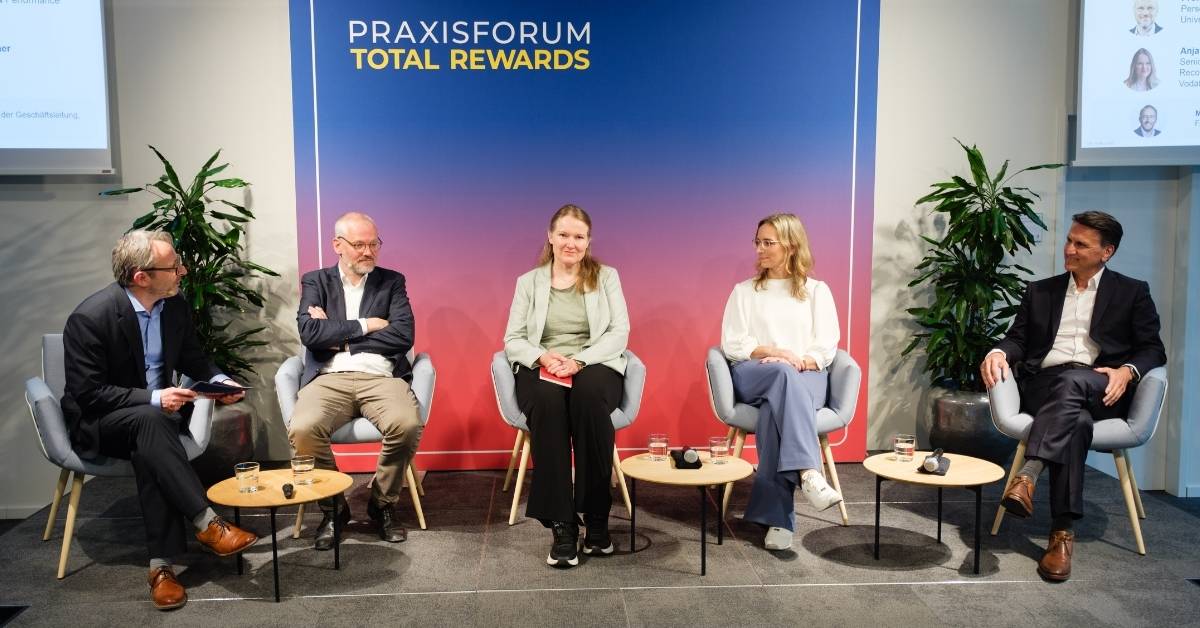
The GEA Group has abolished individual bonuses and only provides incentives via a purely KPI-controlled bonus plan. Vodafone abolished personal goals three years ago, but now the company is reintroducing them. Ikea has aligned its bonus program with collective goals. Representatives of these three companies discussed how performance can be rewarded at the Total Rewards practical forum in the FAZ Tower. Their approaches are quite different:
Through the KPI-controlled bonus plan, we created clarity and set clear expectations.
Niko Lymberopoulos, Vice President Rewards & Performance Solutions bei der GEA Group
Performance is very important to us, and performance is a criterion that should be reflected in compensation.
Anja Knauff, Senior Manager Reward & Recognition at Vodafone
Our bonus program is aimed at collective goals. When these are met, we reward everyone.
Judith Weggeman-Aicher, Total Rewards Manager at Ikea Germany
Anyone who relies on bonuses needs a well-founded system
But what does science say about bonus models? The Cologne professor Dr. Dirk Sliwka did not want to demonize individual bonuses across the board. “If you have good KPIs, individual compensation can work,” he noted. The problem, however, is if it is not set up in a well-founded manner, he warned.
In various experiments he has scientifically proven how bonuses work. A conclusion: Companies have to look closely at what motivates employees: tasks or monetary incentives. Only those who know this can design a suitable incentive system.
Corporate culture is crucial for performance
Just like the other company representatives, Stada also wants to specifically promote performance. To this end, the drug manufacturer has defined four corporate values that are reflected in the remuneration, based on its in-house motto “Culture drives performance”. These include integrity, entrepreneurial action, adaptability and global cohesion.
“We at Stada see a strong correlation between value expression via short-term incentive mechanics and business outcome, but cannot prove scientific causality,” said interim CHRO Ruben Lopez Bouza. According to the company’s own statements, the figures prove that integrating culture and remuneration was still the right step: the company was able to triple its EBITDA between 2017 and 2025.
Standardized performance evaluation
The DIN Institute takes a different approach to performance evaluation. Managers award points to their employees based on six defined evaluation criteria. “The challenge was to develop common evaluation standards,” explains Karsten Bich, member of the management team and CHRO at the DIN German Institute for Standardization. Anyone who does not have enough points can – but does not have to – be excluded from the collective salary increase. “I can’t take anything away from anyone, but I can leave them alone,” said Bich, explaining this approach.
The performance evaluation is integrated into the flexible working time and remuneration model that the DIN Group developed around two years ago together with lawyer Dr. Alexander Insam from the Görg law firm introduced it. At that time, employees could decide whether they wanted to switch to the new remuneration model or remain with the previous remuneration according to the collective collective agreement. 86 percent of the workforce switched to the new model. Bich’s conclusion: “The right to vote and change was a success factor.”

Team-oriented goals in sales
Performance incentives in sales need different approaches, especially these days. A new study by the management consultancy Kienbaum provides information about which. According to the study, 70 percent of those surveyed agree that one-dimensional commission models are being replaced by multi-dimensional bonus systems. Fabian Konrad and Marvin Schmidt, authors of the study, emphasized in their presentation that individual goals continue to be influential in sales, but team-oriented goals are becoming more important in sales. “Away from the silos,” is their recommendation, in order to meet customer requirements.


Trust the managers
Another important message from the practical forum: “When managers have the right information, they make the right decisions.” Sebastian Wetzel, Head of Compensation & Benefits at Siemens Energy, was convinced of this. The Munich-based company has, with scientific support, created transparency and fairness in remuneration in recent years. This made it possible to reduce the adjusted gender pay gap from 5.16 percent in 2022 to 3.67 percent (2025). This puts the company well below the German average of 6 percent.
One lever for reducing the gender pay gap was to inform managers: “Managers who knew what the pay gap was took more account of it in their salary decisions,” explained Carolin Lachner, who was co-responsible for the project as Senior Consultant Global Compensation Governance at Siemens Energy.
Individuality is crucial when it comes to benefits
Magdalena Nübel, Head of Customer Relationship Manager at the benefits provider Belonio, focused on the needs of the employees: “The individuality of the benefits determines the effect: If I only ride my bike, a fuel voucher is of no use to me.” She outlined that every company has to find the right benefits for itself depending on its size, employee structure, location and problems. It helps to know the three types of loyalty, namely whether employees stay with their employer out of a sense of duty, calculation or because of emotions.
According to Nübel, benefits should start with the emotional connection. “The emotional leverage arises from small factors, moments that employees particularly remember, such as a birthday or an experience in which I as an employee know that my employer supports me.” Therefore, touchpoints outside of everyday working life are crucial. Although the benefits area is also a cost factor, companies should not underestimate its effect on employee loyalty: “Lack of employee loyalty is expensive. Losing employees costs a lot of money,” says Nübel.

Employer branding through a company pension scheme
The Aachen chocolate producer Lindt & Sprüngli also relies on employee loyalty and attractiveness as an employer. With “Lindt My Pension” he has fundamentally renewed his company pension scheme (bAV), moving away from a little-appreciated direct commitment to a capital market-oriented model with high return potential. The company automatically pays 1.5 percent of each permanent employee’s gross monthly salary into the new pension plan from the first day of work.
For Helge Kniepen, Head of HR Competence & Payroll, the new model is an important component in employer branding: “Our new capital market-oriented model is very well received by the young people in the company.” This allows Lindt to position itself as an attractive employer. This is important because the confectionery manufacturer, like large technology companies such as Bosch and Siemens, is fighting for tech talent, but is hardly perceived by them as an employer with a technology division.
Info
We would like to thank our partners AON, Belonio, GÖRG, Kienbaum and Penzilla, who supported the Praxisforum Total Rewards 2026!
We will discuss what will happen next with pay transparency, which benefits are promising for the future and which compensation trends will prevail at the next Total Rewards practice forum. It will take place again on April 27, 2027 in the FAZ Tower. You can register here.


Kirstin Grundel deals with the topics of compensation & benefits, remuneration and company pension schemes. She also works as an editor for the magazine “Comp & Ben”. She is the editorial contact for the Total Rewards practice forum.

Erwin Stickling has been the editor of the magazine Personalwirtschaft for many years and is also a member of the management team at the FAZ specialist publisher FAZ Business Media.