


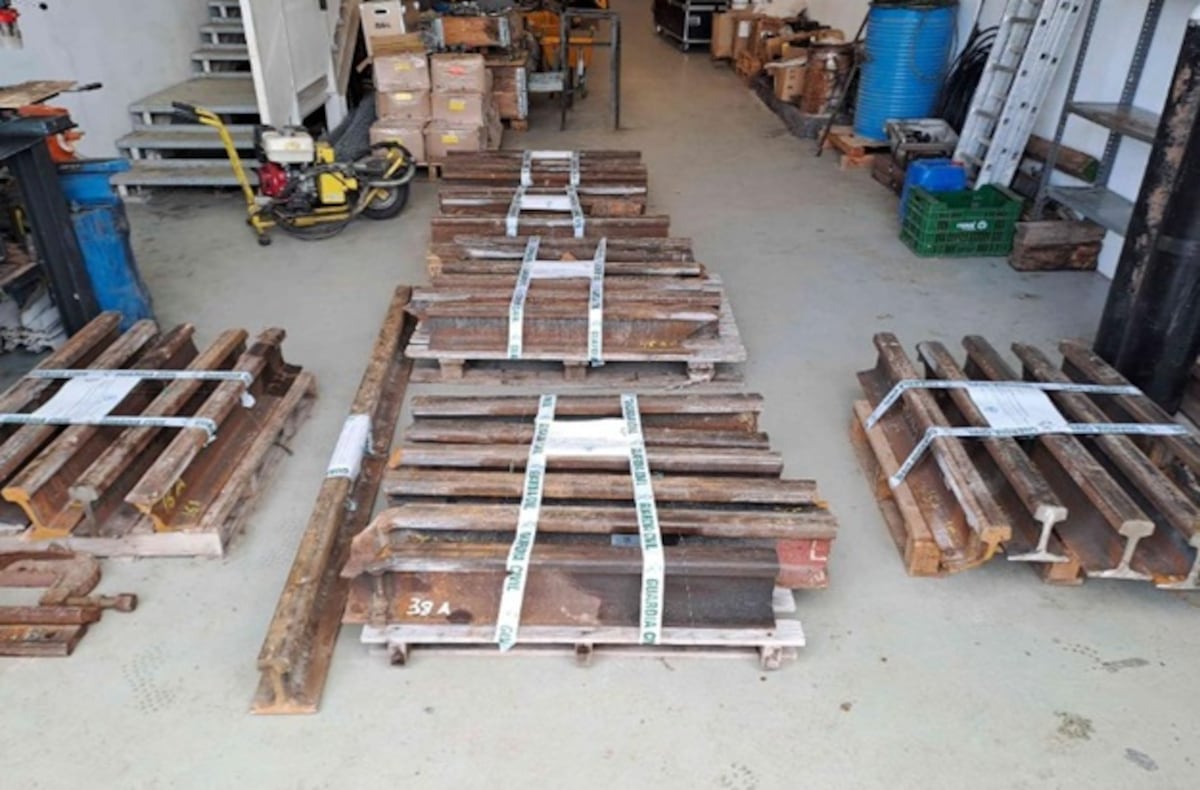
The technicians investigating the railway accident on January 18 in Adamuz (Córdoba) have in their custody, in coordination with the Civil Guard, all the material that they consider probative and that was removed from the ground zero of the accident until January 22, when the infrastructure manager Adif entered the area of the accident in the middle of the night of the 23rd and collected segments of rails without express authorization from the court. The Railway Accident Investigation Commission (CIAF) has rail segments and welds extracted from the surroundings of kilometer point 318,681 of the Madrid-Seville high-speed line, where it is suspected that a break in the rail led to the derailment of an Iryo train at 7:43 p.m. that Sunday. Sources from the commission explain to this newspaper that what was gathered by Adif could hardly be complementary.
Members of the CIAF, also from the Organic Unit of the Judicial Police (UOPJ) of Córdoba, held a meeting on Wednesday with Judge Cristina Pastor, head of the Montoro court (Córdoba) and instructor of the case, which served to confirm that the evidence is under the control of the investigation.
The CIAF has submitted a proposal to hire one or two laboratories to analyze the metallography of the rail, welds and treads of the derailed train (and at least three others that crossed through Adamuz an hour before the accident). These are a private laboratory of the Galician business association Aimen and a second public one dependent on the National Center for Metallurgical Research (CENIM). Both are left to the judge’s choice to move forward in determining the cause of the lane break. The opening of the black boxes that were traveling in the derailed Iryo and the Renfe Alvia that was traveling in the opposite direction and that could not avoid the collision is also expected.
The slowness with which the process is progressing, due to the different times and procedures provided for in the Criminal Procedure Law and the Railway Sector Law for a case like Adamuz’s, also came up at the meeting. Judge Pastor received representatives from both investigations, technical and police, after a letter from the armed institute was published, sent to the court on February 7, in which the person in charge of the maintenance base of the infrastructure manager Adif in Hornachuelos (Córdoba) was informed of the statement taking (on the 6th). Samples of rail, with their welds, ended up there, which Adif collected on the night of January 22 to 23 without the aforementioned explicit authorization from the court.
The company maintains, in a report on the 9th advanced by EL PAÍS, that it cleaned the area once the CIAF and the Civil Guard left it. According to his version, he collected the pieces and inventoried them to prevent their deterioration in Adamuz or even their scrapping.
The Secretary of State for Transport, José Antonio Santano, maintained this version in an appearance before the media last Tuesday, when he acknowledged that Adif had carried out tests on the collected welds, “similar to those at the point of the accident”, and that these had been extracted from an unsealed area: “They were between 127 and 380 meters away from the point of the accident, and what Adif has done is preserve elements that could be of interest and that were not considered at the time or by the CIAF not even by the Civil Guard.” These components of the road were sealed by the judicial police on the 3rd, although at the moment they have not been requested from Adif for the investigation.
The UOPJ report, however, left open the possibility that among the lane coupons deposited in Hornachuelos, “there could be those that the CIAF intended (due to the welds) to analyze and for which authorization was requested from your honor in a letter dated February 3, 2026.” Such a possibility was rejected by Secretary of State Santano because “on day 3 the works (to remodel the section) had not only begun, but had already been underway.” several days and hardly any element of the road, which was already being scrapped, could have been converted into evidence.” Despite this, Judge Pastor signed an order on February 10 reprimanding Adif for collecting possible evidence and analyzing it.
In the reconstruction of all these events, according to different sources consulted, the CIAF technicians asked Adif representatives for a few more hours on January 22 before concluding the collection of samples. It was in verbal communication, so there is no notification to the court, nor was Adif’s decision to remove parts of the lane that same night, “outside the cordoned off area,” insisted Santano, number two at the Ministry of Transport. The fragments essentially belong to the opposite route to that of the derailment.
The Civil Guard, for its part, was not aware until January 30 that Adif had transferred road coupons to Hornachuelos, about 90 kilometers from the scene of the event. They learned about it when agents from the armed institute returned to the road in Adamuz to inspect the fragment of the bogie (structure that joins the wheels and axles of the train) of car number 8 of the Iryo, found in a stream about 250 meters from the point of the derailment.
Three days before, on January 27, the Organic Unit of the Judicial Police of Córdoba informed the substitute judge of Montoro, María Jesús Salamanca, that “all measurements, actions and collection of evidence by the Civil Guard have been completed, so there is no objection to access, repair and reconstruction that is necessary” by Adif. In any case, the letter sent by the judicial police to Montoro on February 7 emphasizes that the infrastructure manager was not authorized to clean the area before January 28, which was when Judge Salamanca gave her approval (claimed by Adif on January 26 through judicial means) to the beginning of the reconstruction work, as well as to the collection of vestiges and material evidence that were still found in the area.
All of this has led to the harsh communication from the judge to Adif and some discomfort between the parties, which she tried to iron out at Wednesday’s meeting in Montoro.