

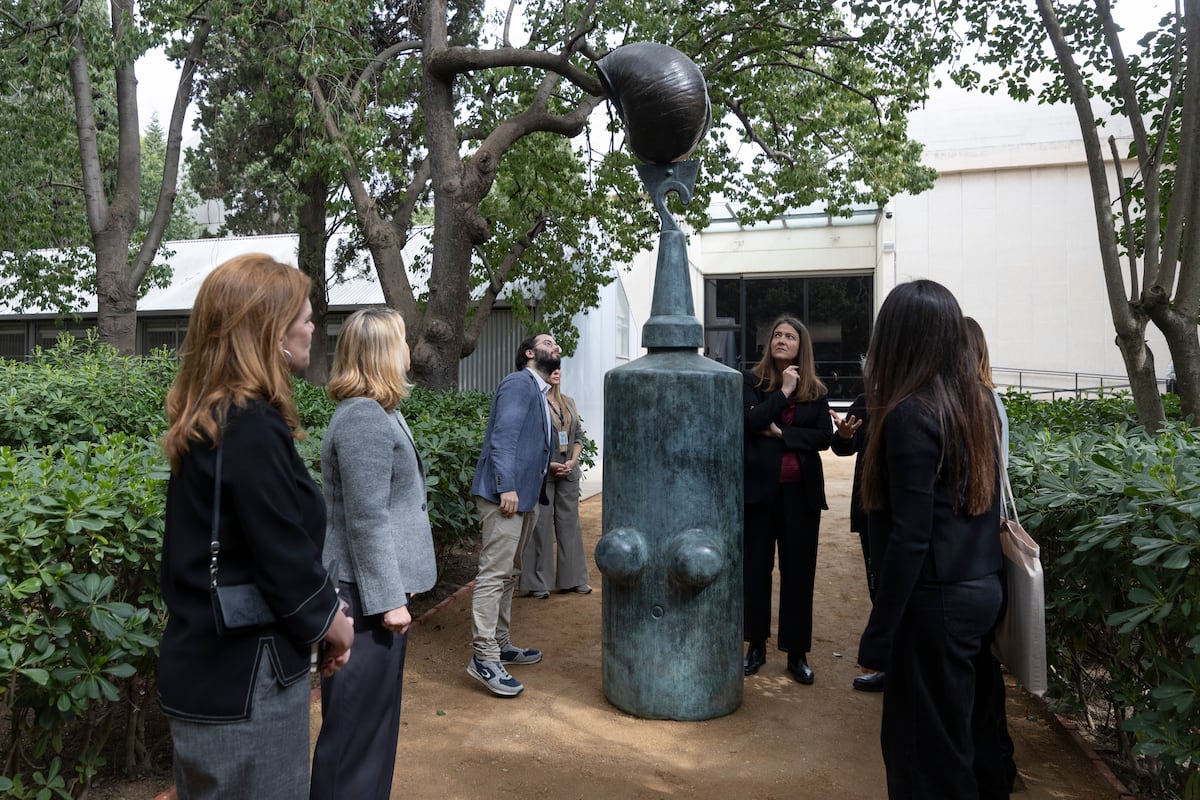
The director of the Miró Foundation, Marko Daniel, will end his eight-year period at the head of this Catalan art institution, leaving as a legacy the opening to the public for the first time of the Garden of the Cypresses, where the sculpture can be seen. Womenfrom 1970. Although it was a space accessible occasionally, it now becomes part of the museum tour of the collection, which has been reorganized to better connect it with the architecture of Josep Lluís Sert and, at the same time, with the public. Coinciding with the fiftieth anniversary, notable loans have been added, such as six works temporarily on loan from the Reina Sofía Museum, and a selection of pieces by Alexander Calder. In addition, you can see the unpublished painting two women, of 1931.
If two weeks ago the Board of Trustees of the Foundation reported the upcoming departure of the person who has been its director for the last eight years, this Thursday he himself presented one of the great challenges in which he has been involved lately, with the permission of the pomp to celebrate the fiftieth anniversary. In the presentation, Marko Daniel stated that “everything begins and ends with the circle” in this new look titled precisely Joan Miro. Circles. In parallel with his situation, he has considered that life is stages that open and close.
In this sense, the director highlighted that, when he arrived at the center, the first thing he did was open the North Patio to the public, which has become a great viewpoint of the city, presided over by the sculpture Moon, sun and a star (1968); and it leaves integrating another outdoor space, the garden that Forestier, Rubió i Tudurí and Puig i Cadafalch created jointly between 1915 and 1929, which was part of the old layout of the Laribal Gardens, also crowned by a bronze sculpture, a woman with a snail.
It is not new, this piece was already in the Foundation, but the change of location gives it much more prominence. For now, it is the only work by Miró in this green space, which has been rehabilitated fully respecting the original and its centuries-old furniture, such as the stone and ceramic fountain, which follows the same chromatic line of the benches that invite you to escape, contemplating the cypresses, which with their slender silhouette evoke eternity.
“If I walk, I look at either the earth or the sky, not the landscape,” Miró emphasizes in a text included in the tour, a way of understanding art that branches out throughout the exhibition. All the elements are played with to reinforce the different points of view that the artist proposed. His work can be understood as a constant dialogue between opposites: it cannot be read the same up close as it is from afar, from the outside as from the inside, and with natural or indirect light.
A rediscovery
Reordering the collection has been a work of more than three years that has concluded with a new look at Miron’s work, where the chronological or thematic story is dispensed with to put the works in dialogue with each other, with the space and the visitor, according to Teresa Montaner, the head of Collections, one of the people who knows the most about this influential 20th century painter who wanted to leave the city a living art center.
Making Miró’s art immersive long before this word spread through some artistic centers, Teresa Montaner has defended that “the idea is that the visitor becomes part of the work itself” and the objective of artistic and architectural fusion of Miró and his friend Sert makes even more sense by opening spaces and facilitating the collection to modulate over time.
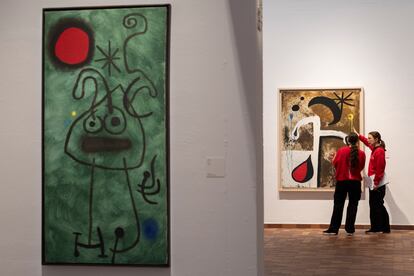
To achieve this, a hundred pieces have been intentionally placed in the different rooms, based on the concept of circlewhich was how the artist named a folder from the 1950s where he kept his works based on astronomy that led him to search for a “cosmic painting.” This discovery allowed us to better understand its creation processes, which emphasize an ancestral relationship between heaven and earth, as indicated by Marta Ricart, artist and researcher who is also curator of the exhibition.
As an example of Miró’s connection with the earth, the large-format work with different textures stands out. Overteixim of the eight umbrellas (1973), located at the beginning of the route. Right at the other end of the circuit, but facing this one, it stands out Hands flying towards the constellations (1974), a huge acrylic on canvas that gains visibility in the new space.
Among the novelties, the two triptychs located in the two chapels created to house them are also of great importance, which now look as they were imagined: Painting on white background for the cell of a solitary I, II and III y The hope of the condemned to death I, II and III. Both have a wooden chair designed for a complete immersion experience.
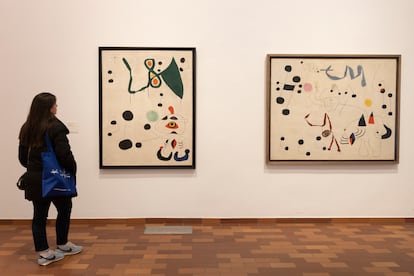
Although there are some emblematic works such as the Foundation Tapestry that remain in the same place because it is the most appropriate place due to its overwhelming size, many others have moved to generate these new interpretations. The gold of the azure (1967), Woman and bird at night (1945), Poem (1968), Flame in space and naked woman (1932) o smoker’s head (1925) are part of this presentation, where there are loans from the Reina Sofía such as snail, woman, flower, star (1934).
Avoiding a closed discourse, the exhibition breaks with the fixed and one-dimensional gaze of the works, according to Marta Ricart, and opens the focus to continue enriching Miró’s art with new perspectives. That is why a mediation and performance program has also been planned that begins next April 11 with A permanent test by Fondo, which includes a scenic artifact designed with The Fourth Skin that will be installed in various spaces.