


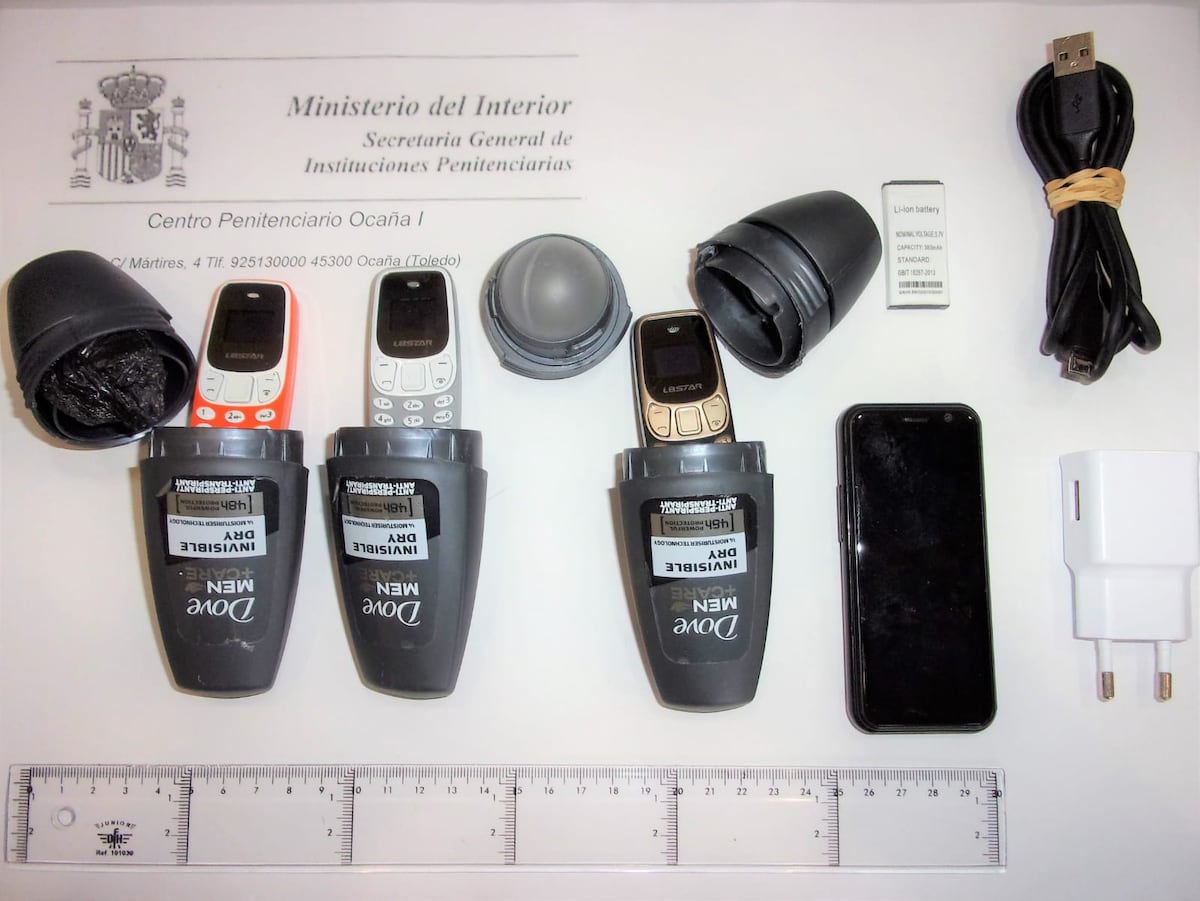
An object as common in daily life as a mobile phone is a very precious asset in prisons, where its possession is strictly prohibited. The figures of the intervened devices reveal the lucrative business that is their trafficking and clandestine use within prisons, where they are a security problem as their possession and use becomes the origin of fights and extortion between inmates. In recent years, prison officials have seized 13,208 of these phones, of which 2,466 were in 2025 (about seven a day), according to data provided by the majority union Grouping of the Corps of the Administration of Penitentiary Institutions (Acaip) and confirmed to this newspaper by sources from the Ministry of the Interior.
Three Andalusian prisons, Almería (756 devices), Málaga (728) and Albolote (647) in Granada, top the list of prisons in which the most mobile devices have been intervened in the last five years, closely followed by the Madrid prisons of Valdemoro (646) and Estremera (567). At the opposite extreme, those of Alcalá de Guadaira (Seville) and Menorca, the only ones without any arrests since 2021. In another 16 centers, less than 10 devices have been located in this time.
Compared to 2025, seven prisons exceeded 100 cell phones seized, again with Almería in first place, with 166. Málaga appears in third place with 150 phones and Albolote, sixth, with 116. Alicante also exceeded one hundred (which was second with 152), Córdoba (148), Estremera (128) and Asturias (115). Acaip emphasizes that these devices “allow inmates to evade established communication controls, facilitating the continuity of criminal activities from inside prisons” and denounces that the staff of officials are not sized to deal with the problem nor do they have the appropriate technical means to locate. “(Prison workers) manage to detect and confiscate thousands of these devices every year through constant searches, searches and controls,” he adds.
Most of the mobile phones that are intercepted are small in size: they measure just over six centimeters and are easy to hide in a shoe or in body cavities. They are offered on websites for just over 20 euros. But there are also, in increasing numbers, with access to the internet, those known as smartphonesmuch more sought after among inmates. Many of them are brought into prisons by relatives during visits dream to dream (intimate) or by inmates returning from leave and carrying them hidden in the objects they carry – one has even been found in a tube of toothpaste – or in their body orifices. Now they are also found in the prison courtyards supposedly dropped from drones, a system on the rise both to sneak in these devices and small quantities of drugs and which, according to Acaip, “makes prevention work difficult and facilitates the entry of more sophisticated devices.”
Possession of mobile phones is considered a serious offense that carries sanctions for inmates who are found to have them. These punishments range from reducing the hours spent on the playground to changing modules. Furthermore, the incident is reflected in the prisoner’s prison record with the consequent effect on the granting, for example, of permits. In the training courses that prison officers receive before starting to work in prison, they are trained precisely in the detection of prohibited objects inside prisons. In these teachings, special emphasis is placed on the new systems used by prisoners or their families to introduce and hide them.
Furthermore, since 2008, the Ministry of the Interior has taken measures to prevent its use by inmates, especially after it was discovered that some famous prisoners, such as Zakhar Kalashov, head of the Georgian mafia, and the Galician drug trafficker José Ramón Bravo Bugallo, Miñanco siteused these devices from their cells presumably to stay in contact with their organization. That year, Penitentiary Institutions began to install frequency jammers inside many of the prisons. However, Acaip denounces that these have become obsolete because “they have not adapted to new telecommunications technologies and that, in many cases, they are insufficient to prevent the effective use of these devices.”