
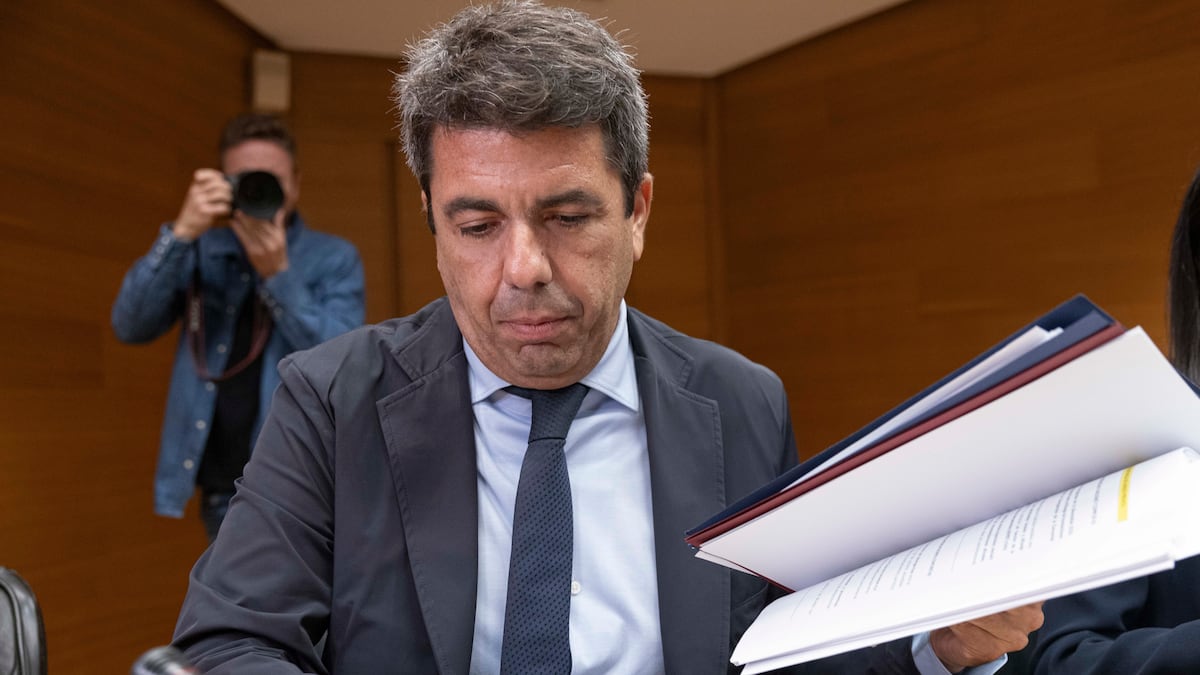
The former president of the Generalitat Valenciana Carlos Mazón will not be investigated for his management of the 2024 dana. For the moment. The Superior Court of Justice of the Valencian Community (TSJCV) has “unanimously” rejected putting the focus of the investigations on this popular man, who on the day of the flood spent almost four hours in a restaurant with a journalist while the province of Valencia was flooding. The judicial body does not appreciate in the reasoned exposition of the investigating judge of Catarroja (Valencia), Nuria Ruiz Tobarra, “a solid and objective foundation” from which “the character of a crime” derives. The five judges of the high court thus rule out their jurisdiction to open a case against the former presidentas reported this Monday by the Valencian TSJ. Being certified due to his status as a regional deputy, Mazón could only be investigated by the higher judicial body after the investigator observed signs of a crime.
With the movement of the Superior Court, the Catarroja judge will continue to lead the case. After 16 months of investigations, Ruiz Tobarra only maintains as defendants in the proceedings regarding the storm that left 230 dead on October 29, 2024, the former Minister of Justice and Interior of the Generalitat Salomé Pradas and who was his deputy during the flood, the former director general of Emergencies, Emilio Argüeso.
To refuse to investigate Mazón, the Valencian TSJ alleges that the then president He did not hold the position of guarantor of a duty to be punished with the crime of reckless homicide in its form of commission by omission. In his argument, he maintains that there must be “reinforced evidence of criminality” and a “concrete individualization of conduct.” “Any suspicion or conjecture is not enough. More or less close positions or indirect allusions are not enough,” he points out. The judicial body reminds the judge that “founded and serious evidence” and a “clear and concrete accusation with evidentiary support” are necessary.
The court also specifies that its role is to analyze the conduct of the accused “from a criminal point of view” and ignore “moral or political” considerations. “Not all politically or socially debatable and even reprehensible conduct fits into a criminal provision,” he argues. This refers to the expressions used by Catarroja’s instructor. In the reasoned statement that the judge issued on February 24 to request the indictment of Mazón, she accused the popular of incurring “alleged gross negligence.” The judge criticized that the leader of the popular in Valencia spent “about five hours” with a “passive attitude” in a restaurant booth; and directly connected this fact “with a serious fatal outcome of 230 deaths.”
Mazón did not have duties in civil protection and emergency management
“It cannot be concluded that the president violates specific legal duties derived from a legal obligation,” states the order of the Superior Court. The magistrates emphasize that the regional legislation does not assign the head of the Consell duties in civil protection and emergency management. They also remember that this responsibility falls on the main person investigated in the case, the former counselor Salomé Pradas, who acted as sole command during the crisis.
Regarding the cornerstone of the investigation, the delay of It’s Alertthe massive mobile alert that was sent to inform the population of the magnitude of the 2024 dana, the court maintains that the involvement of Mazón that the instructor defends “moves in the realm of conjecture.” He explains that it cannot be derived that the head of the Consell influenced this decision for the reasons given by Judge Ruiz Tobarra: the wasaps between Mazón’s former right-hand man, José Manuel Cuenca, and former counselor Pradas. “Consequently, in the absence of any minimally founded or credible indication regarding the participation of the authorized party in the sending of the It’s AlertNor, from this perspective, will the Chamber be able to declare itself competent to hear the case,” concludes the resolution, which can be appealed before the court itself within a period of three days.
The magistrates do not rule out, however, that criminal liability may arise from the tragedy. “Naturally, the previous decision does not mean that the procedure cannot continue in the Civil and Investigation Section of the Court of Instance of Catarroja,” he points out.
The resolution, which praises the “effort and industriousness of the instructor,” contains general considerations about those qualified. And he cites a barrage of jurisprudence, such as rulings from the Supreme Court of July 2025 that inadmissible several complaints and complaints against the President of the Government and ministers due to the dana of 2024.
The move by the Superior Court comes a week after the Prosecutor’s Office issued a report in which it also opposed charging Mazón as it did not see sufficient evidence of a crime. And he asked that the case continue in the hands of the judge of Catarroja.