






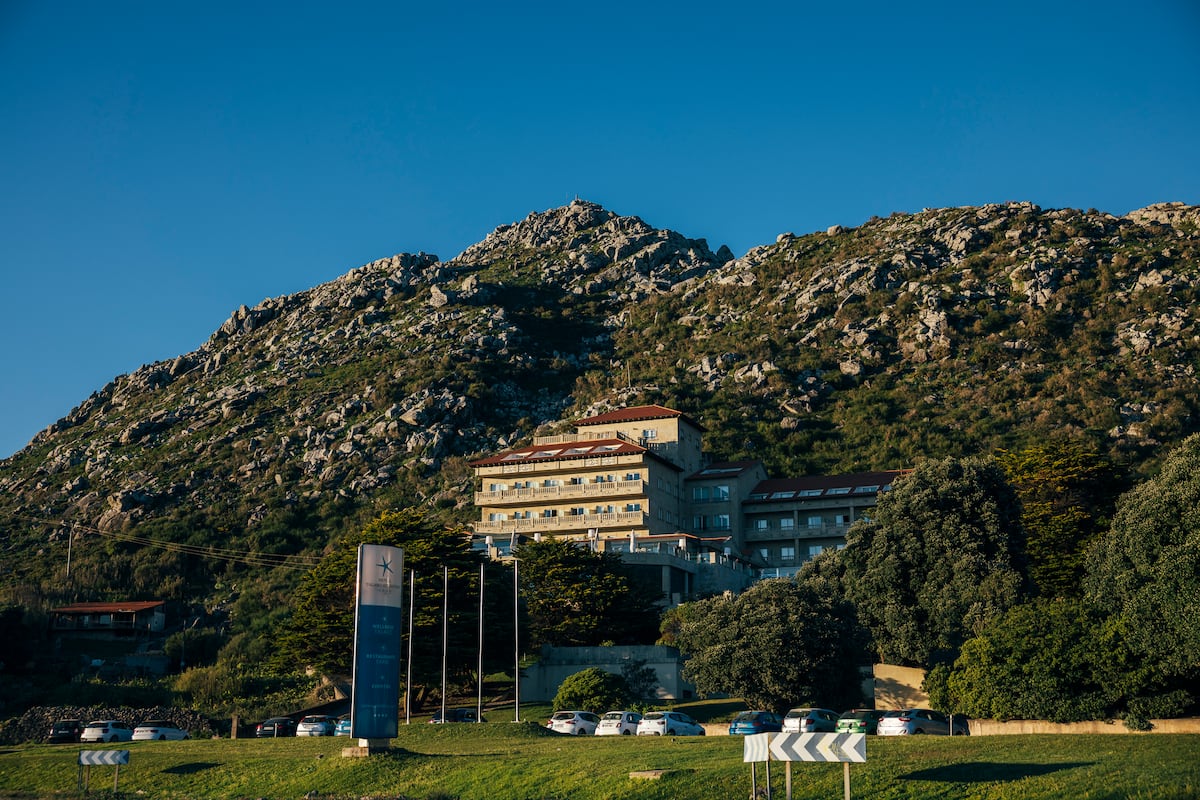
When the court declared the Talaso Atlántico of Oia (Pontevedra), a 70-room hotel, spa and sea views, illegal, Alberto Núñez Feijóo had not yet been sworn in as president of the Xunta and Yolanda Díaz was a councilor in Ferrol. The mass built on protected land in Cape Silleiro has evaded a court order for demolition for 17 years thanks to the paperwork and lawyers paid by this small town hall in Baixo Miño to try to legalize it. It was a local PP government that gave him an illegal license and Feijóo from the Xunta called for his pardon. A few weeks ago, however, an ultimatum came from the courts for it to be demolished. “It would lead us to ruin,” warns the mayor of this municipality of 3,000 inhabitants.
With a municipal budget of two million euros, the popular Cristina Correa predicts bankruptcy due to the cost of tearing down the building and the compensation that the company that owns it could claim because it was built with a license, even if it were illegal. The spa is a source of constant stress for the Oia City Council. It stands on the coast to capture seawater that it uses in its treatments, on 25,000 square meters of rustic land with special protection and within a space of landscape interest. The rule that made the plot developable never came into force due to a mysterious disappearance that remains unexplained. Without legal coverage, the popular Álvaro Miniño, who had governed the municipality since 1978, granted a license to the developer in 2000.
The socialist José Antonio Olmedo was part of the municipal opposition when that happened. “Urban planning this was a lack of control,” recalls the current spokesman for his party at City Hall. He assures that “anything went” and that most of the licenses were granted “by decree of the Urban Planning Councilor, without a legal report.” In this case it was the complaint of a private fan of urban planning disputes who took the Thalasso to court. In Olmedo’s opinion, the PP government has granted the illegal hotel company “favorable treatment”, since it once drafted an ordinance to reclassify the land and fit the complex into Cabo Silleiro and now “spends public funds for legal reports and partial plans” with which to try to avoid its total demolition. “Jobs must be defended, but judicial decisions must be respected,” he says about another of the PP’s arguments to save the spa. Regarding the million-dollar compensation that the mayor fears, she believes that it remains to be seen if the company would be entitled to it, something that the courts would decide after reducing the mass to rubble.
The Talaso Atlántico, meanwhile, has been operating without problems and has received subsidies from the Xunta and European funds. It has survived the ruling that declared it illegal in 2009, the court order for demolition that the City Council received in 2012, and the subsequent threat of fines that the judges issued to force the council to send the pickaxe. In the midst of environmental complaints about polluting discharges, the local government began seven years ago to process an urban plan that would legalize the complex. The mayor has not yet managed to complete this saving document and blames the bureaucracy. “The world of urban planning is tremendously complicated,” he says.
Every month, Correa says, a letter is sent to the court explaining how the legalization process is going. “The legal officers hand me papers and I sign them,” he says about the decade he has been in office. They have presented two schedules to the court with a deadline for approval of that plan, but both have been breached. The contentious administrative court number 3 of Pontevedra seems to have had enough. An order has just been issued ordering the City Council to require the thalassos company to demolish the complex. The local government has filed an appeal for reconsideration but at the same time has formally urged the owner of the hotel to demolish it. The mayor’s hope is that the court will allow a new deadline to approve the urban plan that would legalize the property. The decision to stop or not the demolition procedure that has just started is in the hands of a newly arrived judge. The previous togada, the one who knew about the case, is no longer there.
The environmental association Verdegaia, which has denounced Thalasso for polluting discharges, assures that the special plan being drafted by the Oia City Council is “unrealizable” according to current legislation. Its spokesperson, Sabela Iglesias, criticizes the “total impunity” of the municipal officials who got the municipality into the problem. “They will not be held responsible for anything, neither economically nor legally. As long as measures are not taken against the impunity of the politicians in office, these things will continue to happen,” he laments. The mayor, for her part, disagrees and defends her party colleagues. He alleges that they did so “with favorable (technical) reports” and rules out “bad faith.”
The complex opened its doors in 2003 with public aid of around 4.5 million euros. This amount includes up to 740,000 euros in compensation for the damage caused by the oil spill. Prestige despite the fact that when the tanker sank it had not yet started operating. The company has declined to give its version.
The mysterious disappearance of ordinance number 13
S. V.
The lawsuit that sentenced the hotel to death has its origin in a strange episode: the disappearance of ordinance number 13. In a time without digital formats, this document that made the protected land where the thalasso was built can be developed was misplaced and was not part of the urban planning regulations that were definitively approved. It was never published in an official bulletin and for justice it is as if it had not existed. “It is not known if it was a human error or a black hand,” says the mayor. “The municipal secretary at the time was a very rigorous person and I know it affected him a lot,” Correa recalls. The consequences of the enigma keep Oia in suspense 26 years later.
