
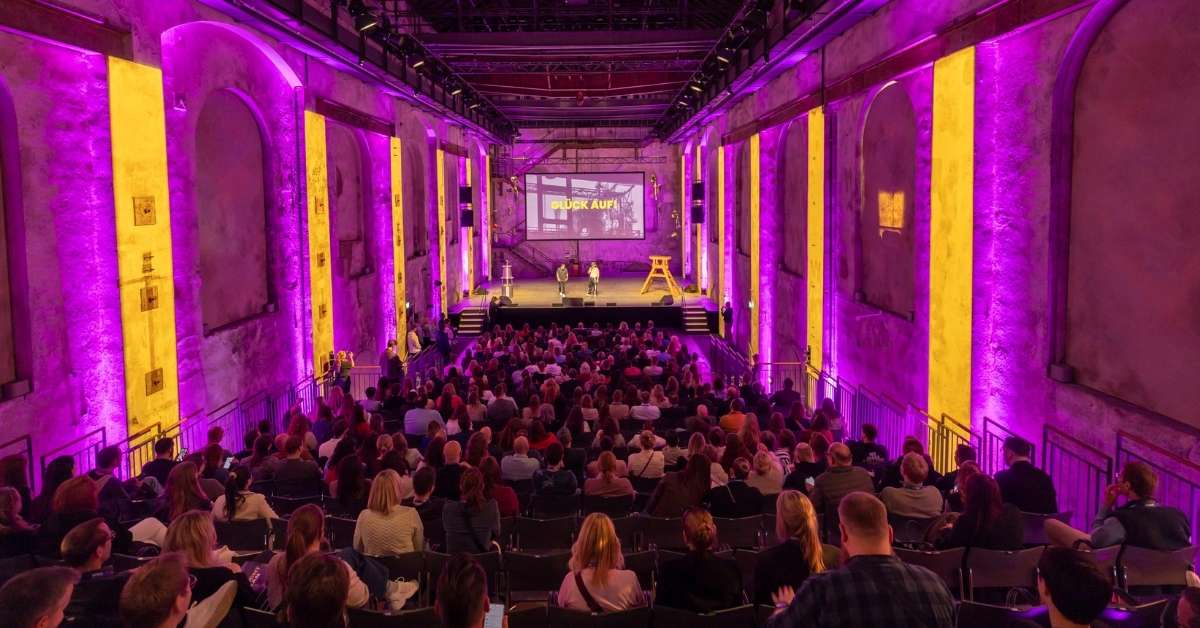
In his career as a football coach, Peter Neururer has seen teams fall apart. He knows what it takes to be a leader when your team is down by three goals at halftime. His keynote speech at this year’s “Schicht im Schacht” was one of the highlights of the recruiting event in the Duisburg-Nord Landscape Park. Around 500 HR professionals gathered there to talk about new trends, challenges and developments in recruiting and HR. Thematically, Neururer’s lecture was a bit out of the ordinary, but his look back at his long career as a football teacher was still entertaining. Because Neururer knew how to entertain the plenary session very well.
That was fun, even if some people might have wished for a little more HR involvement. Martina Voss-Tecklenburg, former national coach of the women’s national team, did a better job of this with her keynote speech at the “Shift in the Shaft” two years ago.
The “Shift in the Shaft” took place for the fourth time. Rusting blast furnaces now stand where pig iron was once produced. Initiator and recruiting expert Marcel Rütten did not choose the location for the recruiting conference in the heart of the Ruhr area by chance. The structural change there makes visible what the event is discussing in terms of content: the transformation of the world of work.
KI: Neither promise of salvation nor horror scenario
Accordingly, the program on three parallel stages reflected the range that talent acquisition has to deal with today. As expected, AI was omnipresent. Professor Dr. Stefan Süß and Professor Dr. Marius Wehner (Heinrich Heine University Düsseldorf), for example, discussed which professions are actually affected by automation and which are not. Dr. Roman Briker, Junior Professor of Organizational Behavior (WHU), took a more in-depth psychological look at the topic. His thoroughly questionable thesis: AI carries the risk of making people more radical and intolerant.
Severine Fiegler, Vice President HR Talent Acquisition at Infineon, outlined what could be realistic in a few years: AI recruiters who evaluate AI agents who independently send out applications and conduct interviews. She deliberately left it open whether that would happen and whether it was wanted. The real question is what this means for recruiters today: more strategic depth, less operational routine. For many in the room, this is not an abstract vision of the future, but an ongoing process.
Info
Then take a look at our dossier on the topic. There we continuously put together current reports, analyses, deep dives and tools for the use of AI in everyday HR for you.
Read it!
Ute Neher, Talent Strategy Director at Indeed, set a clearer framework for this. Companies that continue to think in terms of rigid job profiles, titles and perfect CVs sort according to yesterday’s criteria. The new currency is skills: the ability to learn, adaptability, analytical thinking, but also empathy, responsibility and judgment will become particularly important skills. In addition, there are skills that can hardly be named today. AI does not play a competitive role for humans, but rather a relief role: taking over routines so that people have more time to create value that only they can achieve.
Too many applications, not enough information
The panel on the “application tsunami” showed that AI also creates very specific operational problems. Dimitri Knysch, Co-CEO of the video recruiting platform Cammio, Elisabeth Krims, Head of Recruiting & Personnel Marketing at the transport company Wiener Linien and Katja Dombrowski, Team Lead Talent Acquisition & Employer Branding at the fashion company Walbusch, described how economic uncertainty and AI-generated mass applications threaten to suffocate recruiting teams not because of a lack of applications, but because of too many applications, while at the same time the informative value of the documents decreases.
Inclusion: More than a buzzword
The fact that diversity in recruiting should not just end up being a buzzword was the topic of a panel that brought the #EveryTalentCounts initiative to the stage. The initiative, whose partner is “Human Resources”, wants to provide information about how people with disabilities can be integrated into the labor market and supported there.
Moderated by human resources editor Lena Onderka, Anke Lenz, Chief Inclusion Officer & Digital Accessibility Lead at Accenture, and Laura Becker, who has headed the human resources department at FC St. Pauli since 2022, discussed how companies can specifically break down barriers and create structures in which real participation is possible. The tenor: Inclusion does not arise from good intentions, but rather from consistently designed framework conditions. Anyone who only treats it as a model has not yet understood it.
Employer branding from within
During her presentation in the pump hall, Thea König from Berliner Verkehrsbetriebe (BVG) showed where employer branding regularly fails: when external campaigns are developed without internal anchoring. As early as 2022, the BVG realized that a strong employer brand does not have to be produced by agencies, but must be lived from within, said König. Credibility comes from culture, not from communication.
Another high-profile name: Inga Dransfeld-Haase, Human Resources Director at TÜV Nord, emphasized in her keynote that it is time for HR to “venture further out than ever before”. Given the growing pressure to be efficient, HR must above all strengthen its own ability to change. And that only works if recruiting, development and retention are thought of together.
Graduation with the Knappenchor
The “Shift in the Shaft” ended in style: At the end, the Consolidation miners’ choir, founded in 1932, sang the Steigerlied, the anthem of the Ruhr area. A fitting end to a recruiting conference with Ruhrpott flair – down-to-earth, but with a confident view of the topics that HR is currently and will be concerned with in the future.


Sven Frost is responsible for HR tech, which includes the areas of digitalization, HR software, time and access, SAP and outsourcing. He also writes about recruiting and employer branding. He continues to be responsible for the editorial planning of various special human resources publications.