

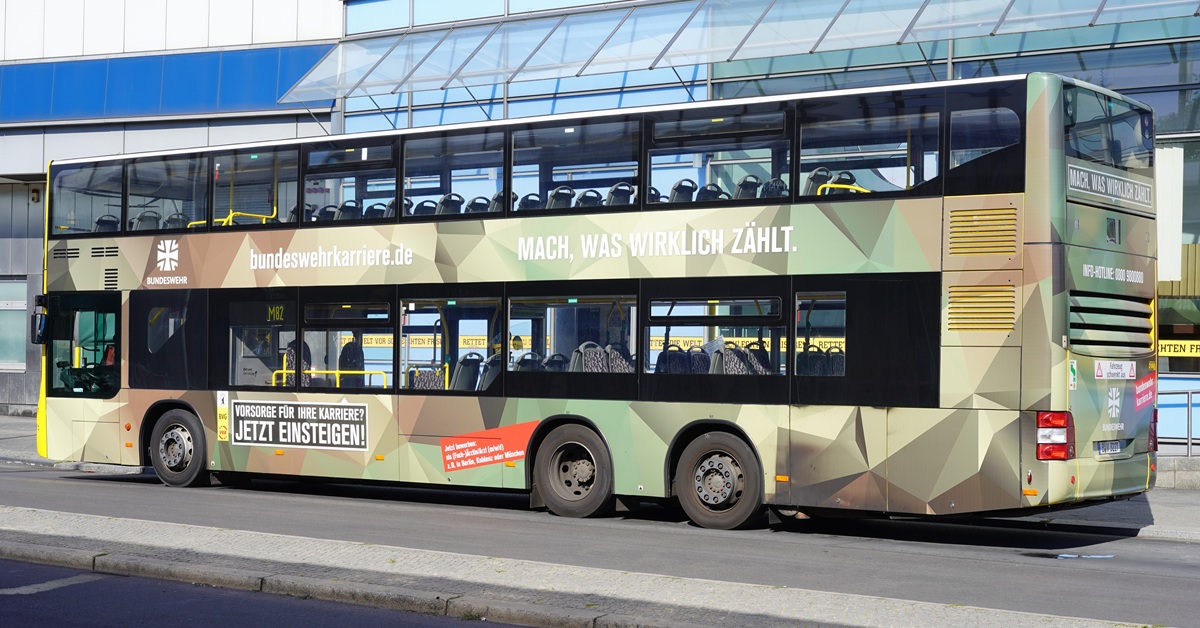
The Munich labor court recently had to decide whether an employee of the local transport company could refuse to use the train because the vehicle carried outdoor advertising for the troops. As a recognized conscientious objector and pacifist, he could not drive the vehicle – and that had to be taken into account in the roster. His employer didn’t find this funny, filed a counterclaim and won.
Why did the lawsuit before the Munich Labor Court fail?
Since the man had only been assigned to drive the tram in question “in about one and three quarters of a year so far,” the court said that a repetition was “very rarely to be feared.” Therefore, he is “not entitled” to refuse trips because of a plight of conscience that he cites. Otherwise the employer would have considerable planning effort.
However, this is not something to smile about. The case affects fundamental rights: it is important to weigh up freedom of conscience (Article 4 of the Basic Law, GG) and freedom of entrepreneurial activity (Article 12 Paragraph 1 Sentence 2 of the Basic Law). And this is not petty stuff, but rather the foundation of our legal system. This means: Despite the employer’s right to direct, according to the decision, “the conflicting fundamental rights positions” of both sides must be balanced in accordance with the constitution.
Which fundamental rights collide in the event of conflicts of conscience in the company?
The employer’s position is therefore not per se more important: the main issue here was the frequency of the problem situation. However, previous decisions show that in the event of serious and persistent conflicts of conscience at work, employees may even have the right to refuse performance and may not be forced to perform certain tasks (e.g. BAG, judgments of May 1989, ref. 2 AZR 285/88 and December 1984, ref. 2 AZR 436/83).
What is more important is that conflicts of interest in professional life are not uncommon. But when it comes down to it, companies and employees have the opportunity to raise justified objections. This may be arduous, but it shows that democracy also has its place in the workplace. Good this way.
Info
ArbG Munich, judgment of May 21, 2026 (ref.: 4 Ca 15395/25).
(Note: This article first appeared in a slightly different form in the July/August 2026 issue of Human Resources.)

Frank Strankmann has been an editor for human resources management for many years. His focus is on the topics of labor law, co-determination and regulation. He is also responsible for other projects for media brands from FAZ Business Media GmbH.