

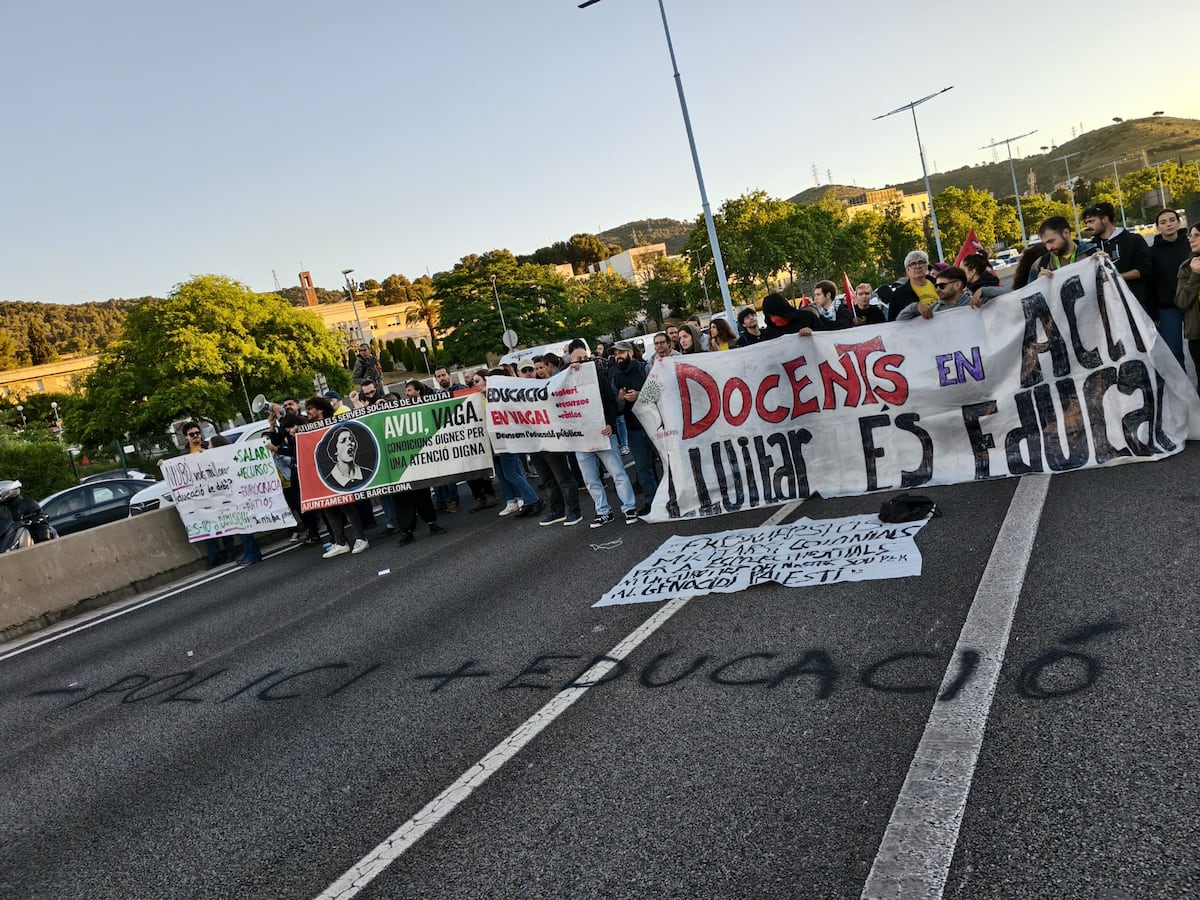
The new wave of teachers’ protests – 16 strikes in one month – started this Tuesday with main road closures, especially in the accesses to Barcelona. Starting at 7 a.m., different groups of pickets have blocked the entrances to the city along the ring roads, blocking the Trinitat and Llobregat junctions, in addition to cutting off the Dalt ring road in both directions at Santa Coloma and in Mundet and Gran Via at La Campana. Beyond the capital, there are also cuts on the C-31 in L’Hospitalet, the C-32 in Mataró in both directions and the C-17 in Vic. The teachers are thus leading a new fight with the Government to demand labor improvements, with a strike that aspires, once again, to be massive. During the morning, two marches will start from Plaza Espanya and from El Clot, to converge in Plaza Urquinaona, and then begin the demonstration to Plaza Sant Jaume.
Within this month of strike, three strikes are planned that will affect all of Catalonia; They will be on May 12 and 27, and June 5, which coincide with the start and closure of the new wave of protests. The rest of the days, the strikes will be territorial. It is in the hands of the Government to prevent this calendar from being carried out. After weeks of reluctance, the Department of Education has finally decided to convene all the unions this Thursday at a sectoral table “to share ways to redirect the situation,” according to Minister Esther Niubó this Monday.
🔴⚫️Vaga Educational to all of Catalonia
👉Road cuts in Barcelona and southern Barcelona
📸Round of Dalt at the height of Mundet
📸Gran Via in L’Hospitalet de Llobregat✊🏽Negotiate again or we block everything‼️
💪Vacancy, Vacancy i Vacancy!!
🔥Let’s respect each other. Let’s get back what’s ours🔥 pic.twitter.com/FRlXbJgsXY— CGT Education 🚩🏴 (@CGTEnsenyament) May 12, 2026
This Tuesday, teachers from public and subsidized schools (from 0 to 18 years old), labor personnel and all types of workers from educational centers are invited, from early childhood educators, educators or social integrators, special education, administrative staff, maintenance or cleaning personnel and dining room monitors.
The unrest of the teachers already broke out in February, and to avoid a new massive strike in March, the Government signed in extremis an agreement with CC OO and UGT to invest 2,000 million in five years, which takes the form of a 30% increase in the salary supplement (800 euros more annually), eliminating excess ratios in the institutes, 500 new staffing and the reduction of bureaucracy, among others.
The pact achieved the opposite effect expected and the collective spirits flared even more. The majority unions consider it “insufficient” and “not very concrete”, and demand a greater salary increase to recover the purchasing power lost in recent years, an effective reduction in ratios or more staff increases. This is precisely the main request of teachers who work in classrooms, who are overwhelmed by such a diversity of students.
More than a thousand centers without excursions
One of the pressure measures that is generating the most stir is the decision to suspend excursions and get-togethers for the next academic year. The initiative is spreading like oil and currently there are already more than a thousand – out of a total of 2,400 public schools and institutes – that have already adhered to the Let’s stop the educational exits manifesto; the last to do so, the thirty centers in Terrassa, which yesterday joined en bloc.