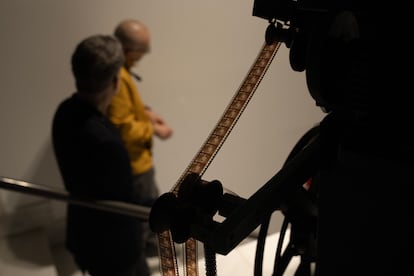


The Film Library of the Region of Murcia Francisco Rabal has begun this 2026, adding to its work of dissemination and conservation of cinematographic heritage, its restoration. Its new film treatment laboratory allows the entire recovery process of old celluloid rolls to be carried out with the particularity that the facilities are visitable and open to the public, with the aim of showing younger generations the material dimension of cinema that is being lost in the digital age.
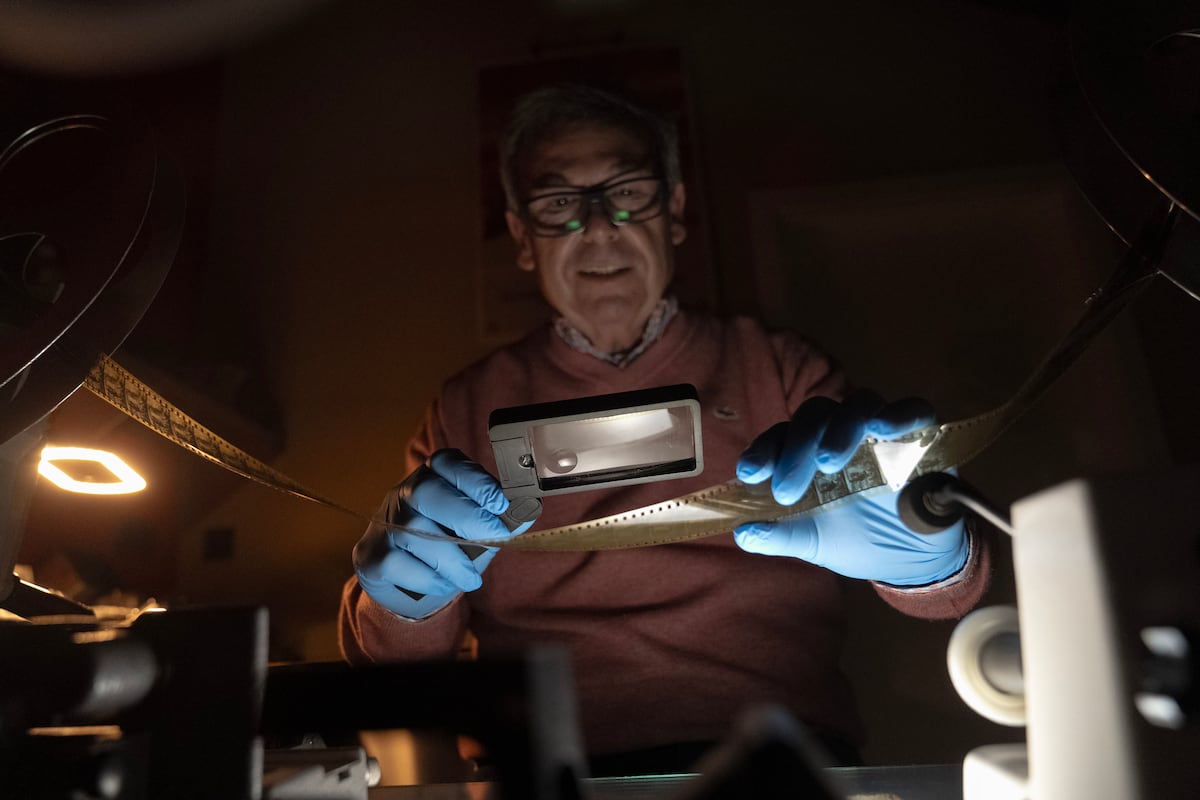
“I like to say that this laboratory is like a hospital in which we curate films. In most cases, each of those films is unique, as with people, there are no more copies, so the responsibility is great. Now, in addition, we leave the operating room door open for whoever wants to peek in,” explains Miguel García. His official position is head of restoration and conservation of the film library; In practice, he is the soul of this institution, to which he has been linked since its opening in 2004, and in which he acts as a technician, projectionist, historian, museographer and researcher, to list just some of his functions.
Doctor in Cinematographic Heritage from the University of Murcia and researcher in Cinematographic Archaeology, García has been manipulating analog films for more than 45 years. The system of adhesive joints with visual identification to facilitate the assembly and repair of 35 millimeter films that is currently used in projection booths and laboratories around the world is a patent of his. But his eyes still shine with excitement when he caresses the reel with which the new restoration laboratory of the film library has been released, a roll recorded in 35 millimeters in 1925 on the occasion of a visit to King Alfonso XIII and his son at the Sericícola Station in Murcia. “The silk industry was one of the main sources of the Murcian economy at the time, and that center had a professional camera to which a good part of the film production in the Region of Murcia at the beginning of the 20th century is due,” says Ángel Cruz, director of the Film Library. In fact, two other films from 1926 and 1927 are also being restored in parallel in the new laboratory, “probably recorded with the same camera,” he explains.
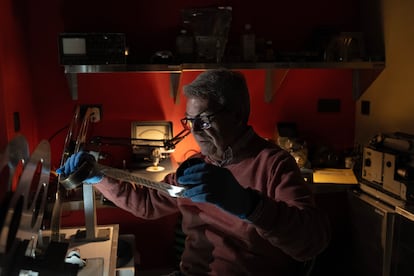
They are not the first tapes that Miguel García restores in the Murcia center, but they will be the first in which the entire procedure is carried out with its own resources, without having to depend on external laboratories. The process, the expert explains, is completely artisanal: the first step is to decontaminate the negative from fungi and bacteria, frame by frame, with cotton swabs soaked in chemicals. With powerful spotlights and magnifying glasses so as not to lose detail. And with patience, a lot of patience. This cleaning process, which García was already carrying out in the regional film library before the current laboratory existed, took him a total of 10 years to fine-tune the 16,000 frames of the film. Mister Me in Vega Murcianaa 1929 recording by José Gallego, which was re-released in 2024 to mark the institution’s 20th anniversary. “I didn’t dedicate the whole day to that either,” the coach downplays, laughing.
With the new facilities, you will also be able to carry out processes such as hydration to give flexibility to the plastic material of the negatives, or the elimination of curvatures and deformities in it, among others. The investment by the Murcian Ministry of Culture has been 35,000 euros, but for director Ángel Cruz, the return is immediate and evident, not only in the conservation tasks, but in their dissemination.
“There is a generation of young people who have not even seen a DVD, let alone these types of reels. Being able to see an analog film up close, how it is manipulated, even being able to touch it. And then, being able to see it projected, is an integral cinema experience,” he points out. The Minister of Culture, Carmen María Conesa, also reaffirms the decision to have opened the laboratory to the public, which can be seen through a large glass window in the corridors of the Film Library, and even enter the room when García is working. “We want you to be able to see and touch the cinema, what is behind its magic, and that it is a much greater and more interesting experience than opening an application on your mobile and doing scroll swiping your finger. We want the work carried out in this laboratory to be seen, to give a material dimension to cinema that is being lost in the digital age and that is unknown to new generations. We want young people to touch and smell cinema,” he explains.
To this end, in addition to this laboratory open to the public, the Film Library has installed eight projectors of different formats in its premises, including one of 70 millimeters, one of the least known due to the high cost of this type of film, in addition to rolls of different types, historical cameras and all types of material, almost everything, provided by the projectionist himself.
In the permanent programming of the Film Library there is also a cycle, The filmed memoryin which this type of films from the beginning of the 20th century are projected, produced and shot in the autonomous community, and projected directly from the original format, something that in Murcia is only possible to see in this institution, since no commercial theater retains 35 millimeter projectors.
In its archive, the Murcian film library holds some 1,500 recordings made in the autonomous community, many of them amateur works donated by individuals or found in antique shops, churches, schools, flea markets and removals, where García spends a good part of his time searching for audiovisual material. He has, he explains, two thorns in his nails: two tapes that he has not been able to find and whose existence he is aware of through historical documentation and newspaper archives. This is the recording of the coronation ceremony of the Virgin of Fuensanta, patron saint of Murcia, in 1927, and The jaca shinesconsidered the first fiction film produced entirely in Murcia, shot in 1926 by Luis Baleriola. Especially in the case of the latter, García believes that it is possible that there are no copies left, since the entrepreneurs themselves, when talkies arrived, reused many silent film tapes, cutting them up and using part of the negatives to make cuts and splices. Even so, he does not lose hope that the magic of cinema will give him a movie ending in which he achieves his challenge of finding her.