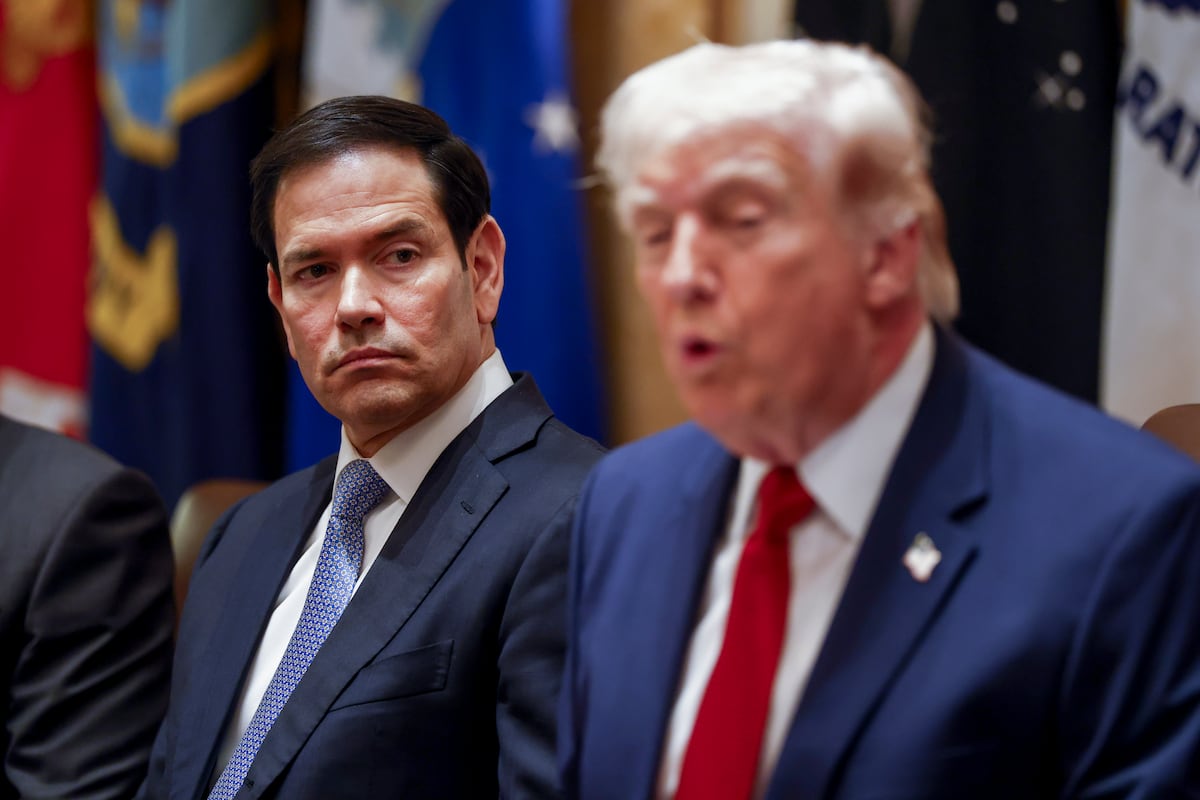



The White House has responded with disdain to Spain’s decision to close its airspace to flights involved in Operation Epic Fury. According to him, he does not need any other country to meet the objectives of the offensive, which both President Donald Trump and other senior officials of the Administration assure are almost achieved. At the same time, the Secretary of State, Marco Rubio, has referred to the Spanish veto to point out that Washington could retaliate against NATO for what it considers the lack of support from member countries for the US-Israeli operation.
In a statement to EL PAÍS, a senior official who spoke on condition of anonymity laconically stressed: “The US armed forces meet or exceed all of their goals under Operation Epic Fury, and do not need Spain or anyone else.”
The senior official did not want to specify whether the United States is considering any retaliatory measures. In the past, US President Donald Trump had threatened Spain with the imposition of a trade embargo following the Pedro Sánchez Government’s refusal to allow the use of Spanish military bases for US-Israeli attacks against Iran.
Trump has also frequently expressed his frustration with NATO member countries regarding what he considers the lack of help from member countries in the war against Iran — which is outside the Alliance’s space — and has assured that in the future he will “take into account” this refusal to form a coalition that would protect merchant ships trying to cross the strategic Strait of Hormuz, effectively closed by Iran and key to global trafficking of oil, gas and other key products.
“We would always have come to his aid, but now, in view of his actions, I suppose we no longer have that obligation, right?” he commented on several occasions last week. The last one, in Miami on Friday, during a business forum financed by Saudi Arabia.
In an interview given to the Al Jazira television network, the Secretary of State, Marco Rubio, has focused on this threat and has assured that his country will have to “review” the relationship with NATO when the conflict has ended, due to the refusal of Spain – and other countries – to allow the use of their bases for war.
“In a time of need for the United States (…) we have countries like Spain, a NATO member that we are committed to defending, that denies us the use of its airspace and that boasts of denying us the use of its bases. And there are other countries that have done the same.”
According to the White House National Security Advisor, one of the reasons why the Atlantic Alliance is “beneficial” for the United States is that it provides “bases for contingencies,” such as the stationing of soldiers, planes and weapons in Europe.
“If NATO is only going to serve to defend Europe when Europe is attacked, but denies us the right to use bases when we need them, it is not a very good agreement. It becomes difficult to get involved and say that it is something good for the United States, so all of this is going to have to be reexamined. All of this is going to have to be reexamined,” the senior official noted in the interview.
Spain now not only does not allow the use of the bases of Rota (Cádiz) and Morón de la Frontera (Seville) by combat or air refueling aircraft that cooperate in the attack. Nor does it authorize the use of its airspace to US aircraft that come from third countries, such as the United Kingdom or France, and cross it to participate in the war against Iran, as military sources have confirmed to this newspaper.
Speaking during a meeting with German Chancellor Friedrich Merz in the Oval Office a few days after the start of the war on February 28, Trump was specifically aggressive against Spain. “We could use their bases if we wanted. We can fly there and use them. Nobody is going to tell us not to use them. We don’t have to. But they were hostile, so I told them we didn’t want to do it,” he said.
He also took the opportunity to remember that the Sánchez Government did not want to increase defense spending and to toughen his speech: “So we are going to cut off all trade with Spain. We do not want to have anything to do with Spain.”
Those statements were softened almost immediately by the White House, which the next day assured that Spain was cooperating with the US military effort. Immediately, the Spanish Foreign Minister, José Manuel Albares, flatly replied that this was not the case.
Sánchez has defended that Spain repudiates the theocratic regime in Iran, but also the war launched by the governments of Trump and the Israeli Prime Minister, Benjamin Netanyahu. His commitment, he emphasizes, is for democracy. “Some will say that this is naive. What is naive is to think that the solution is violence. Or to think that practicing blind and servile following is leading. We are not going to be complicit in something that is bad for the world for fear of retaliation from someone,” he noted in response to Trump’s threats at the beginning of March.