


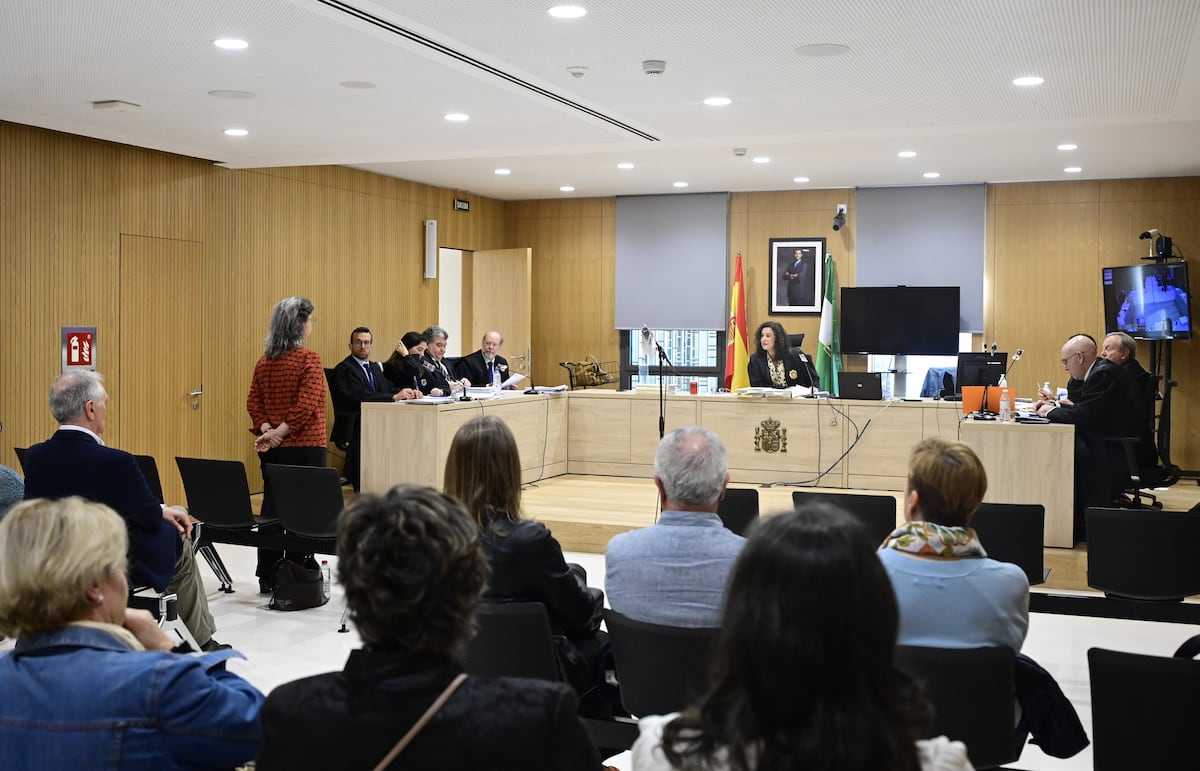
The psychiatrist on trial for the death of an acute patient in Córdoba and facing an eight-year prison sentence, Carmen Prada, argued this Thursday at the oral hearing that the patient did not intend to commit suicide, as the victim’s family has repeatedly maintained. “The patient had a risk of not controlling his behavior, but he did not have suicidal intentions,” alleged the head of mental health at the Reina Sofía Hospital, for whom the Prosecutor’s Office is requesting four years in prison. The private prosecution increases the sentence to eight years for two involuntary homicides, since it considers her responsible for the death of the patient and another man whom he killed years before. The thesis that the doctor has defended is that the patient did not commit suicide but rather his death was due to heart disease complicated by pulmonary edema and the intake of antidepressant drugs.
The patient Francisco Miguel León Benítez died in 2020. The trial seeks to determine whether the head of mental health should have declared the forced confinement in a psychiatric center of the acutely ill patient that his family had claimed since 2010 due to his constant episodes and violent outbursts, which would have prevented his death at the age of 39, and that of another man that the patient killed in self-defense five years earlier, a crime for which he was acquitted. In parallel, Judge Carmen Gema González, head of the Criminal Court 4 of Cordoba, must decide whether the doctor incurred a crime of denial of health care for not forcing the hospitalization of the patient, who suffered repeated psychotic outbreaks over a decade.
“There is no preventive confinement,” the doctor defended at the end of her statement, which lasted an hour and a half and in which she appeared noticeably nervous and with a deep voice. Before his interrogation, the victim’s father, Francisco León, had warned of the constant complaints and claims that he had filed since 2010 before the duty courts, the Prosecutor’s Office, the Andalusian Junta, the police station and the hospital. “I warned countless times about what was going to happen. I reported it and no one did anything. They took him to the emergency room, they gave him painkillers, then to Mental Health and then to the street. He did not take the treatments and tried to take his life several times,” he censured with a broken voice. Since 2006, her son attended more than fifty medical consultations, was treated by two different psychologists and five psychiatrists, and suffered eight episodes of acute crises with two hospitalizations.
The head of mental health treated the patient on several occasions and this Thursday she declared before the judge that he suffered episodes of high behavioral dysfunction and a mixed personality disorder, but that his episodes were caused by the consumption of psychoactive substances, which enhanced his symptoms and caused him to lose control in critical episodes. “This person suffered from a mixed personality disorder with substance abuse, it was not a serious mental disorder. I do not share the affective schizoid disorder,” the doctor stated about the diagnosis made by a private psychiatrist. The victim’s parents and siblings reported at the oral hearing as witnesses that when they showed the alternative diagnosis of another psychiatrist to the head of mental health, she ignored the opinion of her fellow expert and refused to even read it.
The patient suffered eight hospitalizations following the outbreaks, but his usual routine for a decade was to be treated by community mental health services, without being admitted. After killing the other man, he spent three years in preventive detention before his acquittal. “My son came out of prison much worse than when he entered because he suffered abuse,” lamented the father.
The doctor rejects the hypothesis that the man had ended his life voluntarily. “I rule out the possibility of suicide. The family told me that the situation was unapproachable and coexistence impossible (…) But the patient’s evolutionary monitoring did not depend on me, but on the community team,” he argued before the magistrate.
“Substance consumption caused him to lose control. If he did not consume, the symptoms of the personality disorder and outbursts of anger did not increase. He had the disorder whether he consumed it or not, but it triggered it,” said the doctor, the patient’s reference psychiatrist. “It was always recommended that it was necessary for him to go to the addictive behavior team and the drug addiction service. He was very impulsive and there were confrontations, but at no time was he identified as a serious mental patient with serious disorders,” added the doctor.
On the contrary, his relatives highlighted that the patient had “many suicide attempts and stomach lavages” in the emergency hospital services. “My son has suffered abandonment from the institutions and that is why he died. We have asked for help but the doctor did not tell us anything or refer him. She said that the report (from the private psychiatrist) did not interest her, that she did not want to know anything about the report,” criticized the patient’s mother. His brother concluded: “We were helpless.”
The Prosecutor’s Office has reiterated that the victim did not receive home care to monitor the illness and thus respond to the requests of the family, desperate for his violent behavior, since he even attacked his father in 2014. The doctor has defended that the patient’s pathology did not entail home care until he died in 2020, but from 2021 when a protocol was developed. On the contrary, the family’s defense has assured that the general health law is very clear in this regard and that it establishes better care for mental health patients than that received in this case.
While the victim’s family accuses the psychiatrist along with the Córdoba Prosecutor’s Office, the Córdoba College of Physicians, the Andalusian Health Service (SAS) and two insurers are represented in the defense, which would face financial compensation if the doctor were found guilty. The trial will have two more sessions next week before being heard for sentencing. The experts proposed by the parties will testify and will delve into whether or not the law protected the actions of the head of mental health, in an unprecedented case in the Spanish justice system given that no psychiatrist has faced a request for prison for alleged health neglect of an acute patient, according to the scientific societies of psychiatry.