

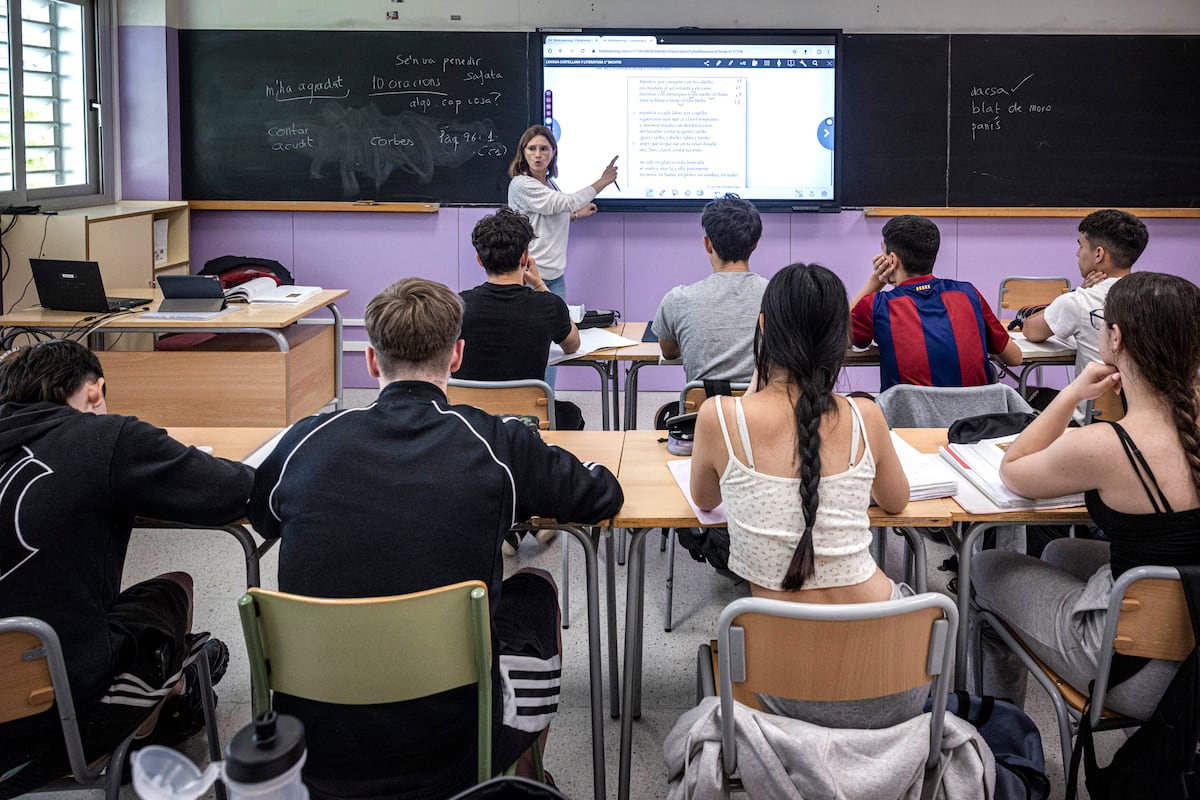
The Generalitat Valenciana finalizes a series of changes in the drafts of the new curricular decree for the next years of Primary and Baccalaureate education that give more value to the optional subject of Religion and banish any reference to the linguistic unity between Valencian and Catalan, accredited by the philological community.
This latest decision of the Generalitat, chaired by Juanfran Pérez Llorca, of the PP, who governs with the parliamentary support of Vox, already sparked intense controversy in the educational, cultural and political sphere when it emerged a few months ago, while Carlos Mazón was still head of the Consell. Now it has intensified with its written expression at a time when the popular and the extreme right formation compete in the defense of what they consider the hallmarks of Valencian identity.
The draft of the new decree grants more teaching time in the first three years of Primary to Religion classes, by including a 45-minute class per week that is added to what was already included in the previous curricular decree of 2022, approved by the Generalitat, chaired by the socialist Ximo Puig. The rest of the courses remain the same.
In Baccalaureate, the text includes the subject Educational Attention in a parallel schedule to Religion, so the student will not have his absence justified, as has happened until now. This change can reinforce the choice of the Religion elective. In addition, Religion will be evaluable, although it does not count towards the average grade for access to other studies such as university studies or for obtaining scholarships. Therefore, it has been incorporated as one more area of knowledge in the new decree.
Sources from the Ministry of Education, Culture and Sports, directed by Carmen Ortí, point out that “the fact that Religion is evaluable is included in the basic state regulations, specifically, in the first additional provision (sections 4 and 5) of Royal Decree 243/2022” of the central Government, chaired by the socialist Pedro Sánchez. The fourth section says: “The evaluation of the teachings of the Catholic religion will be carried out in the same terms and with the same effects as the other Baccalaureate subjects. The evaluation of the teachings of other religious confessions will conform to what is established in the educational cooperation agreements signed by the State.” The fifth section alludes to the fact that it will not be counted in the averages. “Such aspects are literally transcribed in the proposed Baccalaureate decree presented to unions and confederations of AMPAs,” the same sources add. Educational Attention has been included, “as is done in Primary Education and ESO, to cover precisely the regulatory gap that was left,” they add.
This reinforcement of Religion occurs when the recent document Education figures in Spain 2026 reveals that the subject has lost 369,807 students in five years in the stages where it is taught. This drop, the reduction in weekly hours since the entry into force of the Lomloe and the maintenance of the number of Religion teachers means that many teachers have more contract hours than classes.
The draft decree was presented at the Education Sector Board last week to the unions and also to the confederation of parents. Now it must be discussed in the School Council, before its final approval by the Consell so that it comes into force starting next year.
Relevant works
Regarding the Valencian subject, the Baccalaureate decree banishes Catalan authors, limiting the curriculum to the study of writers by place of birth, without any mention of the “Catalan literature” of other creators from Catalonia or the Balearic Islands. “Reading of relevant works of Valencian literature and the main Valencian authors (…)”, indicates the new text, which modifies the previous decree of 2022. It is urged to study, for example, the literature of the Golden Age of the Kingdom of Valencia (which covers the last decades of the 14th century and the 15th century), without referring to its precedents. It was in this period of cultural splendor, which coincided with the economic boom of Valencia within the ancient Crown of Aragon, when the common use of Valencian spread to refer to the language introduced by King James I in the 13th century during the Reconquista.
The new decree emphasizes that the dialectal variants of Valencian must be studied, without referring to the Catalan linguistic system, although the speech of the Castellón population of Vinaròs and that of the neighboring Tarragona population of Alcanar is practically indistinguishable, for example. The draft, on the contrary, is not exclusive with respect to Spanish and makes explicit in the curriculum the “comparative study of the main dialectal varieties of Spanish in Spain and in America.”
The Ministry of Education denies the majority and rejects that “authors from other traditions are eliminated, since the curricular design establishes stages, movements and competencies, but not specific names.” “That does not mean excluding anyone. It means recognizing what is one’s own,” highlighted the general director of the Educational Organization, Ignacio Martínez Arrúe. “It will be the educational centers, in the exercise of their pedagogical autonomy, who specify the readings,” adds the note, which emphasizes that the update is in accordance with the Statute of Autonomy.
The majority Valencian teaching union, STEPV, is very critical of the two curricular modifications. “Valenciano’s only seeks to limit and restrict the content to strictly Valencian authors and to strictly Valencian dialectology, applying a strictly geographical criterion that goes against scientific rigor, since language and culture do not understand geography,” he points out. Regarding Religion, it highlights that “the recovery of Educational Care for students who do not choose Religion” is not regulated in the royal decree and represents a “kidnapping of students” who do not want to teach a subject “that is “indoctrinating.”
Confusion and rigor
The Valencian decree also affects publishers. “The opinion of the Associació d’Editorials del País Valencià is to follow academic criteria. The declaration of leaving non-Valencian authors out of the curriculum creates confusion because it disavows previous philological studies and complicates teaching work. In matters of linguistic matters we trust in the role and knowledge of the Universities and the Valencian Academy of Language,” states its president, Pedro Francisco Medina.
This last institution is the regulatory body of the Valencian, according to the Statute of Autonomy. And also one of the main targets of Vox’s criticism, which advocates its suppression to defend the uniqueness of Valencian within the linguistic unity of Catalan. The Academy has expressed its “concern” about the possibility that in the new Baccalaureate curriculum project “Valencian and Valencian literature could be perceived in an isolated and decontextualized manner, which would be detrimental to the academic training of the student body” and would be contradictory “with the way of proceeding with the curriculum of the other official language”, Spanish.