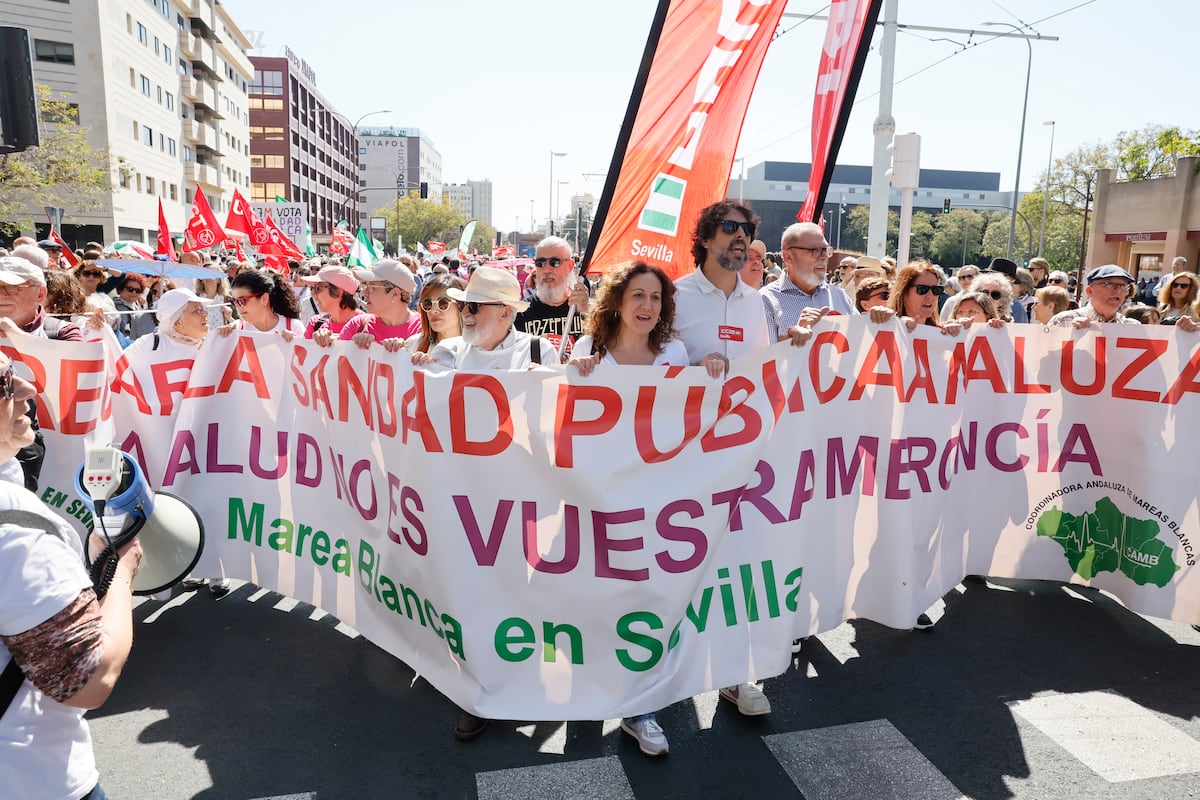


Thousands of Andalusians have once again taken to the streets of the eight capitals of the community this Sunday in protest against the deterioration of public health, under autonomous jurisdiction. It is the ninth time since, in November 2022, months after the historic absolute majority of the popular Juan Manuel Moreno, Marea Blanca will call on citizens to make visible their discomfort over the collapse of primary care and the privatization of the health system. Four years later, the state of public health services has not improved – as evidenced by the Andalusian CIS, where health has become the first concern, ahead of unemployment – but this Sunday, among the protesters, a certain hope has emerged above their frustration that the elections of May 17 could be a turning point where the deep concern about the dismantling of a health system, which had already been weighed down by the cuts applied by the socialist governments with great recession. “Hopefully this will be a reality check at the polls,” said María Dolores Sánchez, a 43-year-old teacher who attended the Seville mobilization from Guillena accompanying her parents.
That desire has become an explicit call in the speech of Sebastián Martín Recio, retired family doctor and spokesperson for Marea Blanca, at the end of the demonstration in the Andalusian capital: “Users, the population in general, citizens, health professionals, the white way, the parties and unions, all together, let us make common cause so that on May 17 we really achieve the political change that can guarantee the recovery and strengthening of our health The demonstrations have gathered 22,300 people, according to the count provided by the National Police (5,000 in Seville and Granada, to which we must add the 600 in Motril; 3,800 in Málaga; 2,000 in Cádiz and Córdoba; 1,500 in Huelva; 1,400 in Jaén and 1,000 in Almería).
The left-wing opposition has made it clear that the Andalusian elections are going to be a plebiscite on public services in general and public health in particular and this morning the three candidates from the main parties, María Jesús Montero, for the PSOE; Antonio Maíllo, from Por Andalucía; and José Ignacio García, from Adelante Andalucía, have questioned the “privatization plan” of the Moreno Government, based on the weakening of public services.
In these four years, the Government of the Junta has minimized the consequences of these demonstrations, which began with low attendance, but have gradually added to patients dissatisfied with the decline in health services in their health centers, waiting lists to access primary care, a specialist or to undergo surgery… and to health professionals, fed up with the workload and unfulfilled promises by the regional administration. Marie Lacroix, who lives in Albaicín, braves the rain and cold in Granada because the Velutti health center, the one in her neighborhood, is going to close. “They will distribute us to centers in other neighborhoods that are already saturated,” he says. Furthermore, “there are many elderly people in the Albaicín. How are they going to be able to get to health centers that are very far from our homes? This is a shame,” he concludes.
In Seville, María Ángeles Tormo, 52, complains, while holding the banner in defense that in Cabezas de San Juan, where she depends, there is no pediatrician, no 24-hour emergency room and family doctors appear and disappear. “But in our reference hospital in Lebrija our specialties are reduced: there is no dermatology, ophthalmology has been reduced… I had to wait 13 months for a cataract operation whose maximum is four. My quality of life decreased, my family offered to finance the operation privately and if it had been my son or my life had been spent on it, I would have said yes,” he says.
The PP is no stranger to a malaise that is palpable in the surveys – the CIS Health Barometer also shows that Andalusians are the ones who value their public health the worst – and that makes clear their arguments that no other Government has invested so much in health before (65% more compared to 2018). With the arrival of Montero, who was Health Minister of the Board between 2004 and 2013, the Andalusian president has made it a point to remember the dismissals of more than 7,000 health professionals or the reduction of the health budget by 1.5 billion euros in those years; Furthermore, the massive demonstrations that the Granada doctor Jesús Candel promoted just 10 years ago, Spirimanin protest of the merger of two hospitals in Granada. An earthquake then began in the field of health and public opinion that, to a greater or lesser extent, determined the future of the PSOE and the then president Susana Díaz in the Andalusian government.
A continued deterioration
“There is a common thread that has been observing how public health has been deteriorating. But each phase has had its point. The deterioration has been progressive and brutal in the last four or five years,” observes Martín Recio. María Dolores also recognizes that the first problems began during the Díaz Government, but she is very clear: “We have never had waiting lists like until now and the fact is that everyone in our environment is suffering devastating diagnoses because there are no resources in the hospitals or people to care for us in the health centers. This entails a very difficult emotional deterioration.”
Juan Ignacio Rodríguez, a 62-year-old official of the Board, remembers how Moreno “based a large part of his 2018 campaign on discontent with healthcare” and recalls that in one of the electoral debates he promised to reduce surgical waiting lists to 60 days. “Not only has he not kept his promise, but he has been increasing it.” Nor does family doctor Ana Roca consider that both moments or the basis of citizen unrest can be compared. “So there were layoffs, but there was no change in the health model,” he points out.
The clearest example of failures due to the deterioration of the health system has been breast cancer screening. The women of Amama have carried a 15-meter banner with the names of 2,500 women, apart from the 2,317 affected women that the Board has counted, who have suffered delays in their diagnoses and who have not been called by the administration. “We have all lost something that cannot be recovered, trust in public health,” said Cristina Fernández, affected by the screenings, during the speeches.
Public health users are not the only ones who suffer from the deterioration of the system; Professionals like Roca have also not seen improvements with any of the shock plans implemented by the Board to try to stop the collapse in primary care or the waiting lists. In Granada, Marta García Caballos, family doctor and spokesperson for the Roundtable in Defense of Public Health, maintains that there is “a lack of real commitment to improving the structural problems of the system that give rise to very long and unacceptable waiting lists for consultations and surgery appointments in hospitals. But also in health centers so that family doctors can see you.” She is convinced that this problem – “which began to deteriorate years ago, around the time of the 2007 crisis” – has a solution. “This is not an impossible deterioration. Moreno’s statements that this has no solution are very self-serving. Destroy the public to justify its privatization. It is perfectly possible to fix it because there are enough personnel and the health system is very robust. We just need to capitalize on it in terms of professionals and structure.”
“My hope is that what people demand on the streets and on the networks will be transformed into a vote, not as a punishment, but as a warning to tell Moreno that he has not done well,” says María Ángeles. However, she is not optimistic because she believes that the surveys, which give very good results for the PP, do not reflect this wear and tear on healthcare. Agustín, a 61-year-old retiree, doesn’t have it all with him either. “I would like it to be like that and to show the reality that we are suffering in Andalusia,” he says, accompanied by his daughter Marta, a 29-year-old administrator.
She believes that neither the person who started the process of deterioration in healthcare, the PSOE, nor the person who has made it worse, the PP, can solve the problem. “They depend on the interests of their parties in Madrid, that is why I believe that the Andalusian forces are the ones who can promote the reform of the system,” he maintains. There is debate between Adelante Andalucía and Por Andalucía. He hopes to decide during the campaign, but he does know, like the rest of the attendees, that his vote on May 17 will be conditioned by the defense of public health. “Be clear that public health is something that we should not do without and that should guide the vote,” defends Juan Ignacio Rodríguez, who is wearing a t-shirt with the slogan “We’ve been fooled”.