


SpaceX accelerates its new businesses linked to Starlink satellite telecommunications services and space vehicle launches. A path that coincides with the plans of the company controlled by Elon Musk to attract investors to its IPO (Public Offering or IPO), probably the largest in history.
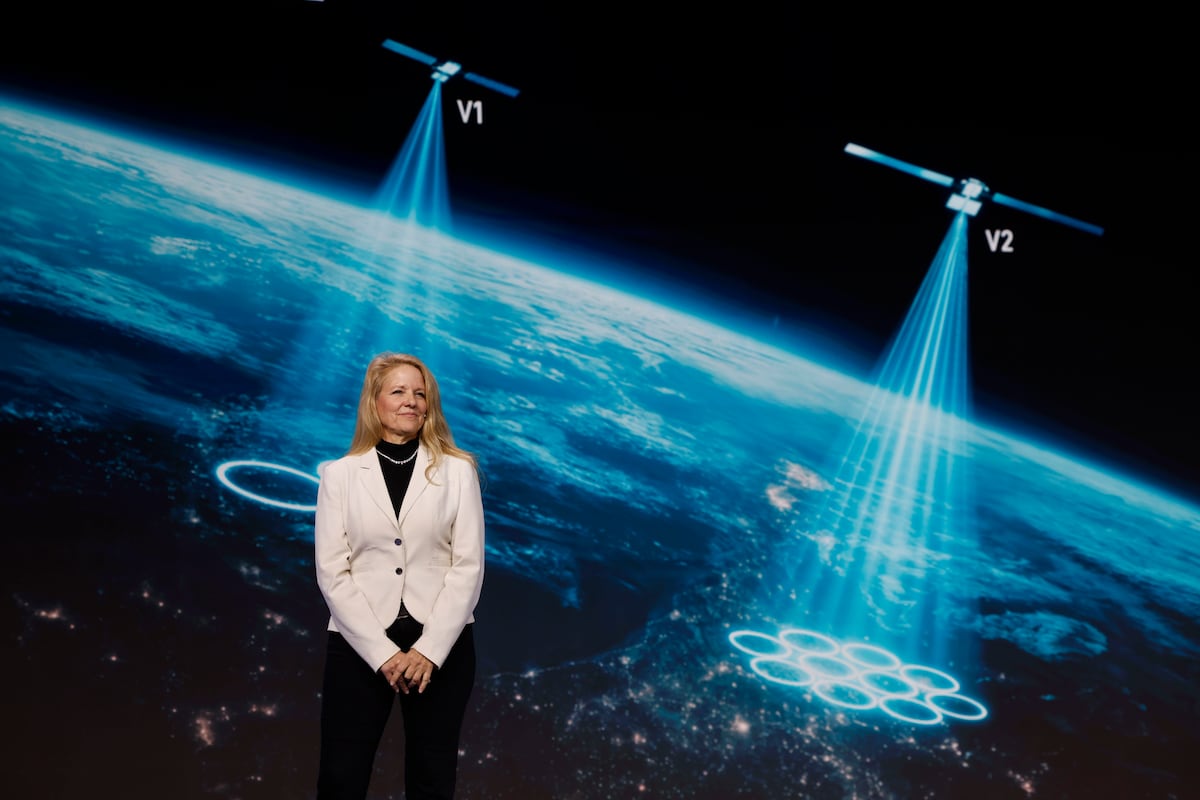
At the Mobile World Congress 2026 in Barcelona, which opened this Monday, Gwynne Shotwell, the president and chief operating officer of SpaceX, launched an almost solemn declaration that redefines the concept of mobility under her company’s space infrastructure: the end of coverage “dead zones” across the planet. During his speech in the main presentation The Future of Satellite-to-MobileShotwell has assured that the technology is no longer a laboratory promise, but rather an infrastructure ready to convert any smartphone conventional in a satellite device. This deployment, which uses the Starlink constellation as a network of cell towers in space, seeks to ensure that no user will ever find themselves in a situation of isolation, regardless of the orography or the lack of terrestrial antennas.
The key to this historic leap lies in the architecture of the new Starlink V3 satellites, whose massive launch has been confirmed for this year thanks to the loading capacity of the Starship rocket. These satellites are specifically designed to interact with the 4G and 5G frequencies already used by the phones we all carry in our pockets, eliminating the need to purchase expensive hardware or external antennas. As detailed by Shotwell, the orbital network is now capable of managing thousands of simultaneous connections per signal beam, allowing not only the sending of text messages in critical situations, but also basic voice and data services in real time.
Within the framework of the fair in Barcelona, SpaceX has emphasized that its objective is not to displace traditional telecommunications operators, but to act as an “invisible network layer” that fills the gaps where fiber and 5G do not reach. This vision of hybrid connectivity allows smartphones to jump from a terrestrial to a satellite network automatically and transparently for the user. To demonstrate this, the company has set up a testing area in Hall 6, called New Frontierswhich shows how the signal arrives clearly even in environments that simulate the most extreme conditions of geographic isolation.
Shotwell has also linked this advancement to the development of the future 6G standard and the expansion of physical artificial intelligence, arguing that a truly intelligent society cannot afford to have “blind spots.” By integrating satellites into the global mobile ecosystem under 3GPP standards, SpaceX has transformed satellite connectivity from a luxury service for marine rescues to an everyday utility. The promise is clear: geographical location will no longer determine the communication capacity of a human being, turning connectivity into a ubiquitous and resilient right in the face of natural disasters or local infrastructure failures.
This full coverage service will begin its immediate commercial deployment in several strategic markets, placing the industry on the threshold of an era of borderless communication. With the support of a fleet of almost 10,000 satellites in orbit and already validated direct link technology, SpaceX, which has agreements in Spain with companies such as Telefónica and MasOrange, has made it clear that 2026 will be remembered as the year in which the sky became the largest telephone network in the world. The phrase “out of coverage” has begun its path toward technical obsolescence.
The company also expects its Starship subsidiary to be ready to launch a new, improved constellation of Starlink satellites in mid-2027, according to Michael Nicolls, senior vice president of Starlink at SpaceX. The manager pointed out that the company will be able to launch more than 50 satellites in each launch. The intention is to launch the launches in mid-2027, to be able to deploy the new constellation more quickly. Thus, SpaceX, which will compete with Amazon Leo, expects to deploy around 1,200 satellites in the six months following the first launch of this new generation next year.
In this scenario, SpaceX plans to confidentially present an initial public offering during the month of March, according to Bloomberg, sources familiar with the matter, while billionaire Elon Musk’s rocket and satellite company moves forward with its plans for the largest IPO in its history.
The firm, based in Starbase, Texas, expects to file its draft IPO registration with the United States Securities and Exchange Commission (SEC) in the coming days, with the goal of starting trading in June.
If so, it would overtake OpenAI and Anthropic, which also plan to go public this year. However, compliance with all the details of the transaction could delay it.
In the transaction, in which SpaceX has the backing of Bank of America, Goldman Sachs, JP Morgan Chase and Morgan Stanley, the company could reach a valuation of $1.75 trillion. With that market value, SpaceX would be larger than all but five companies in the S&P 500 index: Nvidia, Apple, Alphabet, Microsoft and Amazon, and surpassing Meta and Tesla, Musk’s own company.
A few days ago, as part of the reorganization of his business empire, Elon Musk announced the merger of SpaceX and its start-up of artificial intelligence xAI in a transaction in which the new entity was valued at 1.25 billion dollars.
With the IPO, SpaceX would also raise up to $50 billion, above initial plans and breaking the current record, held by the Saudi oil company Aramco, which raised $29 billion in 2019.
The company is considering a dual-class share structure in the IPO, which would potentially give managers like Musk additional voting power to have ultimate control over decision-making.