


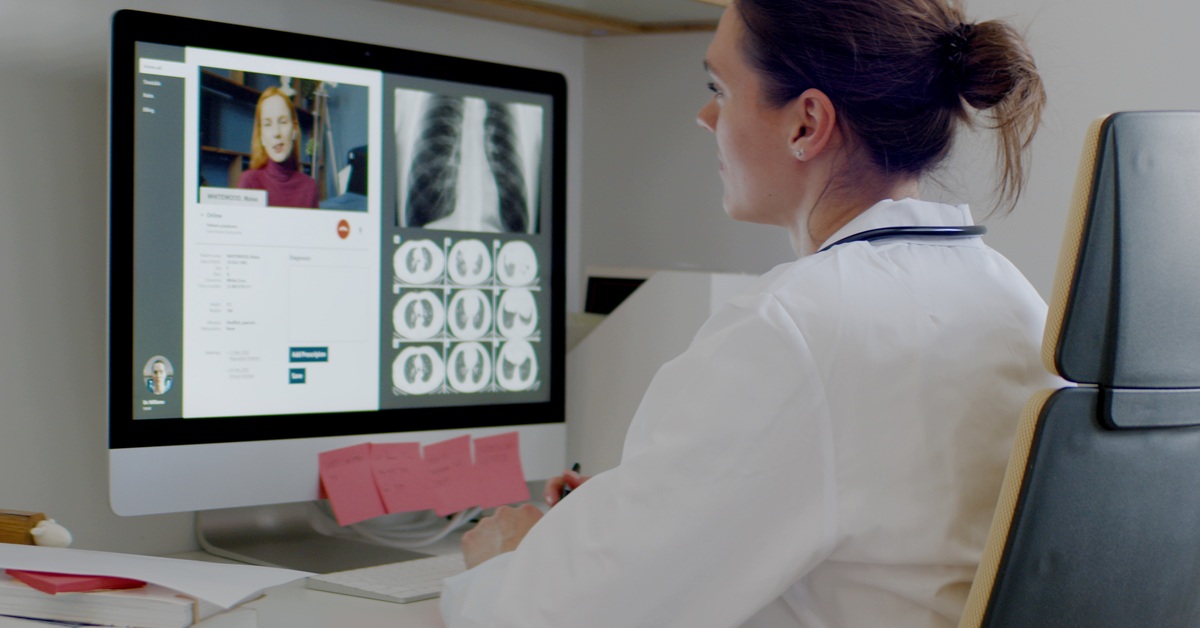
The federal government wants to change certain requirements for issuing certificates of incapacity for work (AU). The Union and the SPD recently announced the introduction of a requirement for employees to have a certificate from the first day of illness. Federal Health Minister Nina Warken has now also announced plans for new requirements for online sick leave.
What are the plans for certificates from the Internet?
In an interview with the Editorial Network Germany (RND), the CDU politician said that “the possibility of a certificate via video” should in principle be retained. Nobody has to “go to the doctor’s office” if they are sick. However, according to Warken, the plan is to “exclude online sick leave through obscure online platforms”. The coalition agreement also provides for this. It states that the rules for an AU without personal contact with a doctor should be changed so that “abuse is excluded in the future (for example exclusion of online sick leave through private online platforms)”.
During the conversation, Warken further announced that the government would “soon present concrete proposals to prevent sick leave using an online questionnaire without contact with a doctor.”
What currently applies to online sick notes?
The basis for issuing an AU to those with statutory health insurance in this country is the “Guideline of the Federal Joint Committee on the Assessment of Incapacity to Work”. Section 4 paragraph 5 stipulates that an AU “may only take place on the basis of a medical examination”. A corresponding examination must be carried out “directly in person or indirectly in person as part of a video consultation”. If the latter is the case, the practice must “ensure the authentication of the insured person”.
It also stipulates that a certificate based on a video anamnesis can only be created “if the illness does not rule this out”. In addition, initial certificates for patients who were not personally known to the respective practice beforehand “should not extend beyond a period of up to three calendar days”. Otherwise, up to seven days are allowed.
Video consultation only if suitable for consultation
But information obligations also apply to this type of consultation. During online consultations, doctors must inform insured persons “about the limited options for obtaining findings for the purpose of determining incapacity for work during video consultations”. Can a possible illness be described purely through audio?–If you cannot assess visually, “you should refrain from determining your inability to work during the video consultation and point out the need for an immediate personal examination by a contracted doctor.” This not only appeals to the ethical and medical duty of care. It is also made clear that there is no right to have your incapacity for work determined via video consultation.
Online AU: Risks with dubious providers
In this context, the Health Minister’s plan is apparently not aimed at contacts with traditional general practitioners or specialists, but rather at online offers of sometimes questionable quality and competence.
Lawyers and medical associations had already warned in the past about such dubious providers who do not issue proper AU. There have been repeated reports of cases in which, for example, only a questionnaire had to be filled out without there being a personal consultation. The sick note could then be downloaded as a file. In the worst case, websites were and are operated by medical professionals who are not licensed in Germany.
Sick notes via the Internet led to termination
Some portals even explicitly point out that the AU they issue does not comply with basic medical rules. If employees still use such a service, it can have serious consequences.
Recently, an IT consultant was dismissed without notice because he submitted a digital AU generated in this way to his employer, which was not properly transmitted via the health insurance company. His unfair dismissal claim was dismissed on appeal because the website he used openly indicated that it was issuing an AU with little probative value. The fact that the man intentionally used the service to report sick was a breach of trust with the employer.
Because, according to the court at the time, a supposed certificate “without personal direct or indirect medical contact” does not correspond to the requirements of Section 4 Paragraph 5 Sentence 1 and 2 of the Incapacity for Work Directive.

Frank Strankmann has been an editor for human resources management for many years. His focus is on the topics of labor law, co-determination and regulation. He is also responsible for other projects for media brands from FAZ Business Media GmbH.