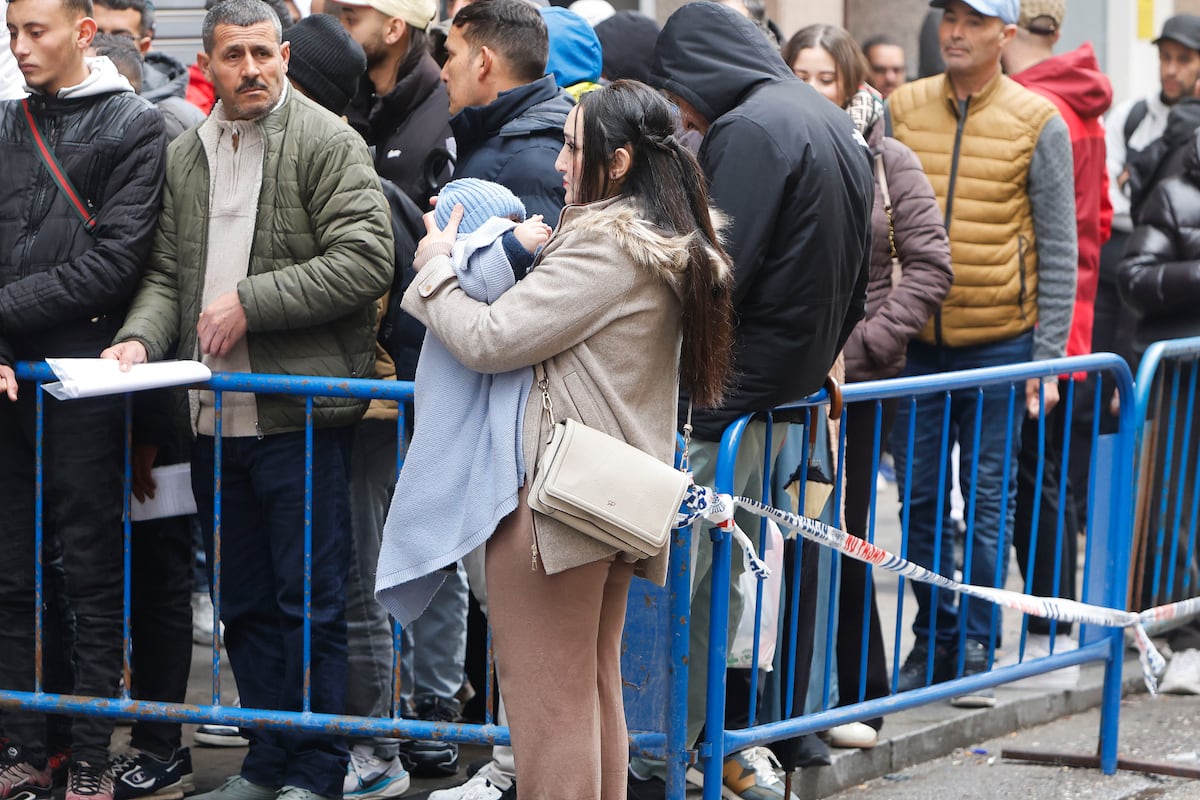


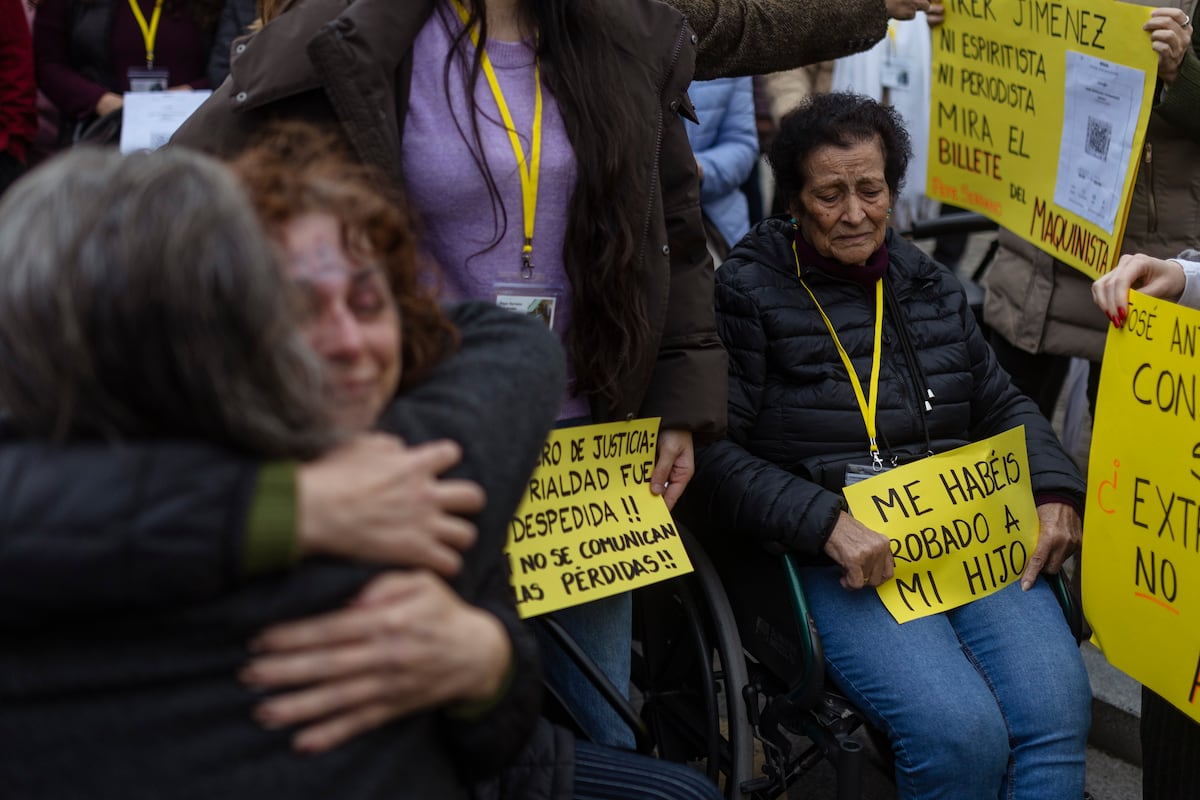
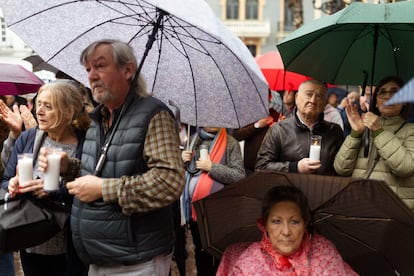
Huelva demands respect and justice for the victims of the Adamuz (Córdoba) train accident, in which 46 people died and 152 were injured on January 18. But it also demands the truth about the causes of the accident because, with it, responsibilities can be settled and, above all, measures can be established to prevent another similar tragedy. Under these premises and with the motto “Memory, truth and justice”, more than 2,000 people, according to the capacity of the final gathering place, and 5,000, according to the police, demonstrated this Friday, in absolute silence and defying the rain, along the kilometer of distance between the train station and the central Plaza de las Monjas in the capital of Huelva. Mario Samper, spokesman for the victims, who include the 440 survivors and their families, has taken the opportunity to criticize all administrations, without distinguishing between the parties that govern them, for the lack of effective response to the first collision of two high-speed trains in Spain and the third most serious since 1972.
“You have stolen my son,” read the banner of one of the protesters. Francisco Albarrán seconded the meaning of the message from the station where his niece, 45, and her sister-in-law never arrived. “I’m just asking for justice,” he said. “I am,” another young protester responded briefly and laconically to a colleague who asked her about her condition.
The march, which has passed without incident and without a single cry of reproach, has been called as a popular tribute (political representation has been relegated), but also to demand measures that guarantee railway safety by clarifying the origin of the accident. “Knowing the truth will benefit everyone because it will serve to implement the systems that are necessary so that this does not happen again,” Samper explained.
Since the funeral mass held on January 29 in Huelva, where the majority of the victims were from, with the presence of the kings, the representatives of those affected have met with the Andalusian Minister of Justice, José Antonio Nieto (PP), and with the Minister of Transport, Óscar Puente (PSOE), ten days ago. After the first, the Board has appointed Huelva lawyer Jaime Mora as commissioner for victims.
Mora has assured that “he will be available to all those affected by this unfortunate tragedy that hit Huelva and Andalusia so hard.” “The doors of the autonomous Administration are permanently open to listen to the demands and needs of the victims and their families and to transfer these to the Andalusian Government,” he added.
But Samper criticizes the incorporation of a new figure without powers to face the psychological, legal, labor and social consequences of the accident. He could only intervene in health care matters, but this has not improved either and is managed with the usual deficiencies of the system, according to the spokesperson: “It cannot be that a person who has two broken knees makes an appointment with the traumatologist and it arrives, like any Andalusian, within six months. If this man (Mora) is there to redirect us to other administrations, we don’t need it.”
Nor has the victims been satisfied with last week’s meeting with Óscar Puente, who has promised to travel to Huelva to meet with them, but has not yet set a date. Samper has reported that the minister limited himself to repeating what he had said in other forums. “We sent them a series of questions and demands, but until now they have not answered us. We remain the same,” he lamented. The victims also question the office created in Transport after the Angrois accident for lacking effective action protocols.
One of the demands that the association addressed to the minister was the consideration of the incident as a work accident to allow greater benefits for those affected, as well as access to higher disability, widowhood or orphanhood pensions. The first vice president, Minister of Finance and PSOE candidate for the Board in the next regional elections, María Jesús Montero, announced on Thursday that the regulatory change in this regard will be processed “shortly”: “This same measure was applied by the Dana (of Valencia) and we believe that it is fair to do so now as well,” she assured.
The fundamental pillar of support among the victims and their families continues to be the WhatsApp group in which they are grouped, but they demand specialized assistance, as Samper details: “We are constantly fighting with Renfe and Iryo insurance, with bureaucratic procedures that are complex. Only two people have received an advance on compensation. But there are others who are in bed without being able to move or with amputated limbs or locked in their rooms because they feel terror, due to the psychological trauma they have suffered. We do not have help from no one.”
The most stable communication is maintained with representatives of the Railway Accident Investigation Commission (CIAF). Based on his information, Samper believes that the hypotheses about the objective causes of the accident are centered on a crack in the road that occurred 22 hours before the accident and that was not detected by the prevention systems. But the responsibilities for this happening remain to be resolved. During the protest, the spokesperson spoke directly of “negligence.”
The representatives of the main political formations have respected the non-partisan call of the association and have supported the demonstration “in a personal capacity”, as stated by the deputy secretary general of the Andalusian PSOE, María Márquez: “We have said it from the first moment: we are next to the victims, we respect what they have asked for at all times. Each socialist, in a personal, individual capacity, has been able to support the demonstration.”
The Minister of Social Inclusion, the popular Loles López, has spoken in the same sense, who has shown her “maximum respect” for the demonstration and its objectives: “Huelva and the families need to know what has happened and, above all, that it never happens again. It is what we all want.”