

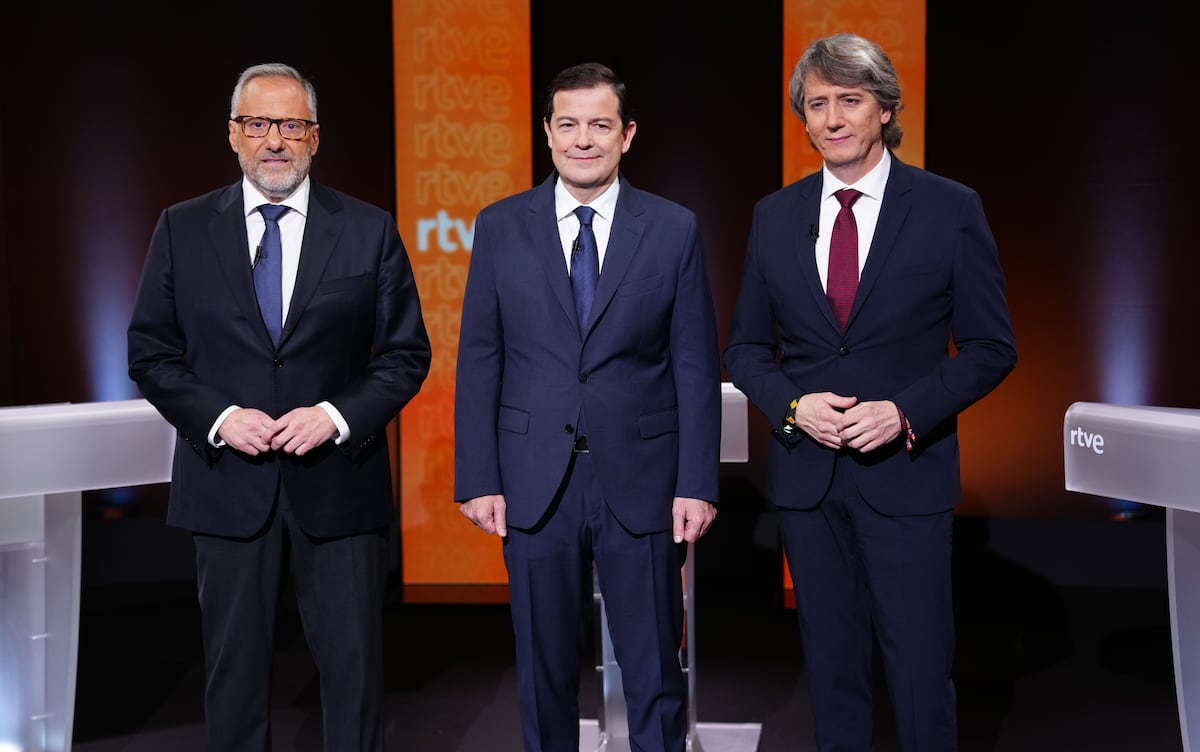
The three-way electoral debate with the candidates for the presidency of Castilla y León from parties with a parliamentary group (PP, PSOE and Vox) this Thursday on TVE has been a faithful reflection of the public surveys and trackings private offices managed by the candidates just over a week before the elections. The acting president, Alfonso Fernández Mañueco (PP) has avoided, except for some occasion related to immigration, directly confronting Carlos Pollán (Vox) and has focused his responses and interventions on the socialist candidate, Carlos Martínez, whom he has despised for elevation, not so much for his management as mayor of Soria for 17 years, but as a representative “of sanchismo” and the “management model of Óscar Puente”, the Minister of Public Works, very touched by the train accident in Adamuz (Córdoba). Martínez, the most relaxed, has won some debate battles with questions or assertions that were left unanswered by his rivals, but he has spoken at all times as if after March 15 he were the leader of the opposition, not president, which is why he has made more criticisms than proposals. Pollán has limited himself to trying to collect discontent, attacking the PSOE and the PP simultaneously, in each argument, as if both parties were lifelong partners.
The debate, moderated by TVE journalist Xavier Fortes, has been divided into four thematic blocks: Environment, rural areas and depopulation; Public services, infrastructure, and housing; Economy and regional financing and pacts and democratic regeneration. According to RTVE, the channel also offered a face to face between the candidates of the two main forces, the PP and the PSOE, but the president of the Junta de Castilla y León rejected it.
The Vox candidate took just a minute to bring up his fetish topic, immigration, when, in his initial greeting to Mañueco’s recurring criticism at campaign rallies – that Santiago Abascal’s party “left its voters stranded” in 2024 by abandoning the coalition government – he assured that they left after Alberto Núñez Feijóo agreed with Pedro Sánchez to welcome “a menas”, the derogatory term with which that the extreme right refers to unaccompanied foreign minors. After multiple allusions to the issue that the PP candidate has let pass in different blocks of the debate, finally, Mañueco has assured that what Vox would like is to “throw human beings into the sea” and has recalled that what Abascal’s party calls “migratory invasion” was the reception of “140 unaccompanied minors from the Canary Islands.” According to Pollán, the community’s problems are due to the fact that immigrants “collapse health care” – something that is not supported by official data – and take away aid that should go to the region’s natives. The socialist candidate replied that “immigration is not a problem” and that the problem is that more than a million Castilian-Leonese people have had to leave their community due to the lack of opportunities and are currently served by public services in other territories.
During the debate, and as the moderator reminded him, Vox’s decision to not support the investiture of María Guardiola, the acting president of Extremadura, was known in the second vote, this Friday, when it only needed a simple majority, that is, when the abstention of the far-right party was enough. Asked about this regarding future pacts in Castilla y León, the Vox candidate disregarded an entire block of the debate – “Until the elections are over we have nothing to say,” he said; Mañueco insisted that his “aspiration” is to “govern alone”, but with whom he is clear that he will not agree is “with the Sanchismo of Castilla y León, and the management model of Puente y Redondo (Ana, Minister of Equality)”. Martinez, for his part, reminded Mañueco of his offer of a pact so that the most voted list governs – “If I were so convinced that he was going to win, he would shake my hand right now” – and assured that the PP and Vox “are going covertly” to the elections with their “married couples” when “everyone knows that they are going to go hand in hand” because the national leaders of both parties “have already agreed on the Government of Castilla y León in Madrid.”
In addition to immigration, Pollan, who began each of his interventions by putting the PP and the PSOE in the same bag, insisted several times on “climate fanaticism”, in reference to the policies, fundamentally European, to combat it; the Mercosur agreement, to try to win the disputed vote of farmers and ranchers who, according to him, will be harmed, and the “gender” ideology. Martínez reproached them for not condemning murders of sexist violence and assured that their way of protecting women is to tie them “to the kitchen,” while recalling that they had voted against the increase in the interprofessional minimum wage and pensions. Mañueco avoided confronting Vox in its proposal of “national priority” to receive public aid, that is, that only those born in the community have access to it, but he replied that Vox usually refers to aid to families as “payas”, without specifying the nationality.
It was the PP and above all, Vox, which does not believe in the constitutional model of autonomous communities, who made the greatest efforts to nationalize the electoral debate, to the detriment of issues related to Castilla y León. Pollán accused Sánchez of having “spent the money of the Spanish people in brothels”, having ascended to the leadership of the PSOE “with money from prostitution” and having allowed “company ladies” to be placed in the body that manages the security of railway structures, in reference to the ex-partner of former minister José Luis Ábalos, who had nothing to do with railway safety. He also criticized the amnesty for the process and mentioned the open cases against the wife and brother of the President of the Government. Mañueco pointed out to Sánchez every time a management problem was brought up in his face, such as waiting lists: “There is a lack of doctors and that is the responsibility of the Government.” During his speech, the acting president cited Minister Puente five times and Sánchez nine times.
Other problems in the region were more blurred, such as the devastating fires last summer or depopulation. Martínez assured that the PP has been talking about the issue for decades as “the great challenge” of Castilla y León, proof that it is not a challenge, but rather political negligence, and Pollán limited himself to framing the problem as a derivative of the supposed “migratory invasion” suffered by the country and the community.