


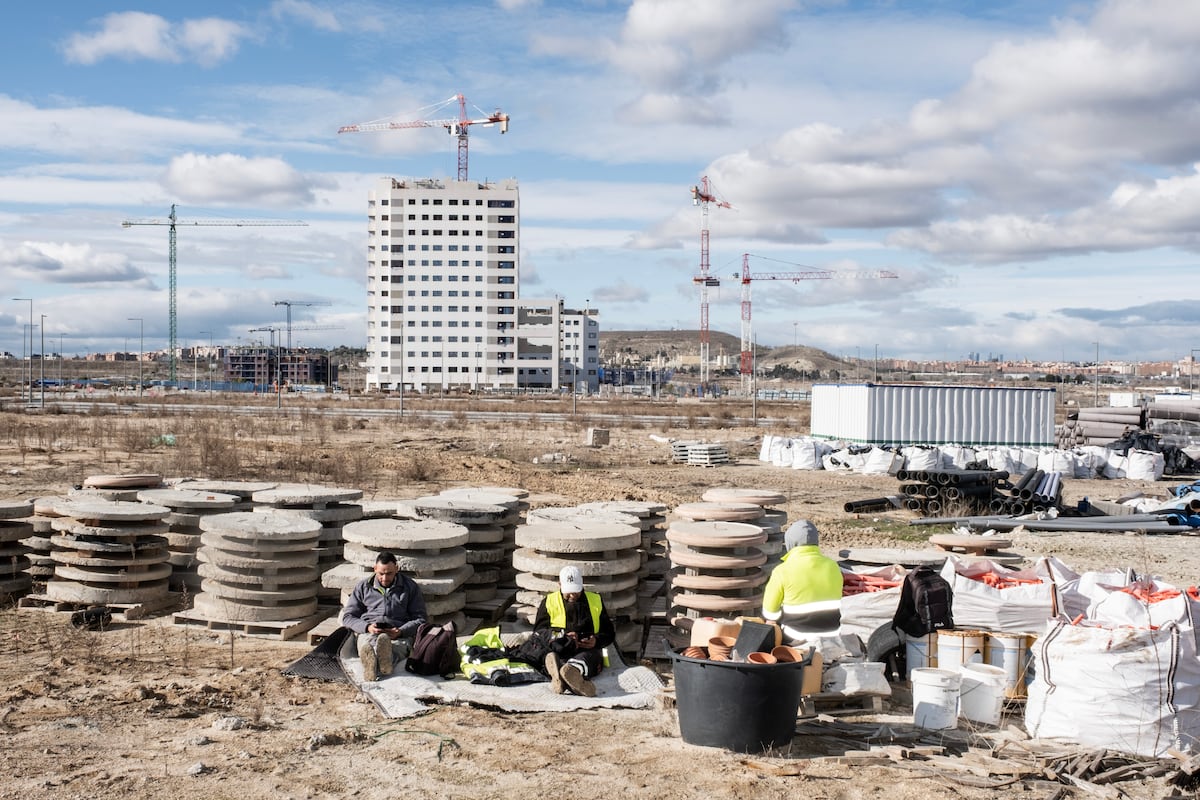
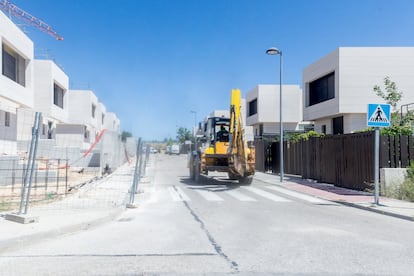
When Rosa María Maya, 54, arrived in El Cañaveral, there was no health center. Nor subway. Not even an institute. Eight years later, he says, everything remains the same in this development in the south of Madrid. Their hardships warn of the challenges that the mayor, José Luis Martínez-Almeida (PP), will face in his commitment to increase the density of Madrid’s new neighborhoods in the coming decades. The preliminary hypothesis is that where 35 homes are built per hectare, it will reach around 70. Translated: the City Council wants to combat the housing crisis by building more in the same space, and is provisionally using a formula that would have multiplied from 120,092 to 302,036 the number of homes planned in the five new developments in the south, where the planned density now varies from 26 to 32 homes per hectare. As a result, the number of potential inhabitants in this area would go from 327,000 to 818,000.
This change is equivalent to building enough houses in Madrid in the long term to accommodate a population equivalent to the current population of Seville or Zaragoza in the coming decades. According to an expert, it is the lesson drawn from El Cañaveral: in low-density neighborhoods, the early provision of services is slower and more expensive due to low demand. The great challenge for the future is that the increase in density serves precisely to prevent these delays from being repeated.
This is how a source familiar with the project who requests anonymity summarizes it: “The challenges are water, electricity, because the developers complain a lot that they do not have the power they need, and that public transportation is made effective, in addition to the equipment being put in place on time (not ten years later), as happens in Vienna, where the equipment arrives before the houses in a new neighborhood.”
Sigfrido Herráez, dean of the Official College of Architects of Madrid (COAM), sees the City Council’s proposal as “feasible”, which is still in the development phase (a preliminary plan will not be approved until 2027) and establishes the needs of the city in 20 or 30 years. That is, the changes you propose will not happen overnight. “Densification does not pose any technical problem, nor the water or electricity connection, because all the networks are oversized for growth of this type,” analyzes the architect. How these houses are built is a different question. “The problem is who keeps the capital gain from these higher densities,” continues Herráez, “(Will it be) the owner of the land, the city council? Will it be social housing? Will we make the developer rich? We will have to see what type of concession is made with the increase in buildability,” he adds. According to what is planned for the developments in the southeast, between 50% and 58% of the homes will have some type of public protection.
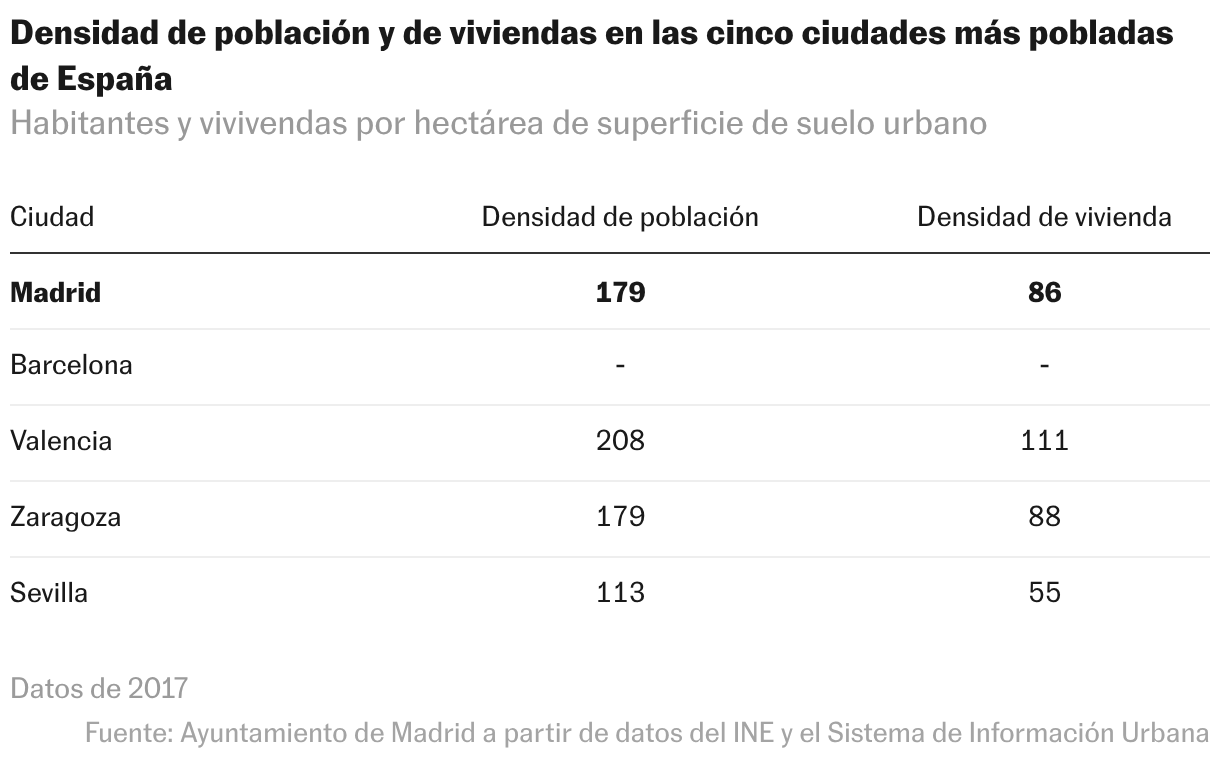
The new developments in Madrid were made with a density of homes per hectare that ranges between 28 and 35. As a result, the density of the capital stood at 86 homes per hectare in 2017, according to official data from the city council. In comparison, Zaragoza then reached 88, and Valencia at 111. According to these statistics, Madrid has grown in width, and not in height. A design that the housing access crisis, with skyrocketing purchase and rental prices, forces to change now, aligning the project with the consensus of experts in favor of increasing the densification of large cities.
“If Madrid has 98% of its land consolidated, we have to grow outward, but also by intensifying housing, or generating transformation operations that allow for intensifying residential use,” summarized Borja Carabante, Urban Planning delegate of the Government of José Luis Martínez-Almeida, who recalled that the capital already has densities of around 144 homes per hectare in the sought-after neighborhoods surrounded by the M-30 (more than double the around 70 that are being studied). for new developments). In fact, Catalonia is exploring similar formulas, as are the United Kingdom and the Netherlands.
The commitment to increasing densification, in any case, entails challenges to which the municipal and regional administration are no strangers, as shown in its Municipal Strategic Plan (PEM), which will have priority over the General Urban Planning Plan (PGOU) and will include the challenges that active developments already face in Madrid.
This is what he says about public provisions: “(It is necessary) a rapid residential occupation in the face of late or incomplete execution of the planned facilities. This gap translates into lack of local educational, cultural and sports services, with a direct impact on territorial cohesion and urban quality.” And regarding public transport, it is highlighted: “The non-execution of key infrastructure conditions urban cohesion and the planned sustainable mobility.”
“It would seem very risky, almost reckless, to try to reach 70 homes per hectare without a direct public transport connection,” says Antonio Giraldo, urban planner and PSOE councilor in the Madrid City Council, where the government has experimented with formulas such as exclusive lanes for buses with priority over other vehicles at intersections, and has extended the public bicycle rental network as an intermediate solution to the arrival of the Metro to all the new neighborhoods.
The important thing, says Jorge Galindo, director of the Esade Economic Policy Center (EsadeEcPol), is that this public transport is “frequent, reliable and parallel to the planned density”, arrives in the format in which it arrives.
“The transportation challenge, structurally, is the biggest, because if you make many private vehicle routes, it will probably collapse, due to induced demand,” Galindo warns. “It is no small matter that the basements of buildings are spaces for common use, and not housing,” he adds. “Those two things, along with taking care of the design of public space, will help a lot with the big challenge, which is the political acceptability of this,” he emphasizes. “My intuition is that in Spain we have gone from being a country that builds in density to being a country that does not like density,” he continues. “And there is a fourth aspect: incorporating density bonuses, so that developers calculate that for each floor they go up they have to include a number of protected homes.”
The Madrid of the future already exists on the internet. There you can consult the draft of the project, which as such is preliminary. What is certain is that the creation of housing must be matched with the arrival of fundamental services.
Currently, the Madrid City Council plans to build 150,000 homes distributed among the different urban projects that are already planned and approved. The bulk – some 107,000 – will be concentrated precisely in the developments in the southeast, such as El Cañaveral. These figures correspond to a density per hectare of approximately between 30 and 35 homes, and imply an increase of about 300,000 inhabitants, similar to the population of Bilbao. If we reach around 70 homes per hectare, which is the City Council’s starting hypothesis, the change would be radical. The Madrid of the future would go from growing in width to also growing in height. A novelty with a domino effect: everything that happens with the price of housing in the capital has an immediate response in what it costs in the municipalities of the metropolitan crown.