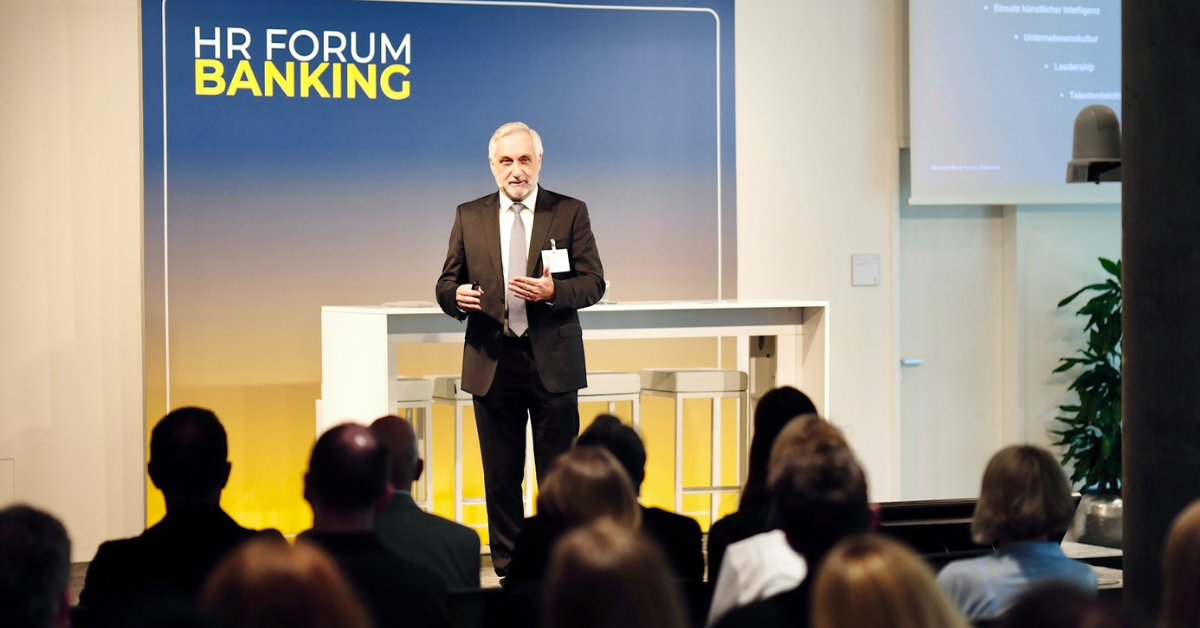
Workforce management, AI competence, pay transparency and regulation – the HR Forum Banking 2026 showed which questions concern the industry. And what answers there are.
AI transformation, growing regulatory pressure, demographic change and geopolitical uncertainty: the questions that HR managers in banks have to deal with today are not small. At the HR Forum Banking 2026, around 100 HR professionals came together to find answers. For the second time, the human resources industry invited HR professionals from banks and financial services to the FAZ Tower in Frankfurt am Main to discuss the latest developments and challenges.
What became clear: The challenges are real – but they are also an invitation. Now is the time for HR in banks to prove what they can do. The need for strategic human resources work has rarely been as clearly felt as it is today.
People decide whether the bank is successful – and that’s why HR is in demand now
Volker Steuer, Global Head of Human Resources at Deutsche Bank, opened the day with a keynote. His basic thesis: Professional human resources work is not a downstream support process for the company’s success, but rather a central competitive factor. “Companies have customers and staff. Without these people, none of this would work,” he said. The HR department decides which people work in the company and thus whether customers receive the advice they expect.
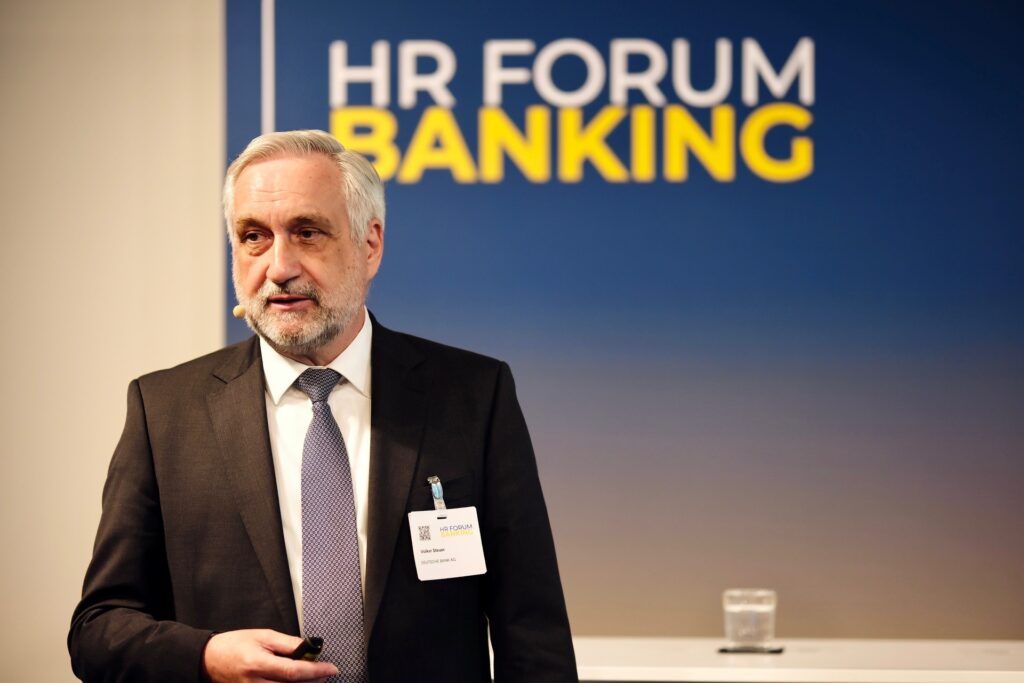
Five core topics determined his HR agenda at Deutsche Bank: skill-based workforce management, AI transformation, corporate culture, leadership and talent development. He named strategic workforce management as the central control variable – the task of ensuring the right workforce in the right quality, quantity and at the right cost at all times. In addition, in the future, managers would also have to be able to control the collaboration between human workers and AI.
Steuer did not accept an apparent contradiction: Anyone who wants to provide strategic advice must have a grasp of the operational foundation. “Anyone who messes up payroll cannot be taken seriously as a consultant.” His conclusion: “The decisive success factor of the banks of the future will be to combine people, leadership, learning, culture and artificial intelligence in such a way that sustainable performance is created.”
What remains of the work – and what doesn’t
How much work will machines really take on in the future? Prof. Dr. Jutta Rump, Managing Director of the Institute for Employment & Employability at the Ludwigshafen University of Economics and Society, presented three years of research with differentiated findings. Not all digitalization means job loss: rule-based automation, intelligent automation and AI as an assistance system are three different things. The latter complements human work, it does not replace it: “The assistant in artificial form sits with me in the driver’s seat.” The substitution potential – i.e. how many tasks can be completely or partially transferred to the machine through automation or the use of AI – varies greatly. The potential is highest in the passive back office area, where it is 55 percent overall. However, it is significantly lower where human interaction counts. And: The numbers do not reflect what is technically feasible, but rather what is regulatory and technically feasible.
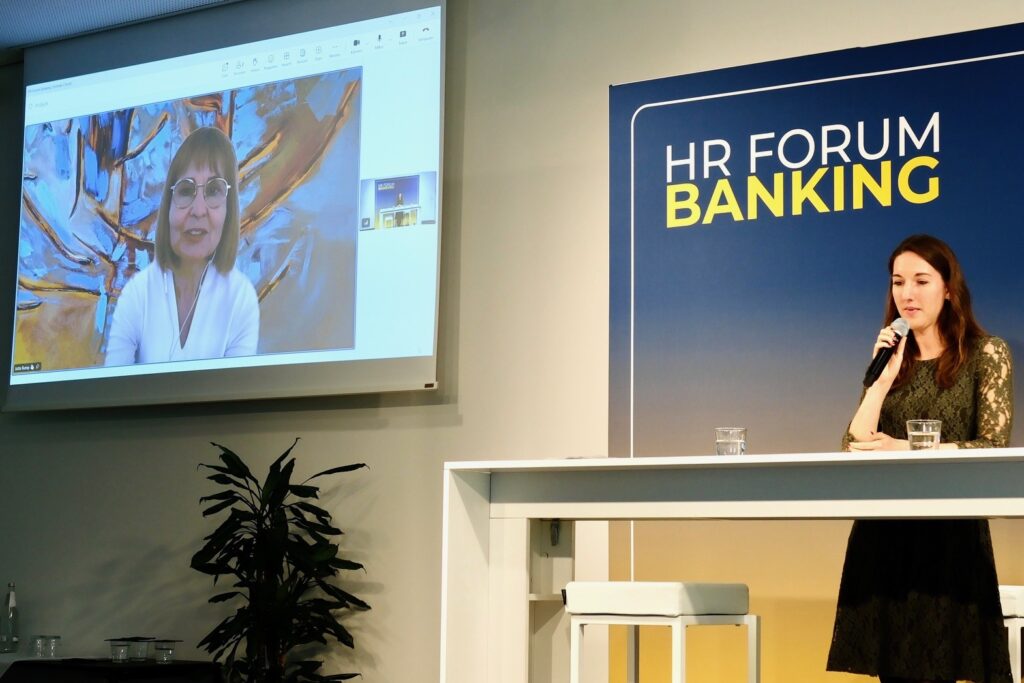
According to Rump, the AI transformation is also being driven by demographic change. According to the professor’s estimates, up to half of the positions in many banks will become vacant within the next five years due to retirement. “The demographic development will cover this development like a warm blanket,” says Rump. Any possible job cuts due to automation could be offset by natural fluctuation – at least if you plan in good time.
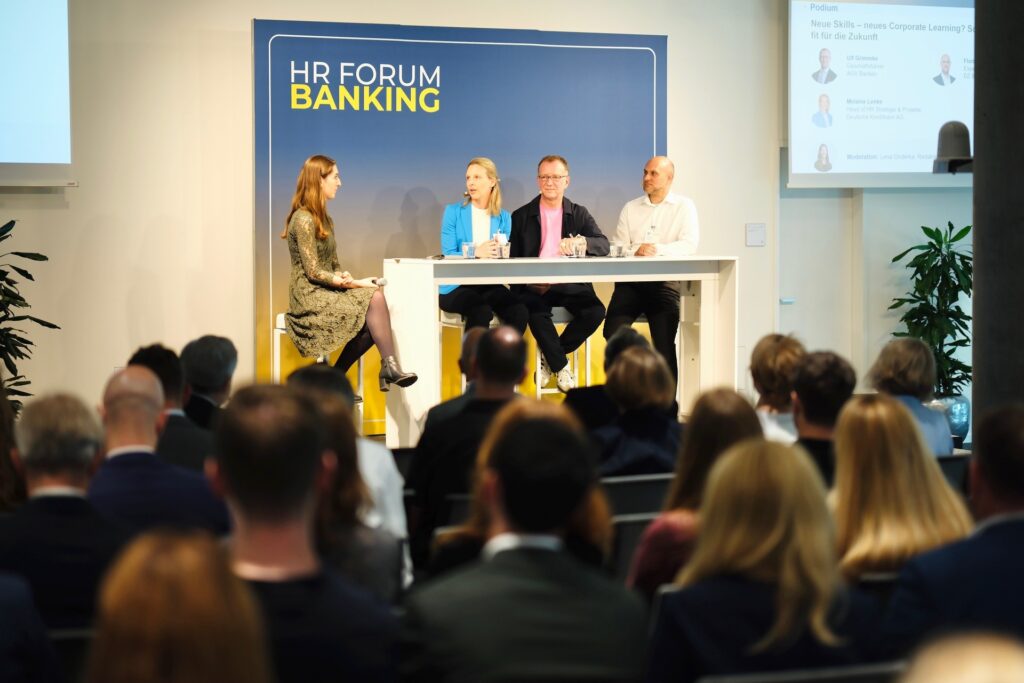
What then remains are capabilities that no tool can replicate. Melanie Lenke, Head of HR Strategy & Projects at Deutsche Kreditbank, Florian Hess, HR development expert at DZ Bank, and Ulf Grimmke, Managing Director of AGV Banken, agreed: It’s not just about knowledge of the application of AI, but above all about attitudes – curiosity, ability to learn, resilience. Grimmke added that validation and transformation skills are becoming increasingly important. This results in a clear task for HR: not to train individual tools, but rather to develop method and change skills that will survive the next technology change. An unsolved problem remains: AI is increasingly taking over the tasks that previously gave young professionals the opportunity to learn the basics. Anyone who no longer trains juniors today will not have any experienced specialists in ten years.
Compliance as a design task
Several sessions of the day revolved around one topic: how HR deals with regulatory pressure – and what happens when you actively shape it. Silke Lattermann, Head of HR Principles and Strategy at LBBW, and Oliver Baierl, Senior Principal at Mercer, showed how an equal pay analysis can be implemented internally without sensitive compensation data leaving the company. The analytical core: a risk analysis that reveals which salary differences cannot be explained. Lattermann’s insight: “If I only rely on the AI for programming, then I can no longer validate the result because I don’t know the basics.”
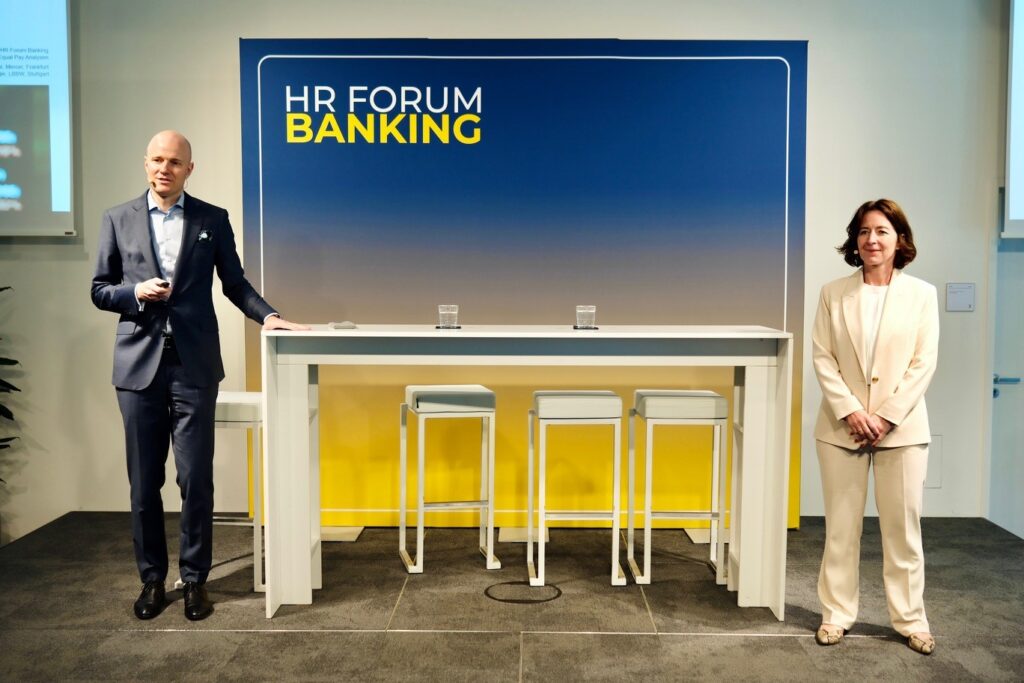
The Pax Bank case made it clear how extensive such projects become. According to consultant Christian Kossendey, senior manager at zeb Consulting, only 5 to 10 percent of German companies currently have a compensation system that complies with the EU Pay Transparency Directive. The Pax Bank was not one of them, where the discussion about equal pay acted as an accelerant for structural revisions: job descriptions, AT remuneration system, job grading, social plan. Daniel Reidel, head of organizational development and human resources at Pax Bank for Church and Caritas, summarized the effort humorously: “Say goodbye to friends and family when you do the project.” Christian Kossendey learned a lesson from this: “What is important is an authentic change story, the early involvement of all stakeholders and quick decisions.”
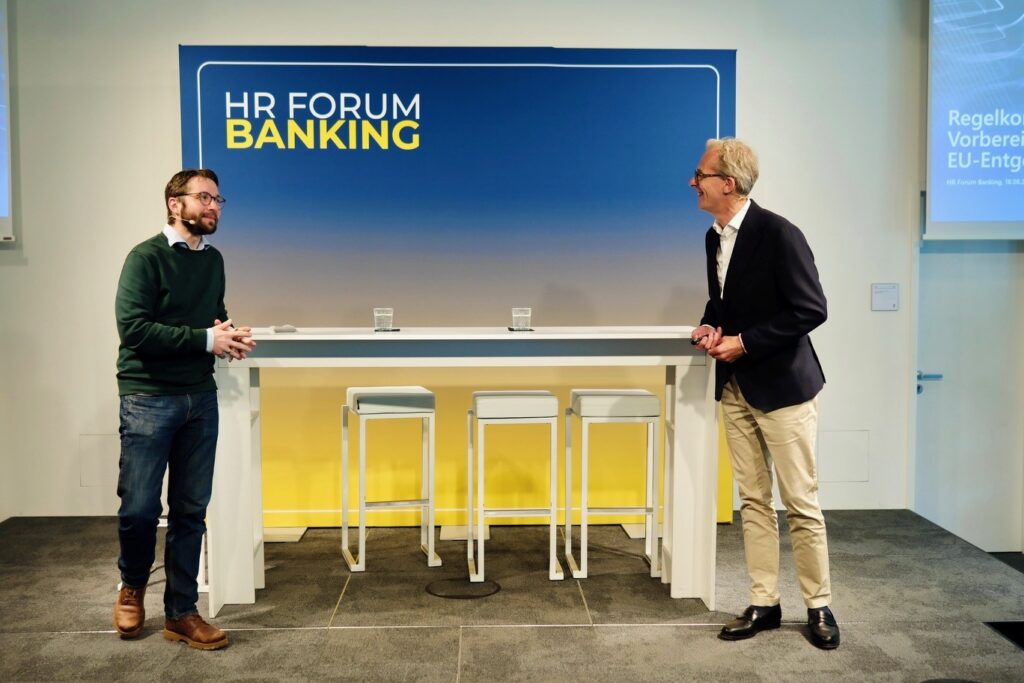
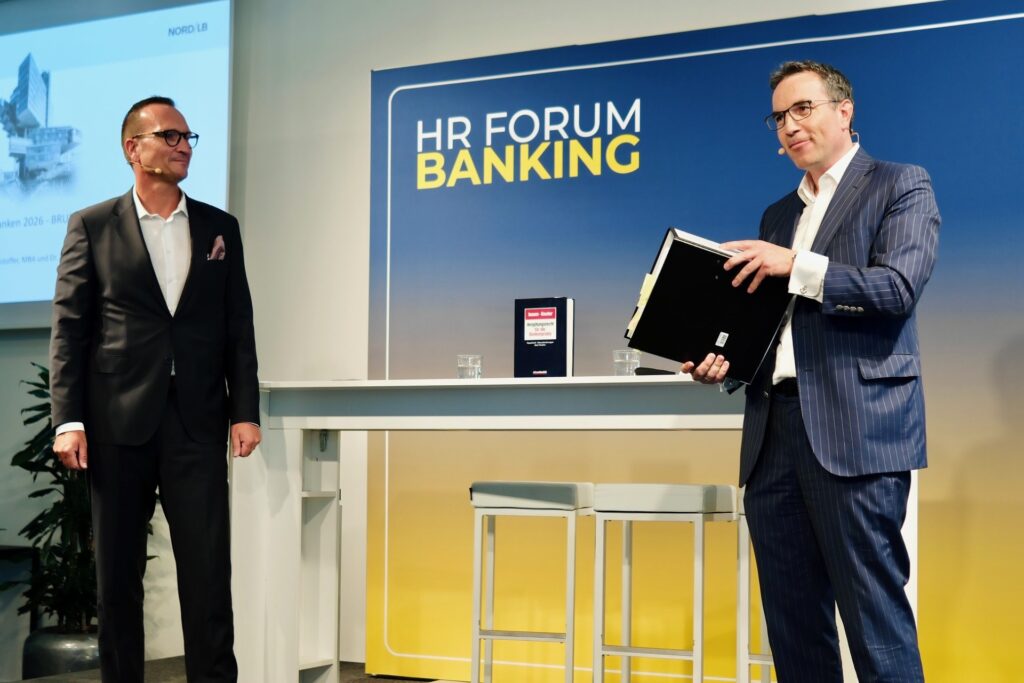
Less in the spotlight, but with considerable regulatory impact: BRUBEG. Dr. Thorsten Christoffer, Head of Human Resources, Legal and Executive Board at NordLB, and Dr. Alexander Insam, partner at the Görg law firm, agreed that the rules governing key functionaries are systematically underestimated. Insam warned: “It’s all interconnected. Like Lord of the Rings.” The same principle applies in all three cases: Regulation is not just a burden – it is an opportunity for HR to become visible as a strategic partner.
Strategic partnership means being able to disagree
In the panel with Isabel Jahn, Global Head of Human Resources ODDO BHF, and Christine Neuberger, Human Resources Director BW-Bank and Head of HR Landesbank Baden-Württemberg, the panelists emphasized what it is all about in the end: strategic relevance does not arise through self-assertion, but through substance. A few years ago the question was how HR could get more staff capacity. Today, business HR asks what skills employees will need tomorrow. Anyone who has a well-founded answer to this no longer has to demand their place at the table.
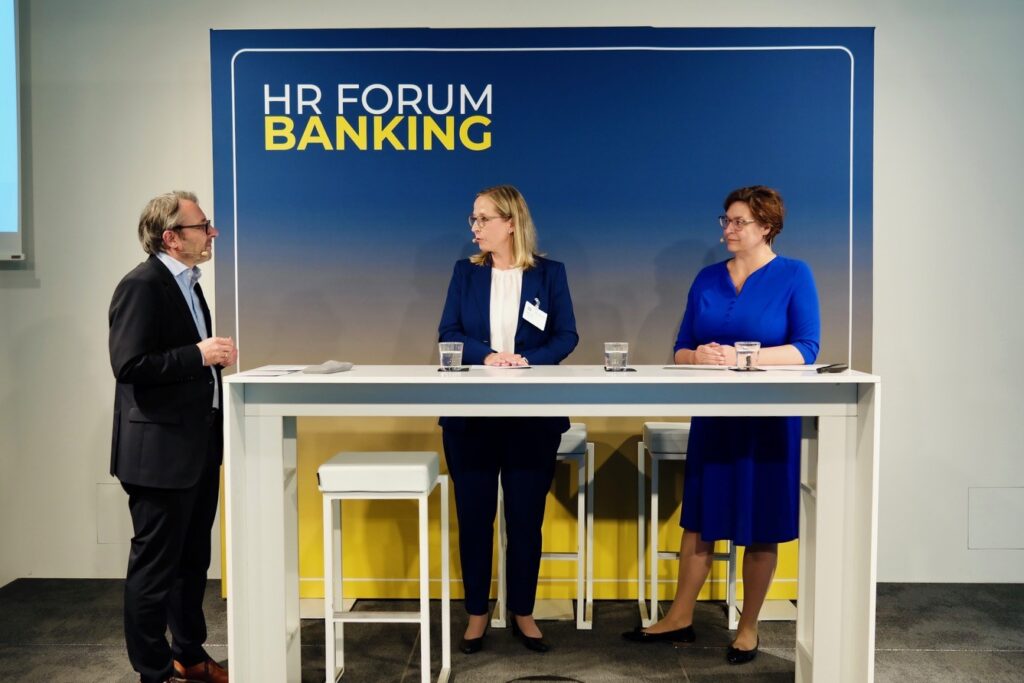
The prerequisite for this is evidence-based work and attitude. The added value also comes from “the fact that HR dares to contradict sometimes,” as Neuberger said. Regulation is not a brake, but “precisely the opportunity as an HR department to find the right path within this regulation.” Now, in a time of change, the potential exists not despite the framework, but within it.
Info
The HR Forum Banking will take place again next year, on May 11, 2027 in the FAZ Tower in Frankfurt am Main. Register now.
We would like to thank our partners Mercer, zeb, Görg and AGV Banken.