

“It’s very nice to have wolves and have others feed them,” complains Fernando Moreno, a 46-year-old rancher, when summarizing the feelings of his colleagues in the Sierra Norte of Guadalajara, and of himself, every time his cows and sheep suffer an attack from this animal. A problem, he says, that has worsened in the last 15 years. Moreno, like his colleagues, opposes the request that Ecologists in Action and the Fund for the Protection of the Iberian Wolf has sent to the Government of Castilla-La Mancha so that, within a maximum period of three months, it commits to implementing a recovery plan for this species throughout the autonomous territory, beyond the areas of Guadalajara where it is already present. Both organizations say this is what the state and regional laws on endangered species require, and the wolf has been cataloged as such in Castilla-La Mancha since 1998.
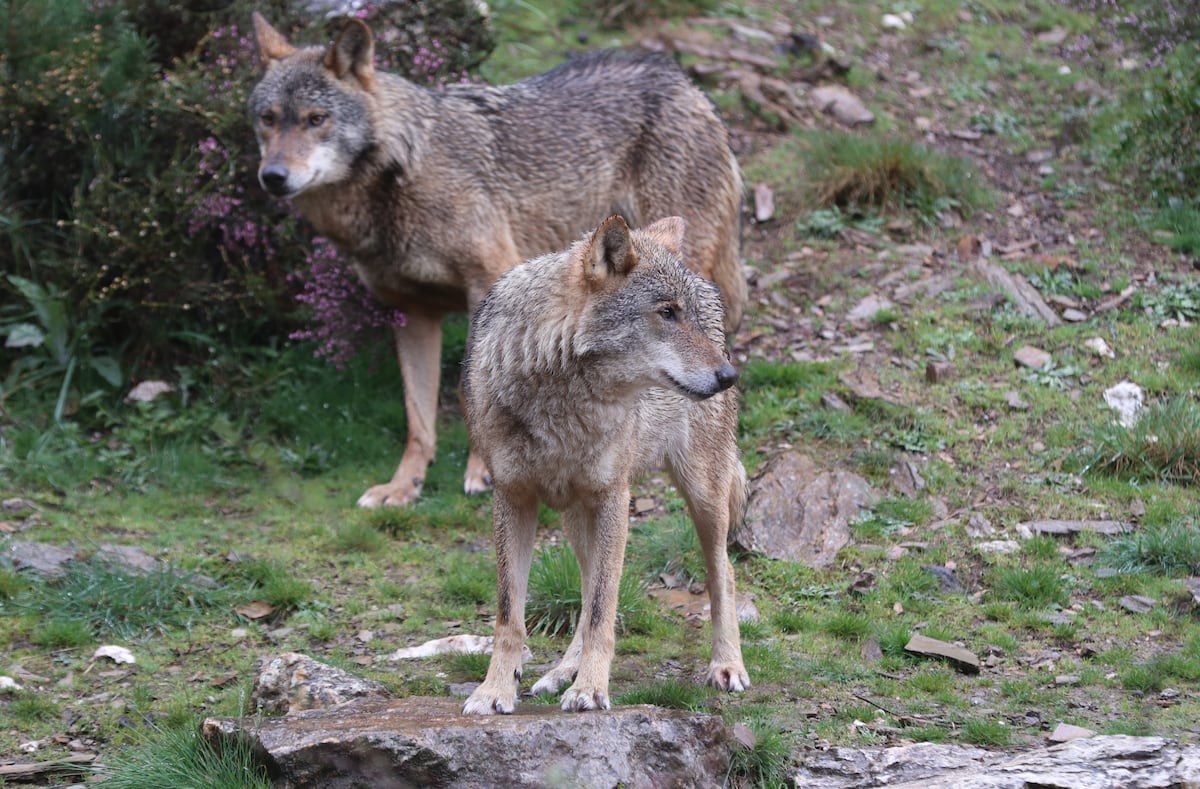
By that date, the last stronghold of the species in the region was already limited to this corner of the province of Guadalajara which, according to data from the Ministry for the Ecological Transition (Miteco) in 2024, houses the only four wolf packs present in Castilla-La Mancha, two of them shared with Castilla y León and the Community of Madrid. “We are not talking about conserving it only in the Sierra de Ayllón and surrounding areas, where there is already a better or worse focused level of action. We are talking about recovering those wolves that we had, not so long ago, in the Sierra Morena, the Montes de Toledo, the Tiétar Valley or the Alberche,” explains Miguel Ángel Hernández, spokesperson for Ecologistas en Acción in Castilla-La Mancha, who prefers to talk about “groups” and not packs. The organization speaks, at most, of 10 or 15 canids. “A ridiculous population that cannot be sustained by the image of damage to livestock that exists.”
The Association of Farmers and Ranchers of Guadalajara (APAG), however, draws a very different scenario, with 35 wolves and 198 attacks between 2022 and 2024. Too many, they point out, for such a small territory. An increase that also coincides with the inclusion of the wolf in 2021 in the List of Wild Species under Special Protection Regime (LESPRE) prepared by Miteco and which prohibits its hunting throughout the national territory with the exception – after a controversial vote in the Congress of Deputies in 2025 – for the communities located north of the Duero. Moreno, who estimates wolf attacks at around 10 or 12 each year on his cow herds in La Nava de Jadraque and Alcorlo, is president of the Sierra Norte Cattlemen’s Association and charges against the administrations for a situation that, he assures, “has gotten out of hand,” just as happens, he says, with vulture attacks.
The fact that the wolf has returned on its own to areas like Guadalajara does not exempt the Government of Castilla-La Mancha, Ecologistas en Acción insist, from developing a specific plan for the recovery of the species in the areas that it once occupied and that the regional administration discards. Two laws, the state law on Natural Heritage and Biodiversity of 2007 and the regional law on Nature Conservation, of 1999, support, the general director of Natural Environment and Biodiversity of the Board, Susana Jara, explains to EL PAÍS, that the conservation and recovery plans for endangered species are integrated into the management plans of the Natura 2000 Network spaces when their presence is limited to a single territory. In the case of the wolf, these measures, and their coexistence with extensive livestock farming, are included in the Sierra de Ayllón SPA (Special Protection Area for Birds), the only enclave with the presence of the canid in Castilla-La Mancha.
“This SAC/SPA has a management instrument that establishes the Iberian wolf as a key element. We have analyzed its conservation status, its distribution within that space, its future prospects, threats and pressures, and we have developed a calendar of actions to maintain its conservation status, with specific monitoring indicators,” explains Jara. “When a species is classified as in danger of extinction, the administration does not have the discretion to decide whether or not to prepare the recovery plan,” replies Sara González, lawyer for Ecologistas en Acción. “The wolf situation in Castilla-La Mancha is not like those images of Yellowstone, with dozens of wolves attacking bison. What we have here are family groups with four or five animals at most. There are no true packs,” says Hernández, who warns of going to court if the Board does not approve that plan.
In 2025, fifty municipalities in Guadalajara signed a manifesto led by APAG to demand “a change” in the management of the species. According to their data, 137 animals died from wolf attacks in 2024 and another 17 were injured. Added to them, Moreno points out, are the calves that disappear when the cows give birth in the field and for which they do not receive any type of compensation: 11 that same year. “Since we can’t find them, they don’t pay us for them,” remembers this rancher, who adds the abortions due to the stress caused by the wolf. The Board has increased premiums for dead cattle by 30% to adapt them to the market price, but the sector insists that they are still “insufficient.” Meanwhile, the canid, they say, continues its expansion, colonizing territories further south in the province of Guadalajara, such as the Cogolludo area. “The wolf is armored and there are more and more,” says Moreno.