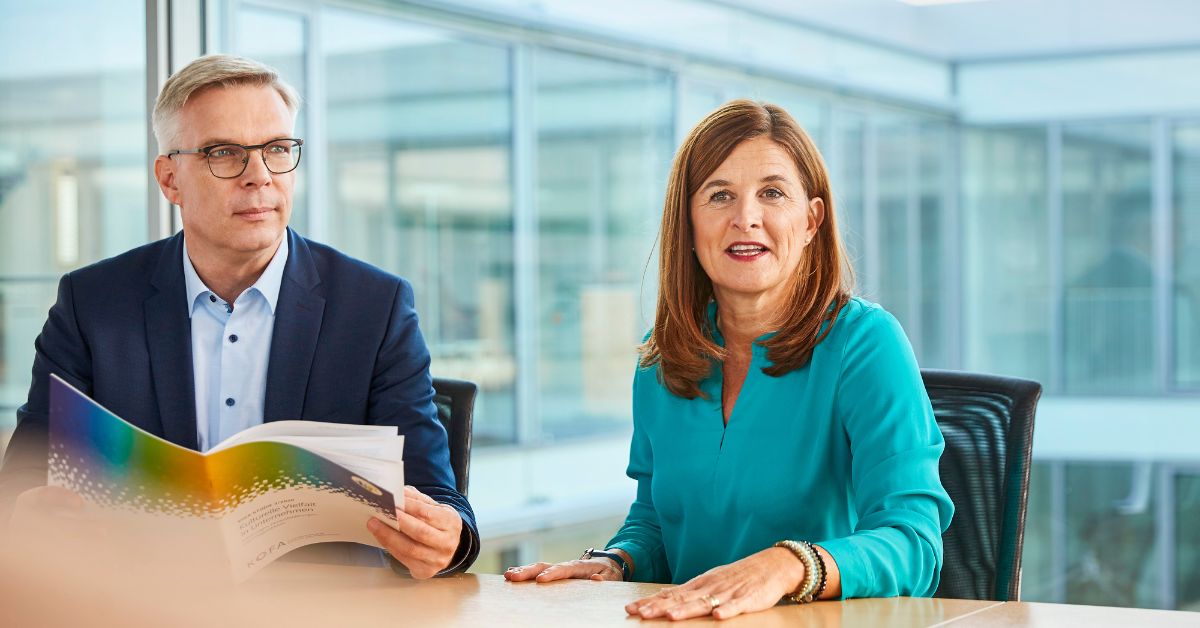




The proportion of women in the management of German family businesses is progressing only slowly. According to a current report by the German-Swedish Allbright Foundation, it remains at 13 percent among the 100 family businesses with the highest sales. In the past two years it has only increased by 0.4 percentage points.
There is also little movement in the recruitment of women: since March 2024, only 17 percent of new management positions have been filled by women. In addition, women (32 percent) are significantly more likely than men (24 percent) to leave family businesses. Why is that?
Recruitment continues to follow traditional patterns
According to the Allbright Foundation, the fact that the proportion is so low and that many women leave management positions in the family business is due to various factors. One of them is the recruiting process. From 2022 to two years ago, companies have appointed women to management positions more frequently. This increase has now almost come to a standstill.
A key reason for this is that women are still often selected according to a narrow, repetitive pattern. According to Allbright, the filling of management positions follows “traditional recruiting templates”. The report describes this mechanism as a self-reinforcing cycle: decision-makers still prefer to rely on “younger copies of themselves”, mostly men in their mid-50s from West Germany with a business or engineering background. Women and international or East German perspectives are often overlooked.
Internal recruiting also remains male-dominated
According to the report, women are also less likely to be promoted internally to the management of family businesses. While 40 percent of women are promoted from their own company to management, the figure for men in family businesses is 62 percent. This means that the majority of women are recruited externally. According to Allbright managing director Dr. Wiebke Ankersen points to weaknesses in talent management. Either the company’s own pipeline for female managers is not sufficiently filled or women in upper management are less likely to make the jump to top management, so that more external recruitment via headhunters is used.
Women are leaving leadership positions more often
In addition to the recruitment problem, the report points to difficulties in retaining female managers in family businesses. 32 percent of women on management boards of family businesses have resigned from their position in the past two years. For men it was only 24 percent. A different picture emerges in listed companies: around 23 percent of women left the company after taking on a management position.
According to the Allbright Foundation, this is also due to the corporate culture. Many family businesses still lack experience with mixed management teams. “If highly qualified women don’t get the opportunity to really help shape things, they look for other companies that are more open and dynamic,” says the foundation’s management.
Both are therefore needed: more female appointments and at the same time a change in the management culture. Family businesses not only need to bring more women into management, but also consistently invest in “a modern, open and participative management culture,” says Wiebke Ankersen. This is the only way diverse teams can really bring benefits.
Less transparency slows down diversity
According to the Allbright management, the proportion of women in leadership positions depends heavily on the transparency and influence of external actors. “The more private the company, the more male the leadership,” says the study. Listed companies are under greater pressure due to strict transparency requirements and public expectations than family businesses, which are more self-sufficient and operate more self-sufficiently. There are also legal requirements such as the Second Leadership Positions Act (FüPo II). This stipulates, among other things, that at least one woman must be represented in listed and co-determined companies with more than three board members.
This is also reflected in the numbers: the proportion of women on the boards of the 160 listed companies is 19.7 percent, and in the 40 large DAX companies it is even over 25 percent. In the 100 largest family businesses, however, it is only 13 percent and in non-listed family businesses it is only 11.1 percent.
According to Ankersen’s assessment, family businesses often lack external actors who question decisions. Strategic decisions therefore lie more with the owning family and their respective values and priorities. According to the Allbright managing director, if equal opportunities and diversity are not given high priority in leadership, there is hardly any external corrective action. This effect is further reinforced by the fact that family members often have a formative role in company management across an entire generation.
How more diversity can be achieved in leadership
Positive examples such as Jungheinrich, Otto and Merck show that the development of mixed management teams can be successful if the internal development of female talent and external appointments of women are strategically linked and consistently managed. As the managing director of the Allbright Foundation emphasizes, clear objectives for the proportion of women at certain management levels within a defined period of time are crucial. This is the only way to understand from an HR perspective whether measures are actually effective and where adjustments need to be made.
It also applies here that transparency and external expertise can be important levers. They can help to continually critically question and objectify promotion and recruiting processes. The more clearly the criteria are defined and the more standardized procedures are incorporated into the decision-making processes, the less influence of subjective assessments will be and the less likely it is that selection will continue to be made according to traditional patterns.
Susanne Dietz, human resources developer and consultant for the advancement of women, has already revealed further tips to our editorial team on how companies can promote women’s advancement in 2024. She emphasizes that companies should actively and naturally address issues such as career paths and family compatibility during recruiting. This included, for example, disclosing the existing development opportunities, flexibility models as well as expectations and limits. This creates credibility and trust, says the HR expert.
Building on this, mentoring and networking programs can help to specifically promote female talent and make them more visible and to strengthen collaboration between women. In addition, Anja Schulte, head of the cross-mentoring network OWL, pointed out to our editorial team at the time that flexible leadership models such as job sharing, part-time leadership or shared leadership roles were important instruments for making leadership compatible with different realities of life.
Info
About the Allbright Foundation
The non-profit Swedish-German Allbright Foundation (spelled AllBright) was founded in 2011 and is based in Stockholm and Berlin. The foundation’s current spring report was published on April 28, 2026 and analyzes the management and supervisory bodies of the 100 largest German family businesses as well as the boards of directors and supervisory boards of companies listed in the DAX, MDAX and SDAX. You can access the study here.

Mara Marx is a volunteer at Human Resources.