

The two underground galleries that linked Morocco and Ceuta to traffic drugs and that have been located by security forces in just over a year were designed by an alleged trafficker whom the Police have nicknamed the “narcoarchitect” or the “patron of the tunnels.” This is Mustafá Chairi B., a Moroccan businessman with a background and resident in the town of Fnideq (formerly Castillejos), neighboring Ceuta. Owner of several businesses, Mustafá Chairi B. was arrested on March 26 in the autonomous city in Operation Ares, which has allowed the dismantling of “the hashish network of networks” that he allegedly controlled, as highlighted this Tuesday by the Ministry of the Interior in a note. Along with him, 26 other people were arrested, including a relative identified as the leader of the organization and a retired civil guard.
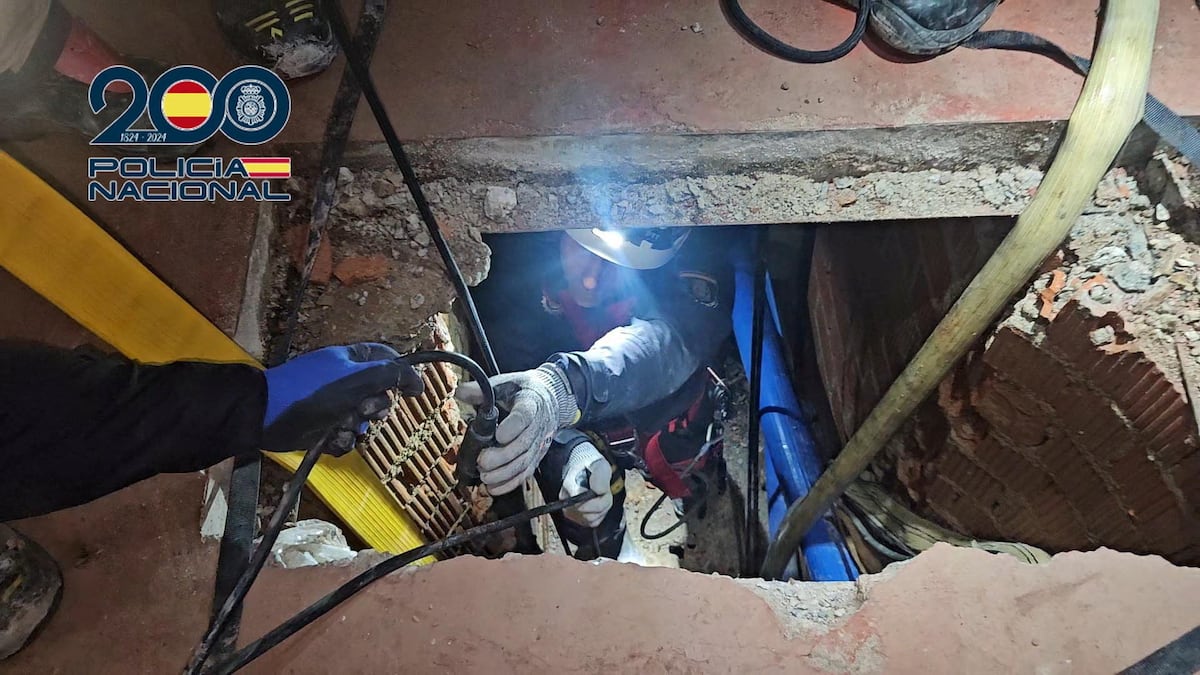
The images provided by Interior of the new narcotunnel show a “complex underground infrastructure” that the agents compare to the “labyrinth of a mine” and through which two tons of hashish a week could transit to Spain. “It is a very prepared, very conditioned narcotunnel, a narcotunnel specifically designed for hashish trafficking,” Commissioner Antonio Martínez Duarte, head of the Drugs and Organized Crime Unit (Udyco), stressed at a press conference this Tuesday. From here, the narcotic left for other European countries, mainly the Netherlands, where the “narcoarchitect” had family ties with members of the Mocro Mafiathe powerful criminal organization based in this European country.
Access to the gallery was in a warehouse in the El Tarajal industrial estate, just a dozen meters from the border fence with Morocco and, to find it, the agents had to move a large refrigerator behind which there was a door that gave access to a second warehouse that was soundproofed. There, Udyco agents discovered obvious signs that an area of the ground had been “touched,” that is, that work had recently been done there.
After lifting a layer of cement, the agents found a trapdoor that gave access to a passage organized into three different layers. The first level was the access gallery, 19 meters deep. The second or intermediate has been baptized by the agents as “narcodespensa.” It is a large hole in which “bales of hashish were stacked on pallets before being extracted outside.” The third and last was the passage that led to Morocco and was 80 centimeters wide and 120 high. Its total length and exit point have not yet been determined, as it is still flooded.
The businessman had provided the tunnel with elements worthy of “a work of engineering.” It had a system of pulleys, cranes, rails and two trolleys that allowed the pallets of hashish to be moved without the need for those operating at one end or the other of the passageway to have to see each other at any time, which increased security in the event of a police raid. Furthermore, to keep the structure operational in a terrain with groundwater that could flood it, he had installed “two powerful bilge pumps” that worked permanently and had soundproofed the ship so that the noise they generated would not raise suspicions.
The researchers highlight that the drug tunnel now discovered had a more complex structure than the one located in February of the year by the Civil Guard and that it was also managed by this alleged drug trafficker. That one had the entrance in an old marble factory without activity in the same El Tarajal industrial estate. It also had its own lighting system, its structure was weaker. Thus, the walls of that passage, excavated at a shallower depth, 12 meters, were covered with wooden planks – in the new one there are sections of masonry – the gallery was somewhat narrower (70 centimeters wide) and in some sections the height was reduced to 50 centimeters. There were neither rails nor wagons, and the carriers were forced to move on all fours to transport the bales of drugs.
Investigators believe that both narcotunnels became operational at the same time, and that the organization – described by Commissioner Martínez Duarte as “very, very powerful” – still kept the one now discovered in operation after learning of the discovery of the first by the Civil Guard. However, investigations indicate that the fear that the second infrastructure would also be discovered caused them to stop using it in September and block its entry into Spain. The agents highlight that it was precisely this lack of use since then that led to the water extraction pumps stopping, which has caused it to now be flooded and has made it impossible to explore it in its entirety. “It will take many days to pump out all the accumulated water,” admits a person responsible for the operation.
Land and sea route
The investigations have revealed that, after the first drug tunnel fell, the organization quickly adapted to the police coup and initially began to use the land route to deliver drugs to the peninsula in trucks that were loaded on ferries. In this sense, the “tunnel boss” boasted in his conversations about having bribed security force agents to allow vehicles to pass through port controls. However, the intervention last June in Almería of a large truck from Nador (Morocco) loaded with 15 tons of hashish hidden between pallets of watermelons and sweet potatoes, which were also stuffed with drugs, led the organization to look for other channels of introduction. To do this, it contacted an organization from the Línea de la Concepción (Cádiz) to start using High Speed Vessels (EAV, known as narcolanchas) to unload on the coast of Andalusia and through the Guadalquivir riverbed, as well as one from Galicia to use fishing boats to transport the caches to the north of the peninsula.
After the interception in November in Malaga of a van with 480 kilograms of hashish, the businessman supposedly considered reopening the narcotunnel “as the main method for the introduction of the narcotic into Spain,” as revealed by telephone interventions. Finally, last week, when it had not yet been done, the Police deployed made 27 arrests and 29 searches in Ceuta, Marbella (Málaga), Villablanca (Huelva), Los Barrios (Cádiz) and Pontevedra. Another 228 kilos of hashish, 88 kilos of cocaine, 1.4 million euros in cash, 66 communication equipment and 15 luxury vehicles were seized. Fifteen arrestees have been placed in provisional prison. Among them, the alleged narcoarchitect.