

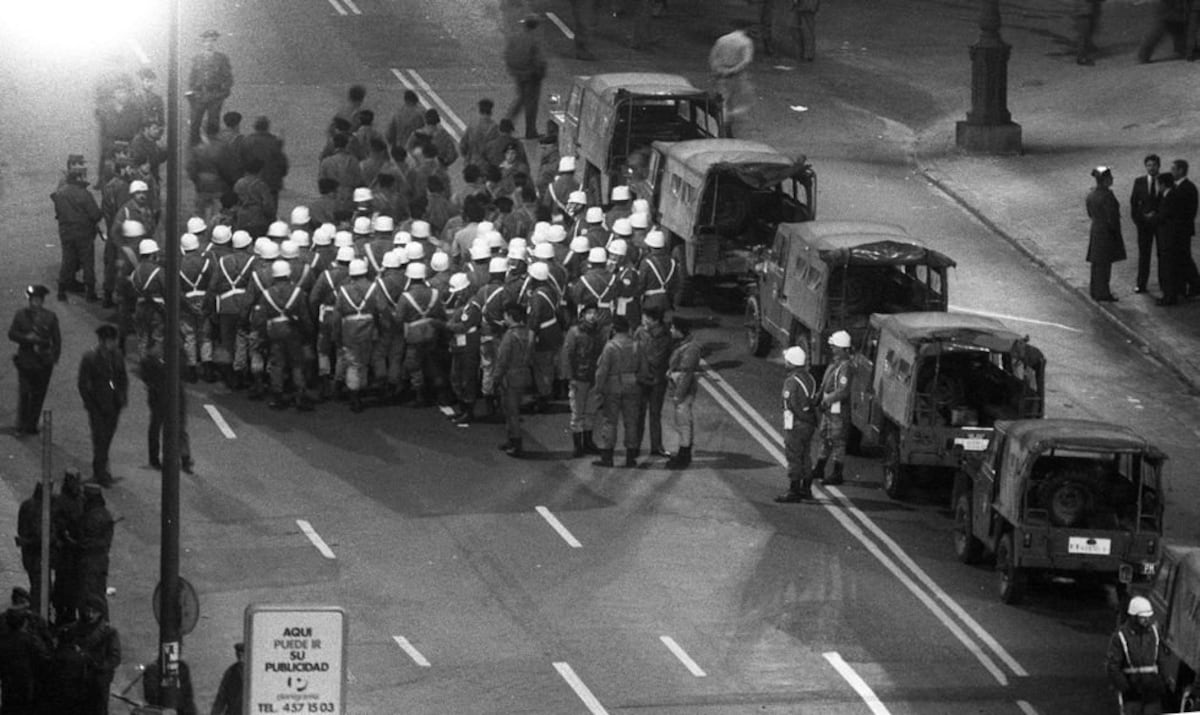
The Interior Brigade warned on March 18, 1981 that the then director of Change 16 and press chief of the Ministry of the Interior (who are not identified) were preparing a book about 23-F where they planned to “reveal various facets that had not been disclosed until now.” Specifically, he mentioned “the evaluation made of the planned assault by GEOS (Special Operations Group) agents on the Congress Palace.” “The operation was estimated to result in between 80 and 110 deaths,” the text states. As he explains, “one of the aspects that stopped it was the fact that” a person, whose name appears crossed out, “would remain in an office immediately next to one of the penetration routes studied.”
It is one of the conclusions drawn from the documents declassified by the Government and published on the La Moncloa website this Wednesday about the attempted coup d’état on February 23 led by Antonio Tejero – who died this Wednesday at the age of 93 -, coming from the archives of the Ministries of Defence, Interior and Foreign Affairs.
In addition, he noted that “the authors of the book consider the thesis that the military coup was based on Operation Ariete”, designed “during the time of (Luis) Carrero Blanco” as President of the Government. That plan “consisted of two parts: power vacuum and mass disorders”, but “this second was stopped in Barcelona after 6:00, when a street call by CC OO and UGT was annulled.”
Among the papers that refer to the trial against those responsible for the failed riot, one advises displaying “fair play” to guarantee the credibility of the process inside and outside Spain. In another text, handwritten and which seems to include conclusions of the military commanders after the failure of the coup, it is highlighted that one of the main errors had been “leaving the Bourbon free and dealing with him as if he were a gentleman.”