






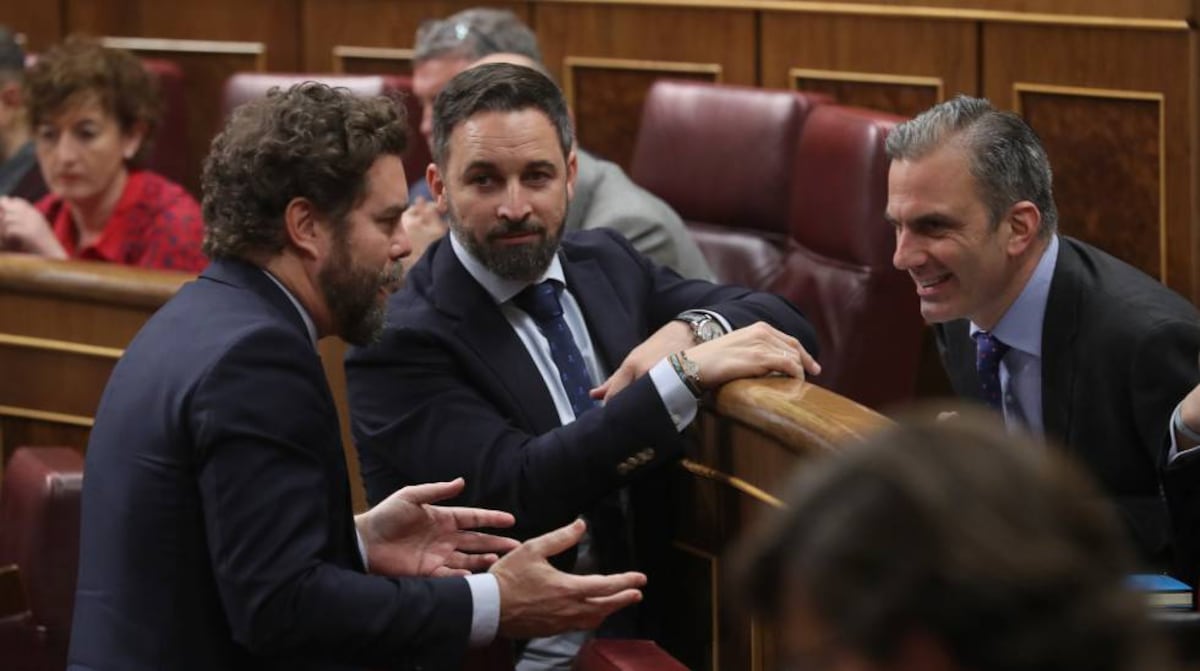
This Sunday’s elections in Castilla y León will have an internal reading in the space of the extreme right: they will serve as a plebiscite on the leadership of Santiago Abascal. And not only because, as in Extremadura and Aragón, the president of Vox has been the undisputed protagonist of its electoral campaign, relegating the candidate to the background, but also because the campaign has been marked by the purge of some of the party’s best-known figures, such as the still spokesperson in the Madrid City Council, Javier Ortega Smith, or its former leader in Murcia, José Ángel Antelo.
Vox sources believe that, if the forecast given by the polls is confirmed – around 20% of the votes, with a strong increase in seats, compared to the decline of the PSOE and the stagnation of the PP – Abascal’s figure will be strengthened. Vox works like a company, pyramidal and centralized, and the electoral result, like the income statement, will dictate an unappealable verdict on the success or failure of its management. The same sources venture that the criticisms will be refuted by the data and discredited in the face of a leader who can show in his balance sheet directing the party that has grown the most in the last three appointments with the polls. It matters little that Vox is still far from obtaining the results of its counterpart formations in France, Italy or Germany; or that the Portuguese Chega!, who entered the institutions years after Abascal’s formation, is the second force in his country. Not even in July 2023, when it lost more than a third of its deputies, did Vox make public self-criticism.
This time, however, Abascal’s team faces an unprecedented challenge: Iván Espinosa de los Monteros, its former spokesperson in Congress, has requested the holding of an extraordinary congress to debate the strategic positioning and internal functioning of Vox. The former parliamentarian maintains that the organization he founded 12 years ago has experienced an “illiberal and statist turn” and is directed from the shadows by “a tiny group of people unknown to the general public, who do not belong to the party but are the ones who make the decisions.” Although Espinosa assures that the objective of the congress would not be to replace Abascal, the Vox leadership has reacted as if it were a hostile maneuver.
The person in charge of disqualifying the dissidents has been José María Figaredo, Vox’s number two in Congress, who has accused his former boss – Espinosa led the parliamentary group when he was a rank-and-file deputy – of being an instrument of the PP. “The one who is proposing it,” he said on Tuesday about the proposal for an extraordinary congress, “is the Popular Party through a former Vox spokesperson whom they are using. Those who want this congress are seeking to place a PP puppet in Vox.” Without citing his former party colleague, Abascal elaborated on the same day in Astorga (León) that “all these attacks on Vox are not internal, they are external attacks from those who are outside Vox, in other parties, and cannot stand Vox doing well.” In reality, those considered dissidents – Iván Espinosa de los Monteros, Juan García-Gallardo, Javier Ortega Smith and José Ángel Antelo – remain affiliated with Vox, at least until the expulsion of the last two is completed, and none of them have been active in the PP, unlike other members of the party leadership, including Abascal himself.
After the closure of the leadership, the calling of an extraordinary congress is materially impossible. According to the Statutes, its celebration can only be forced “at the written request of at least 20% of the full members”; That is, those who have been there for at least nine months and are up to date with the payment of fees. It is not known how many affiliates Vox has. In a recent intervention, Abascal spoke of 68,000. The last known accounts of the formation, corresponding to 2024, put them at 65,615, but recognized that less than half, 32,022, paid their dues.
To collect the signatures of the members, in favor of holding an extraordinary congress, the promoters of the initiative would have to be able to personally address each of them. But the list is only in the possession of the national leadership which, in view of Figaredo’s statements, does not seem willing to provide it. If a dissident obtained it, they could be accused of violating data protection law.
The ultra party must hold its ordinary assembly, equivalent to the annual congress, before June 30, with the aim of approving its accounts and sending them to the Court of Accounts. By then, Vox will have already cleared the question of whether it re-enters regional governments with the PP, which will mark its political course in the medium term. Also, unless Abascal chooses to bring forward the assembly, it will be possible to take stock of the complete cycle of regional elections, including the Andalusian ones, scheduled for mid-June. In these circumstances, instead of holding a purely formal congress, Espinosa’s initiative could make way for a substantive ideological debate. However, this possibility once again comes up against the Vox Statutes, which also require the signature of 20% of the members to include a new point on the agenda of the assembly.
Those in favor of Vox holding a congress in which members debate the party’s line and are not limited to voting electronically on the leadership’s proposals—the ratification of Abascal as president until 2028 was not even voted on, since he was the only candidate who presented—acknowledge that in practice it is not possible to convene it if the National Executive Committee (CEN) opposes it. But they also believe that the initiative cannot be dispatched with a disqualification of its promoters, as has been done until now, and will remain on the table until it is addressed head-on. Although Abascal is crowned again this Sunday as the political winner of the elections.

