





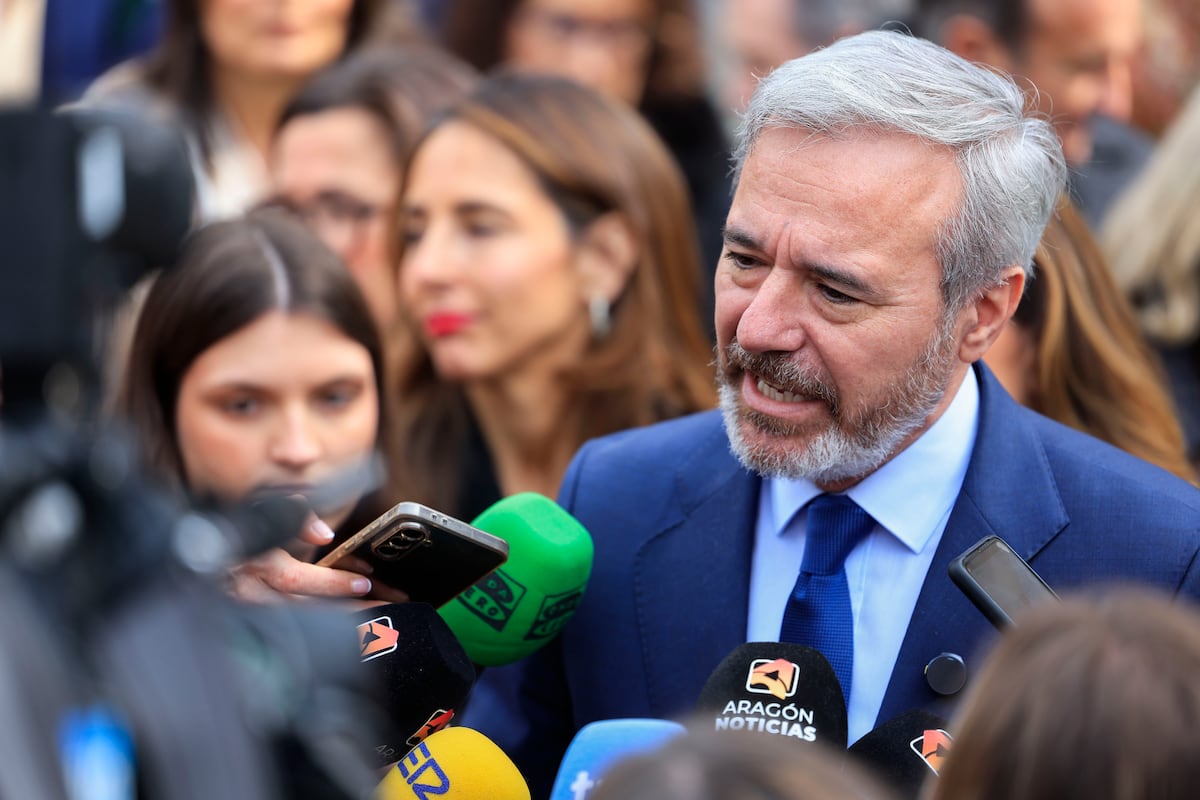
The television cameras caught the acting president of Aragon, Jorge Azcón, by surprise, two weeks ago with a serious gesture on the street of Génova. The popular candidate in the last Aragonese elections had just left the national headquarters of the PP, where he held a meeting with the general secretary, Miguel Tellado, just a few hours after the leadership of the Popular Party confirmed that it was going to get involved in the negotiations with Vox to form a government in both Extremadura and Aragon and thus “take” the “reins” of the conversations. As this newspaper published, Alberto Núñez Feijóo’s turn towards the protection of the pacts generated resistance in the territories. Now, these misgivings are already verbalized in public by the regional presidents, who seek to mark their autonomy from the leader of the PP.
This is what happened this Wednesday. “Everyone who knows me knows that I am going to carry out these negotiations personally,” Azcón stressed at the event for the European Day of Victims of Terrorism, in Zaragoza. “Exactly the same thing is going to happen in Castilla y León as in Aragon in what has to do with the negotiations,” added the acting Aragonese president, who separated the conversations in his community from those of the Extremaduran candidate, María Guardiola. “Extremadura is Extremadura and Aragón is Aragón; it is evident that in Aragón we are going to make our own decisions. We are going to work so that there is a government as soon as possible,” he stressed.
His position contrasts with the approach made by Génova to become part of the negotiations to reach a global agreement after the obstacles posed by Vox in Extremadura to Guardiola. The national leadership of the PP did not want Azcón to go on his own, but rather for the entente to include all the pieces of the regional puzzle in contention, and with the mediation of both Tellado and Feijóo’s chief of staff, Marta Varela. And with a document common to all as a starting point to lay the foundations for the agreements.
In Aragón, unlike in Extremadura, Azcón’s relationship with the ultras is good and a priori everything seemed like it was going to go smoothly. But for now it is stuck. “There have been contacts since the first weeks, but this agreement is very incipient and we still need to work more and better,” said Alejandro Nolasco, leader of Vox in Aragón, this Wednesday within the framework of the round of contacts with the newly appointed president of Las Cortes, the popular María Navarro.
Azcón’s claim of his autonomy from Génova occurred when he responded to questions from journalists about the interview of another baron, Alfonso Fernández Mañueco, published in this newspaper this Wednesday. “Génova is not going to participate in the negotiation of Castilla y León,” responded the PP candidate for next Sunday’s elections. “I am in favor of negotiations always taking place as close to the territory as possible,” the president of Andalusia, Juan Manuel Moreno Bonilla, had already defended in the first days in an interview on Cadena SER.
In Aragon, the maximum limit for not repeating elections is next May 3, one day earlier than in Extremadura, because the electoral clock starts ticking on the day of the constitution of the autonomous Assembly. While in Extremadura it depends on the first vote of the investiture session, which was failed in a double round with the vote against Vox last week. The ultras deflected the shot and attacked Genoa as the problem for not shaking his hand. This Wednesday, Santiago Abascal responded to Feijóo, who a day earlier had questioned whether the ultra leader was a “patriot” for blocking the autonomous governments. “I don’t know if I have enough patriotism, but Feijóo Spain is too big for it,” Abascal snapped.
The Iran War
The outbreak of the war in Iran has also shaken the board of national and territorial politics. Some popular barons have spoken out against the United States attacks more explicitly than Feijóo and at a great distance from the president of the Community of Madrid, Isabel Díaz Ayuso. Last Thursday, the president of La Rioja, the popular Gonzalo Capellán, called for sanity “of those responsible institutionally” to prevent conflicts “from having undesirable consequences for anyone and to protect the interests of citizens.”
Already this Monday, the president of the Xunta de Galicia, Alfonso Rueda, completely distanced himself from Ayuso when asked about the popular baroness’s support for Donald Trump. “What specific people do will have to answer for themselves. You will understand that it would make a lot of sense to judge what certain people do who do not represent all of us, they represent their area,” Rueda replied. “Here we say no to war, without a doubt, but we also say yes to international commitments and not to the personal conveniences, as always, of the President of the Government,” Rueda added this Wednesday in a debate in the Galician Parliament.

