


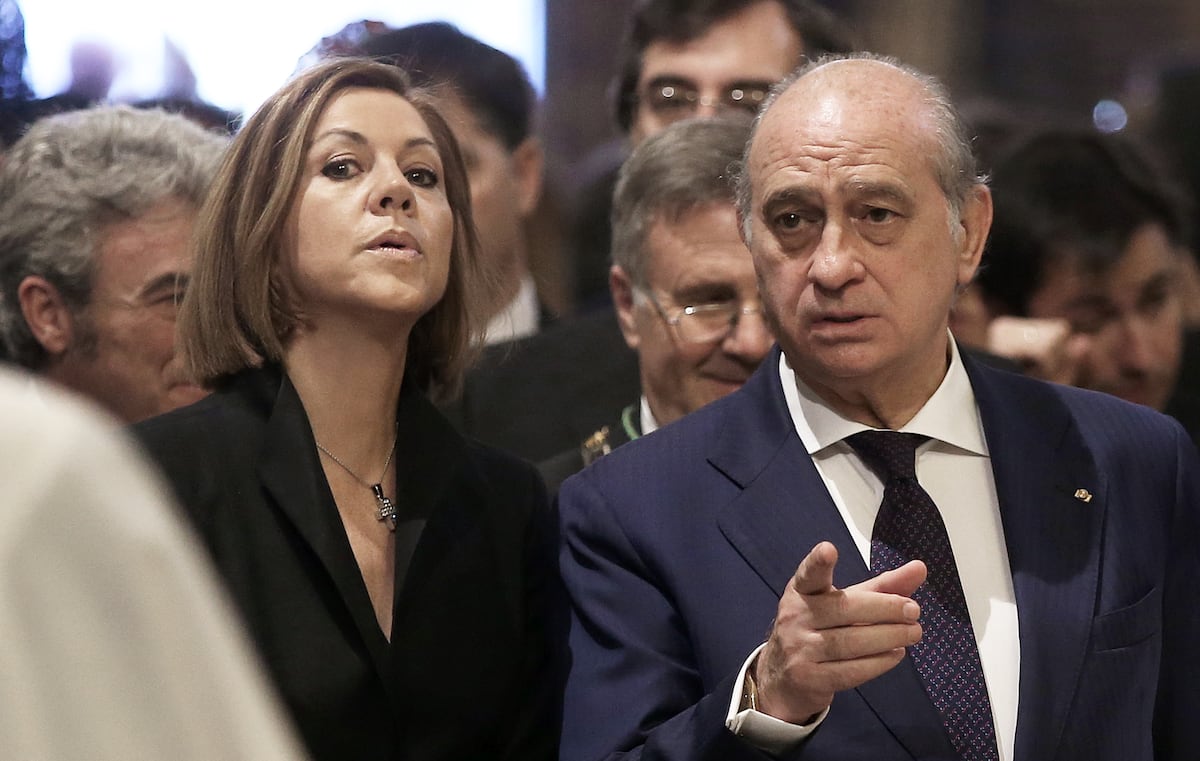


On January 26, 2009, when a limited number of officials from the Economic and Fiscal Crime Unit (UDEF) of the National Police were secretly investigating the Gürtel casean obscure commissioner unrelated to that group of agents and accustomed to moving in the shadows and splashing through the sewers, José Manuel Villarejo, reflected in his agenda a suspicious contact that he had that day with Ignacio López del Hierro, then husband of the general secretary of the PP: “He called to see us. The relative María Dolores de Cospedal wants data to make decisions.” There were only 11 days left until the first arrests of the plot, with businessman Francisco Correa as the main ringleader.
In those days before the outbreak of the case, Villarejo was already handling confidential data about the secret case. And both then and in the following months, he was in charge of moving them between PP positions. This is evidenced by his recordings and his methodical personal notebooks, which show how the maneuvers within the party began long before the conservatives settled in La Moncloa (with Mariano Rajoy in 2011) and also before they took control of the Ministry of the Interior, where the so-called Operation Kitchen was activated in 2013, the espionage plan without judicial control of the former popular treasurer Luis Bárcenas to supposedly steal compromising material from the formation that he could still save, in order to boycott the Gürtel case. A plot that has been tried since this April in the National Court.
The oral hearing began on Monday with the printing of part of the accusations that the Kitchen case arrives decaffeinated at this stage. The National Court has made it clear that the trial focuses on the alleged illegal activity carried out by the former members of the Interior and the Police who sit in the dock, with former minister Jorge Fernández Díaz at the head. Anything that goes beyond is left out. Despite the fact that throughout the investigation the thesis that high organic officials of the PP, such as Cospedal, “supervised” the plot or “encouraged” it, hovered. A hypothesis defended by the Anti-Corruption Prosecutor’s Office, but which the investigating judge Manuel García-Castellón rejected due to, according to him, a lack of evidence. Or, even, despite the fact that the investigation put on the table the possibility that Kitchen was not the only attempt to boycott Gürtel.
In the sessions dedicated to the preliminary issues phase of the trial, held on Monday and Tuesday of this week, the PSOE, involved in the case, made a last attempt to reopen that avenue. In search of a loophole, the socialists asked the court – chaired by Judge Teresa Palacios – to suspend the hearing and return the case to the investigation to investigate the “political leg” and, specifically, the possible involvement of the former general secretary of the PP. “I think there have to be other people sitting on the bench,” the party lawyer insisted. However, the judges denied that possibility.


01:26
The PSOE insists on investigating Cospedal again in the Kitchen case
“If the case has been dismissed for a person, any reopening is not done before the trial court, but before the instructor,” Palacios summarized when responding to the PSOE, thus putting a stop to that path. A position that the Prosecutor’s Office shares, despite the fact that it continues to suspect that there were more people involved in Kitchen (its indictment insists that the intervention of other people cannot be ruled out) and despite the fact that it promoted the indictment of Cospedal at the time.
The public ministry considers that, at this point, the trial court (which belongs to the Fourth Section of the Criminal Chamber of the Court) “does not have powers” to reopen the case against the former general secretary of the PP; and that, if you want to resume that line, you must go to the investigative court that directed the investigations—number six, now headed by Judge Antonio Piña (after the retirement of García-Castellón in 2024) and whose decisions in this case were reviewed by the Third Section of the Chamber.
But that path has already been tried. Without success. In fact, to understand this convoluted procedural skein, we must go back to July 29, 2021, when Judge García-Castellón surprisingly ended his Kitchen investigations, limiting all responsibility to the Interior and ruling out the so-called “political connection” (which implied discharging Cospedal). By then, the Prosecutor’s Office was already convinced that, since 2009, the PP had launched a series of maneuvers to “reduce damage” for Gürtel and “protect” its senior officials. In fact, just 13 days before the judge’s resolution that put an end to the investigations, the public prosecutor’s office had sent him a letter to delve deeper into that thesis and expand the summary far beyond what had been done up to that point.
Judge García-Castellón, however, rejected the approach of prosecutors César de Rivas and Miguel Serrano: “At this point the instructor must accentuate his evaluative function, purging those suspicions that, despite being introduced in the process, fail to pass through the sieve of evidence, dying in the nebulous plane of the hypothetical, without finding their reflection under the brilliance of possibilities close to certainty,” he argued. The accusations then turned to the Third Section of the Criminal Chamber, which agreed with the magistrate in April 2022 and left the way free to seat exclusively the former Interior officials of the Government of Mariano Rajoy on the bench.
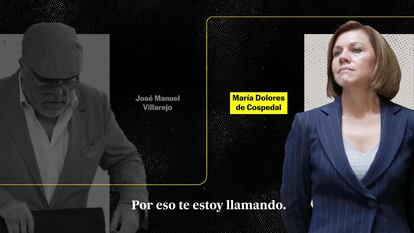
Although there was still another script twist to go. A month later, EL PAÍS published a new audio of a telephone conversation between Commissioner Villarejo and Cospedal, where she tells him: “That’s why I’m calling you… the little booklet (from Bárcenas)… it would be better to be able to stop it.” That conversation was dated January 20, 2013. Only 11 days later, this newspaper published the so-called Bárcenas Paperswhich revealed the existence of the party’s box b (as the court considered proven years later, when prosecuting this parallel accounting within the Gürtel case).
06:53
The secret audios of corruption | Part 1
After this audio was revealed, the accusations (including the Prosecutor’s Office) returned to address the investigating judge and the Third Section to reopen the case against Cospedal. Anti-corruption proposed continuing with the trial against the Interior and Police leadership, and opening an “encore piece” focused on whether there were other “relevant members of the PP, then in the Government of the nation,” who participated in Kitchen. Specifically, the public ministry’s letter pointed especially against Cospedal, whom it accused of having lied during the investigation about the contacts she had maintained for years with Villarejo: “The true purpose of these meetings was to follow up on the news and progress of the investigation of the Gürtel case“, going so far as to give the police instructions to recover and (make) disappear Luis Bárcenas’ notebook, whose notes could affect irregular financing of the PP.”
But, again, the accusations fell apart. The instructor dismissed his claims, and the Third Section endorsed him again in 2023. The court minimized the value of the new published audios, of which he said he “did not know their context.” Since then, nothing has moved. Nor has García-Castellón’s successor, Antonio Piña, agreed to reopen a case against Cospedal: in January he rejected another similar request from the PSOE.
The maneuvers since 2009
The summaries of Kitchen case and of Villarejo case They show that the nervousness within the PP began in 2009 and intensified as the party and its former treasurer became closer. For example, the National Court opened a parallel investigation, closed by García-Castellón in 2024 due to lack of evidence, into another alleged plan hatched to pressure the lawyer Javier Gómez de Liaño, who was defending Bárcenas.
The Internal Affairs Unit of the Police also located other documentation that indicates that in 2012, before the Interior device was launched, Villarejo received another private order that he baptized as the SMP Project, budgeted at 15 million euros and which had the objective of “annulling” the Gürtel case. The Prosecutor’s Office links this maneuver with the deceased Ignacio Peláez, who was the lawyer of several investigated people close to the PP. Bárcenas even said that Peláez visited him one day in prison: “And he wrote to me that there was a possibility of dismantling the entire case.” This SMP Project is included in passing in Kitchen’s trial, since its authorship is attributed to Villarejo, but the clients behind it were never delved into.
Another striking episode that has been left out of oral hearing is the strange assault that a man disguised as a priest, Enrique Olivares, carried out in October 2013, when he entered the former treasurer’s house and kidnapped his family while he was looking for, as he said, sensitive papers that could bring down the Rajoy Government. García-Castellón found no indication that he was connected to Kitchen and Bárcenas’ lawyer ruled out accusing him this week. It was one of the topics that the Prosecutor’s Office wanted to investigate further in July 2021, when the investigating judge closed the investigation. “Data appears that allows us to delve deeper into the possible participation of Olivares in the assault on the Bárcenas family home under the direct control of the police commanders who carried out Operation Kitchen; or, even, under the control of other State security services,” Anticorrupción wrote then.

