




The educational conflict in Catalonia has signs of becoming entrenched and worsening. The first meeting between unions and the Government after last week’s massive strike ended this Thursday without changes: the Department of Education refuses to improve the pact signed with CC OO and UGT – minorities in the education sector -, while the majority of unions – Ustec, Aspepc, CGT and Intersindical – consider the agreement insufficient and demand to go further, reinforced by the response of the collective in the strikes. After this Thursday’s meeting between the unions and the Presidency advisor Albert Dalmau, the social side has reaffirmed its threat of new mobilizations in the third quarter of the course.
Once the meeting was over, the Secretary of Educational Improvement, Ignasi Giménez, declined to take a step further. “We are focused on the deployment of the agreement, because it responds to the demands of the sector,” he assured, and invited the unions to return to the sectoral table, after they did not attend this Thursday. “Let them return to the table so that we can concentrate on these measures (those of the agreement),” he requested, refusing to address the unions’ demand.
For their part, the unions insist on the request to reopen the negotiation. “If they think that the sectoral table is the appropriate space, they should convene one to talk about it,” said Ustec spokesperson, Iolanda Segura. Despite admitting that it has been “a not very productive meeting,” Segura has been optimistic: “If the mobilization has allowed this meeting to take place, it will also force this space for negotiation to be opened.” Otherwise, he has warned that new strikes will be called and has reminded the Government that “the group is very organized.”
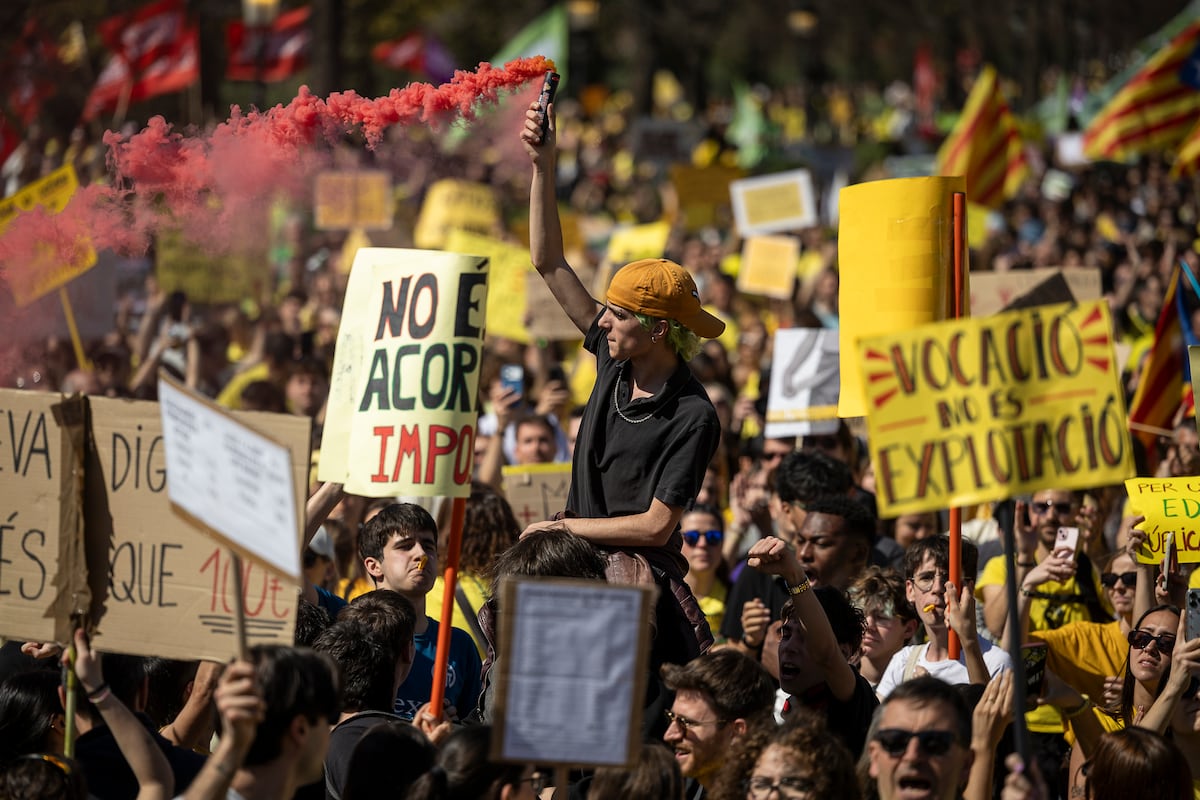
The Government has been pressured and forced to meet with the four unions after the show of force they showed last week, being able to sustain a strike during a week in which thousands of teachers took to the streets daily in each of the territories and about 35,000 on Friday in Barcelona. Furthermore, it arrived a month after another massive strike on February 11, and with the threat of new mobilizations during the remainder of the school year, which also seem important given the level of anger and fatigue that classroom teachers – beyond the unions – express due to, basically, the lack of personnel to care for students with difficulties, the high ratios, the excess of bureaucracy and the partially frozen salaries.
The teachers consider the pact with CC OO and UGT “insufficient”, because it is not known where the 2,000 million investment will come from, because the salary supplement is increased by 30%, and not the 100% that they demanded or because the drop in the ratio only affects the ESO and not all the centers.
After the mobilizations, the four unions had called the Government to a meeting on Tuesday morning, although it coincided with the weekly meeting of the Consell Executiu. The Government summoned them this Thursday afternoon, separately and one after the other, for this Thursday afternoon. But the union representatives have presented themselves together because they assure that they do not accept individual negotiations.
Directors file appeal
Another front that the Government has to deal with is that of the addresses. The group rejects the point of the educational agreement that implies reducing from 7,000 to 2,500 those known as profiled places, which are those occupied by interim teachers, not according to the order of the lists, but according to their profile and which are designed by the management to find specialist teachers (for example, teaching Mathematics in English), thanks to the call template decree. Furthermore, they do not see it as acceptable that unions should be present at interviews to select personnel.
For all these reasons, the Axia association, which brings together more than 300 directors, presented this Wednesday an appeal for reconsideration of resolution EDF/570/2026 published in the DOGC on March 5, which regulates the process of providing places. The entity considers that “the prohibition of proposing interim personnel is an incomprehensible and contrary decision to the template decree” and that it represents a “regression in the autonomy of the centers” and limits the role of the managements, in a way that leaves them with no margin to be able to choose the teachers with the most suitable profile to implement their educational project.

