


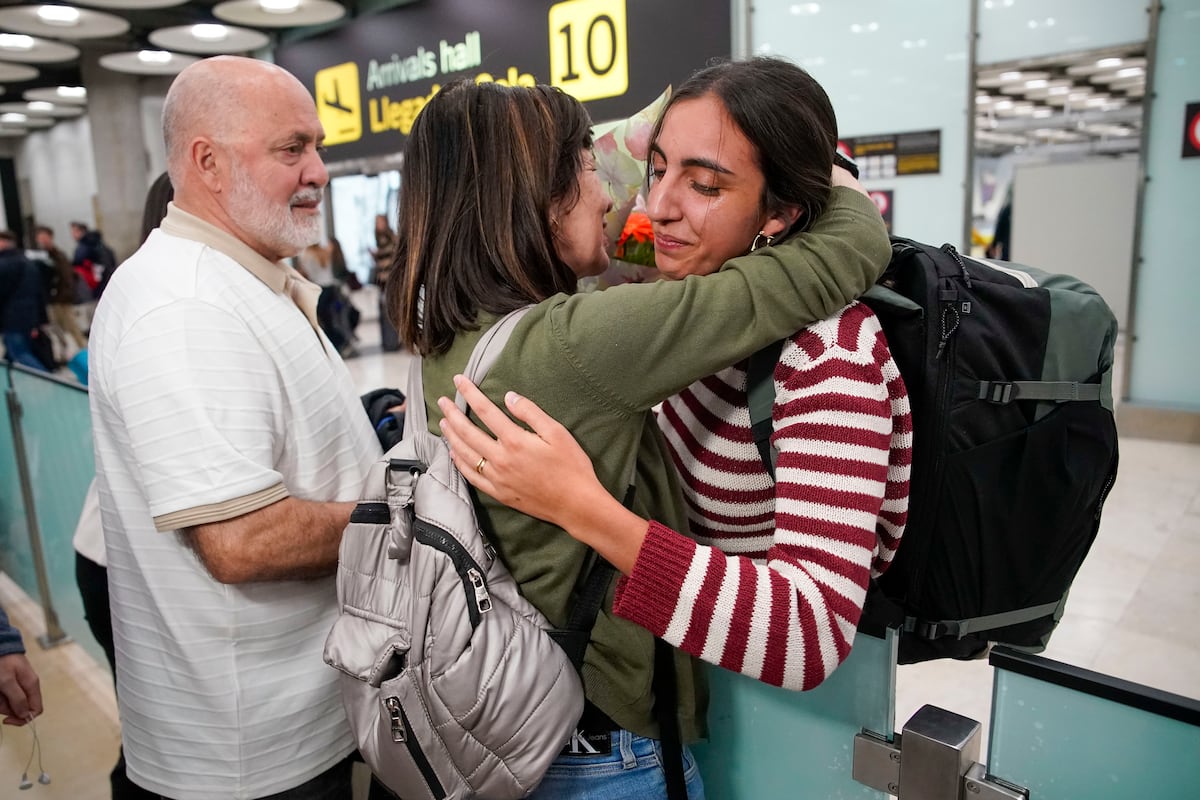
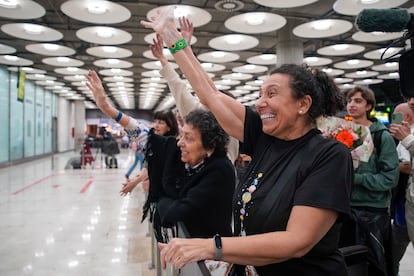
Charo San Pedro was waiting for her son Marco when at 8:50 p.m. she saw him leaving through one of the arrival gates at the Adolfo Suárez Madrid-Barajas Airport. He is one of the Spaniards who have been evacuated from Abu Dhabi in the midst of the escalation of the war in the Middle East after the bombings launched by the United States and Israel against Iran. The citizens arrived aboard an Etihad Airways flight that had taken off at 2:32 p.m. As soon as they touched down, the passage erupted in applause. “Happy, finally home,” said Silvia Aidillo, who had spent three days between explosions, alerts and sleepless nights.
The Minister of Foreign Affairs, European Union and Cooperation, José Manuel Albares, announced early in the afternoon that Spain has begun a repatriation operation to remove citizens blocked in the region from the United Arab Emirates and other strategic points. He also confirmed that so far there have been no Spaniards killed or injured in the conflict and that 13,000 nationals – more than 40% of the 30,000 who are in the Middle East – reside in the United Arab Emirates. Many have been trapped after the closure of Dubai and Abu Dhabi airports, both essential for connections between Europe and Asia.
Among the evacuees is Marco Huertas, trapped since Saturday in Abu Dhabi after the sudden closure of airspace when he made a stopover of just one hour on his return from Malaysia. “Going out to the airport and seeing fighter jets flying over, hearing the anti-missiles… it was hard,” he said, still with tension in his voice. The night before, he says, was the worst: “There were two or three hours that didn’t stop; I thought that at some point I was going to have to leave the hotel or go to an evacuated area.” The confirmation that he could board did not come through official channels, but directly to his mobile phone: “The boarding pass appeared in the application; we were lucky.” His mother, the aforementioned Charo San Pedro, was waiting for him in Barajas from the first hour.
The death of 86-year-old Iranian supreme leader Ali Khamenei has further raised tensions. The offensive called Operation Epic Fury by US President Donald Trump has triggered an immediate escalation that has already claimed 787 lives in Iran, according to the latest report from the Red Crescent.
Dubai, the city that has been a symbol of luxury in the Middle East, has suffered Iranian bombings aimed at US military bases in the United Arab Emirates. These attacks have caused the closure of airspace and the paralysis of operations at Dubai airport, one of the busiest in the world. Although Spanish hotels are not in the most affected area, guests have been asked to remain in their establishments. Silvia Aidillo was there, who decided not to return to the hotel where she had a reservation because a projectile had fallen on the building next door. “We would never have thought to experience something like this,” he explained. She spent the nights sheltering in place at friends’ houses, receiving alerts on her cell phone asking them to stay away from windows and doors. “The most distressing thing was hearing the bombs, the projectiles,” he recalled.
Another of the passengers, Cristina Cordero, arrived with her body still tense from the experience. “It has been difficult, we are super grateful to have arrived and remember a lot of the people who have stayed and have not had the luck that we have had,” he said. “We just hope they can come soon and that there will be peace. We just need peace.” For her, the leaving process was “hard”, but the relief of setting foot in Spain made up for everything. Visibly moved, she explains that her experience has been marked by constant uncertainty after days of alerts, explosions and restless nights.

In the press conference after the Council of Ministers, Albares confirmed that repatriation operations are already underway in different countries in the region without giving further details. The Ministry of Foreign Affairs assures that “all options are being considered to evacuate both by land and by air,” although it recognizes the difficulty of guaranteeing safe operations in such an unstable environment. The minister stressed that the safety of the more than 30,000 Spaniards in the Middle East is the absolute priority of the Government, as well as that of diplomatic personnel and their families. Albares also asked temporarily displaced Spaniards to register in the Traveler Registry, to facilitate monitoring and assistance.
Albares and the Minister of Defense, Margarita Robles, supported this Tuesday the decision of President Pedro Sánchez not to authorize the use of the US bases in Spain in Rota and Morón for operations in Iran.
The measure has also been applied by other governments that have decided to evacuate their citizens to prevent them from being trapped in case the conflict escalates. That is why embassies and consulates maintain permanent assistance to citizens, with active emergency telephone numbers and the consular emergency division operational 24 hours a day. Additional lines have been enabled to reinforce attention.