




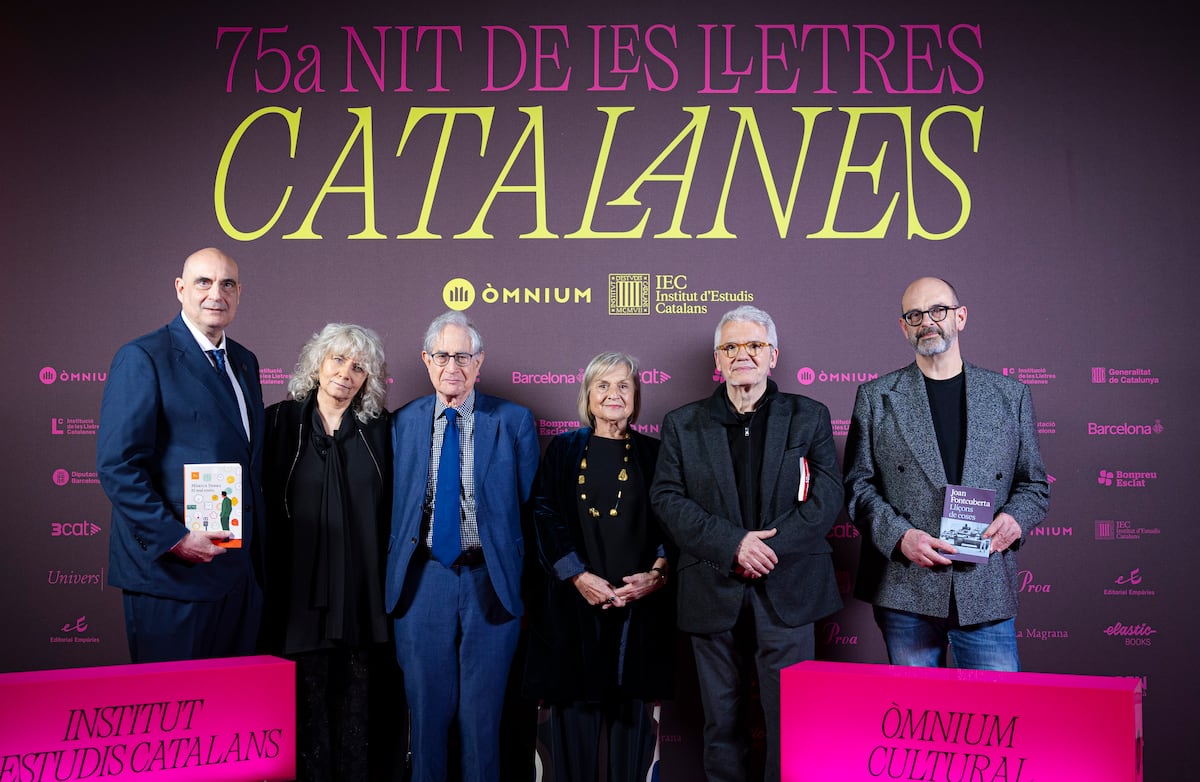
Under the rain, the MNAC was preparing this Saturday afternoon to host the first Nit de les Lletres Catalanes. The ceremony takes up the baton of the Night of Santa Llucia, which was traditionally celebrated in December, and has added more awards in a great gala that aims to be “the Gaudí of literature.” Organized by Òmnium Cultural and the Institut d’Estudis Catalans (that is, civil society and academia hand in hand) and broadcast by 3Cat, an event was held in the Oval Room, more ambitious than ever, festive, agile and also very demanding, where Antònia Carré-Pons and Carles Rebassa shone in the most anticipated awards.
The intention of the ceremony, according to Xavier Antich, president of Òmnium, and Teresa Cabré, president of the IEC, is to “reinforce the feeling of pride and self-esteem” of Catalan literature and “gain prestige and readers” with “the act with the most media impact in the history of Catalan literature.” The transformation of the awards has not come without reluctance on the part of some voices in the publishing sector at a time when there are fears about business concentration, especially due to the prominence of the three large publishing groups, which award the majority of awards to unpublished work, just before Sant Jordi. But the tone of the gala was above all festive and the majority of the winners were writers with recognized literary careers. Twelve prizes were distributed, the traditional ones for novels, short stories or poetry, but also others for new additions to the festival, for translation or comics, or for new creations, for dramatic literature or for a new author.
The event was presented by Elisenda Pineda and Xavier Grasset, who functioned as a satirical tandem, with gags about the Rodalies crisis, the proposed elimination of Catalan writers from required readings in Valencia or the conflict over Sijena’s paintings. The event also included interviews by Alba Riera with the winners; duos of very varied cultural personalities for the awards ceremony; the music of Triquell, Gemma Humet and Sandra Monfort; or dance with Ariadna Peya; and poetry by Josep Pedrals, who began the event by reviewing the chain of the book: “If this is to be sustained, you can start reading now”.
The most anticipated awards of the night and the last to be announced were the Sant Jordi, the award for the best unpublished work in Catalan literature (with 75,000 euros), and the Òmnium award for the Millor Novel·la de l’Any, in this case for a published work and worth 25,000 euros. The winner of the first was Carles Rebassa, a Majorcan writer who already has several books of poems, two novels and, soon, an essay about Blai Bonet, most of them awarded. Now he will publish the novel Promise in a thousand ways (Univers), which deals with class struggle and love based on a protagonist who works in a restaurant in Palma and lives a reckless love story. As he did in 2018, when he won the Carles Riba award, Rebassa offered a critical political speech: “We need legislation that makes Catalan essential to live in the Catalan countries; and the viceroys and titellas who govern us will never make it possible.”
The award for best novel of the year, which was kept secret from the finalists until the gala was announced, went to Antònia Carré-Pons for The big family (Club Editor), the story of two sisters, daughters of a lineage of butchers. The writer thanked the award by demanding gender parity for next year, since two of the ten finalists were women.
In the adult narrative category, actress Cristina Genebat was also recognized with the Lo Somni award for new literary talent for In turna novel about the effect of the male gaze on women of different ages, which will be published by La Magrana in September. It is an award that has also raised some controversy, due to the fact that there are already other similar ones such as the Documenta, from the Altra publishing house. Finally, the writer Marc Artigau, a regular collaborator in the books of journalist Jordi Basté and a radio storyteller on RAC1, won the Mercè Rodoreda award for short fiction for This will be our well (Proa) which, according to the author, is about “current responsibility towards the collective.”
The biggest applause of the night went to the illustrators Pilarín Bayés and Roser Capdevila, who were responsible for announcing the children’s literature award for Víctor Borràs i Gasch for Animals that fall from the sky, a story about memory. Alejandro Palomas won the youth literature award for a truth a novel about “how the gaze of children affects that of adults.” The winner, who had already received the same award twelve years ago, dedicated his speech to supporting teachers. The books will be published, respectively, in La Galera and Elastic Books.
The winner of the Carles Riba poetry prize was Jaume Coll Mariné for Like the leaves (Proa), which he summarized as a collection of poems about “the small stupefaction before the world, which is being aware that a person is nothing more than a leaf.” And Josep R. Cerdà won the Àngel Guimerà new creation award for dramatic literature, the genre that usually receives the least attention, for The second line. Like Rebassa, Cerdà is from Mallorca and also focuses on the landscape of modern-day Mallorca, in this case with a story with a disturbing atmosphere.
In the published work award categories, Ramon Monton received the PEN Català Montserrat Franquesa award for the translation of the tetralogy Joseph and his brothers by Thomas Mann (Comanegra). His long and improvised speech of thanks was one of the moments of the gala: he stated that it is important to go “to the root of the problems, because we are talking about the war and in the end this seems like the Goyas.” Berta Cusó was the winner of the Vinyeta FICOMIC award for The basin of the angels (Pagès Editors), a book about war that she dedicated to women who suffer from it around the world.
The Nit de les Lletres Catalanes included awards beyond specific books; it also recognized the projection and communication of Catalan culture, first of all to Paul Freedman, professor of History at Yale University, for his dedication to the study of Catalonia’s medieval past. And an ex aequo prize was also given to literary podcasts The Back Coverby Clàudia Rius, y Tandem Clubby Juliana Canet and Marina Porras.
