



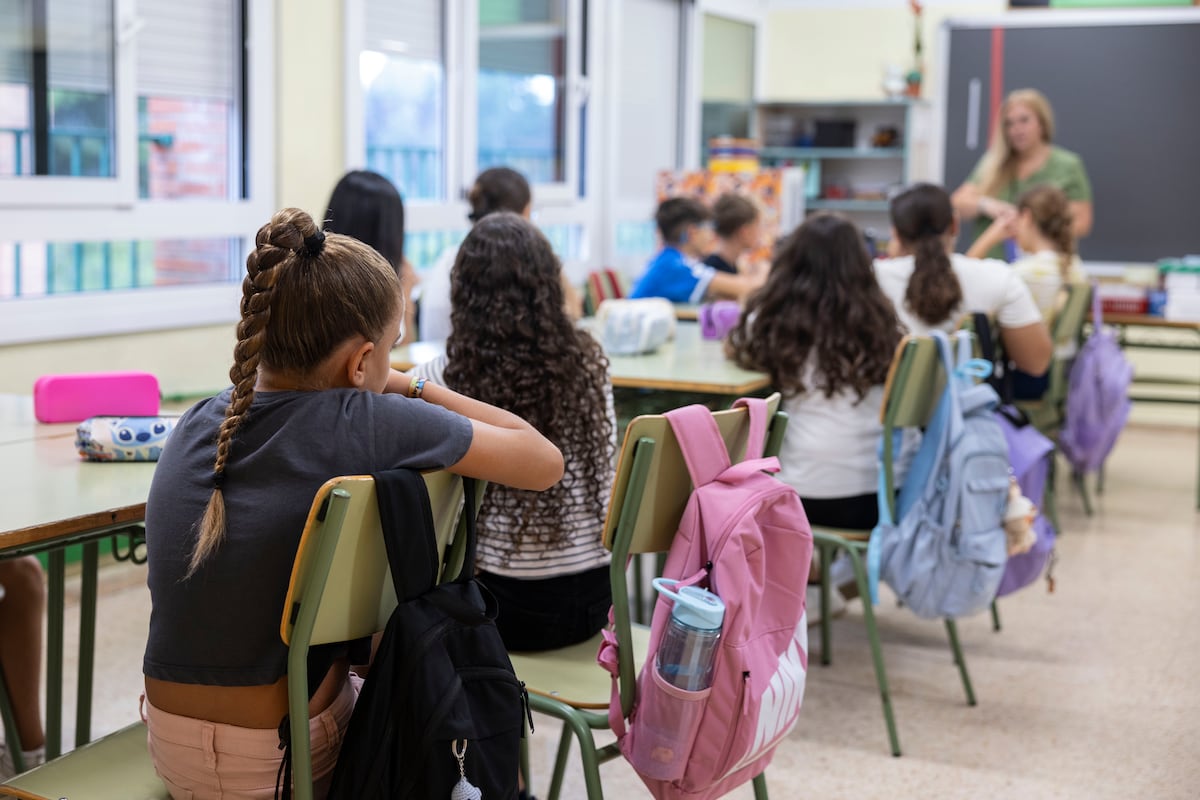
The Budget of the Department of Education once again breaks a new upward record and reaches 7,954 million for this year, according to the project published this Friday, which is 14% more than the last approved accounts, in 2023, when it amounted to 6,960 million. However, the Department raises the figure to 8,356 million, and explains that the difference is due to “additional funds from other administrations that are not contemplated.”
In Education, a large part of the pie goes to the so-called chapter 1, that is, the teachers’ salaries. Spending on official and labor teaching personnel amounts to 4.7 billion, almost 700 million more than in 2023. However, despite having extended budgets, teachers’ payrolls have been growing year after year and have had to be financed with credit supplements. It remains to be seen whether in this significant increase there is room to contemplate the salary improvements demanded by the group, basically with an increase in the so-called regional supplement, which amounts to about 700 euros per month and which has been frozen for 25 years.
One of the sectors that receives a great boost is the Secretariat of Educational Improvement, reaching 570 million, 240 more than three years ago. In this area, the recently created Evaluation Agency stands out – which replaces the Evaluation Council – which comes with an endowment of three million euros. Scholarships also depend on the secretariat, which has a fund of 163 million, 43 more than three years ago.
The financing of the charter school also increases, reaching 1,465 million, 200 more than three years ago, although a large part of the increase is also taken by the teachers’ payrolls, which are borne by the Generalitat. This increase is less than what is claimed by the sector, which claims to be underfinanced, both in terms of the working conditions of the staff – worse than those of the public – and to cover the maintenance costs of the centers.
As a novelty, the budgets dedicate a specific section to the Vocational Training Secretariat, which for the first time counts as an independent unit—until now it was diluted within the framework of the Department. The new section opens with 38 million euros.
The health item, on the rise
The Department of Health also registers an increase in spending: specifically, the health budget grows to 13,840 million euros, 21.3% more than in 2023. The Department of Health continues to be the ministry with the largest budget – 30% of the Generalitat’s spending in the departments goes to the health portfolio – but the expected increase in the Health fund is still far from the real spending consolidated last year: Economy sources admit that the spending incurred by that area in 2025 amounted to 16.6 billion, reports Lluís Pellicer. This indicates that, in the absence of closing last year’s execution, the displaced expenditure will be about 2.8 billion.
The injection of resources in health matters comes at a particularly turbulent time for the sector, with an open conflict between the Ministry of Health and doctors throughout Spain, who have called for several weeks of strikes to demand labor improvements and against the Framework Statute. The Government has emphasized that its priorities are strengthening primary care and limiting waiting lists for operations, consultations and diagnostic tests, among other initiatives.
Specifically, primary care, considered for many years the poor sister of the health system and historically claimed as one of the great pillars of the public network, will have around 3.8 billion euros. According to the Government, the allocation for primary care grows by 616 million. Among the priorities of the Catalan Executive at this level of care is being able to provide care “within a maximum period of 48 hours to people who require it” and also deploying the entire new organizational architecture that Health has designed with the 27 reference comprehensive health centers (CSIR) to improve efficiency and accessibility.
More than 8.6 billion euros are allocated for specialized care with the focus on reducing waiting lists: currently, the average delay for a visit to a specialist is 115 days (8% more than in 2024) and waits for a diagnostic test are close to three months on average. In the hospital context, the Government also wants to “promote personalized medicine and enhance high clinical complexity and reinforce care for minority diseases.”
The budget increase in the Catalan health portfolio contemplates an increase in health and support personnel of 5.6% to 111,577.
In terms of investments, the health sector is, after railway and public transport infrastructure, the best area: it is planned to allocate 463 million euros for works to expand and improve hospitals and integrated health areas. The remodeling of the Hospital Clínic in Barcelona (24 million) or the global transformation of the Joan XXIII Hospital in Tarragona (54 million) are among the investment priorities.
Injection into science
The Department of Research and Universities also receives a significant injection of funds and, if the Budgets are finally approved, would have 1,873 million, which implies 17% more than the 1,600 contemplated in 2023. In this case, the protagonist of this increase is the field of Research – the field from which the counselor comes – which reaches 400 million, 40% more than three years ago.
Public universities will also see their baseline funding increase, which reaches 1,140 million, 140 million more than in 2023, although other amounts they receive must be added to these amounts for issues such as investments for infrastructure, research, etc. Another item that increases slightly is that of scholarships, which goes from 123 million to 138.
Infrastructure and mobility
The budgets of the Generalitat allocate 7.3% of spending to infrastructure and mobility in the midst of the railway crisis. In total there are 3,986 million euros, of which 1,357 will be invested in railway infrastructure, 2,006 million will be allocated to “support for travelers”, especially to bonuses on transport passes.
Among the most notable specific projects are the 355 million euros that are allocated to the Rodalies service in the management contract with the intention, among others, that 96% of the stations are adapted for users with reduced mobility.
529 million euros are allocated and contributed to the transport authorities of all provinces so that all Catalan municipalities have an integrated fare system. 40 million euros will be allocated to finishing the central section of Barcelona Metro L9. 521 million will be allocated to roads, the majority for the conservation of existing roads.
In the investment chapter, the 101 million to extend the Llobregat-Anoia Railway line of the Generalitat of Catalonia, another 101 million for the tram between Cambrils and Vila-Seca and 50.3 million for the FGC line to the Prat airport stand out.
