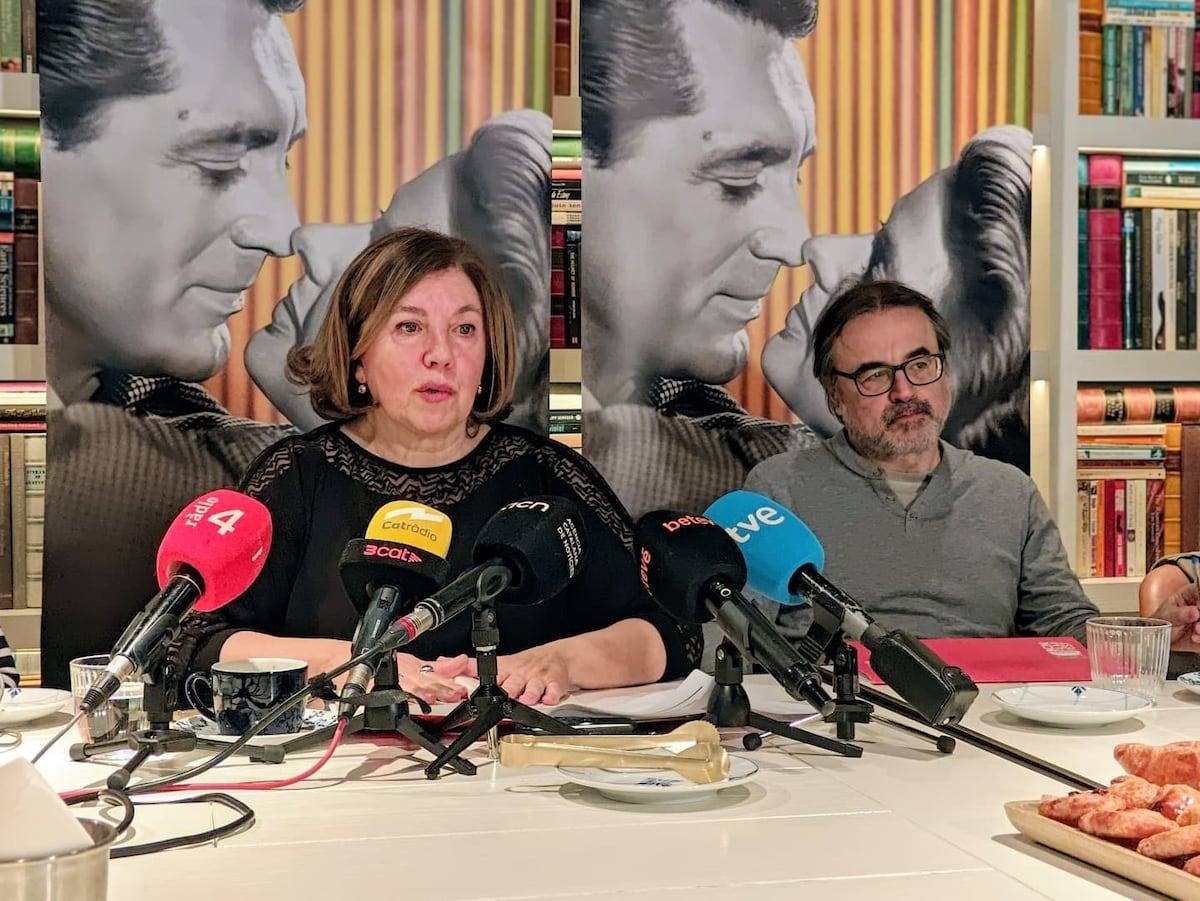



The BCN Film Fest (Barcelona-Sant Jordi International Film Festival), which will take place from April 16 to 24 and will celebrate its tenth edition, vindicates the power of cinema and its ability to inspire in turbulent times like the ones we live in. This was expressed this morning in the presentation of the final program of the contest by its director Conxita Casanovas, who explained the latest additions to the festival, which will offer 90 films, almost ten more than the previous edition. The cinematographic event of the Verdi cinemas and the Gràcia neighborhood once again has, like last year, a poster that looks at classic cinema: if then it was Marcello Mastroianni and Anita Ekberg who were kissing in the image of the festival, in a scene from The sweet lifenow the protagonists are Cary Grant and Ingrid Bergman no less torrid in Chainedwhich is 80 years old. The image also refers to the abundance of noir films.
The inaugural film will be Journey to the country of the whitesby Dani Sancho, a film version of the popular book by Ousman Umar, who arrived in Barcelona from Ghana at the age of 13 after an odyssey crossing the Sahara on foot and the sea in a boat to find a world very different from the one he had been told about. Umar himself stars in the film alongside Emma Vilarasau. Casanovas has congratulated himself for having Vilarasau at the festival again (and doubly, it also appears in Lia, 3CAT series on AI to be presented at Zona Oberta) following the success of House in flamesby Dani de la Orden, which inaugurated the 2024 edition.
The closing film (“it is as important to close well as to open well”) will be the French comedy Murder on the 3rd floor, by Remi Bezançon, a tribute to film noir with Gilles Lellouche and Laetitia Casta and a nod to Hitchcock, precisely, by rear window.
José Luis Garcí, 82, who will attend as a guest, like this year’s star, actor Willem Dafoe (Bobby Perú, Sergeant Elias, Agent Ward, Raven Motorist, David Caravaggio, Nosferatu, Jesús), will receive the Premi d’Honor of the BCN Film Fest. Casanovas has highlighted the director as a reference in Spanish cinema and recalled that in a difficult moment, 1982, he won the international Oscar (then for best non-English language film) by start over. He has also highlighted his role as a great disseminator of cinema. “There is a lot of love for cinema in Garci,” he noted after explaining that the festival will review El crack (1981) in a restored version, “a film that is still relevant”, and the filmmaker will star in a discussion after the screening.
“We face the 10th edition with great joy and desire to party,” stressed Casanovas, who considered that the current moment in cinema invites us to be optimistic. “Cinema regains its pulse, current events, we can continue attracting viewers.” The purpose, he said, is to make the festival a place where the public, artists and the industry feel comfortable. And for this they have developed a “very complete, with a lot of love, one of the best in our history, with many different perspectives” programming and with the centenary of the Verdi cinemas “as our compass this year.” For the director, it is essential to “enhance the sense of community of the spectators, to make them feel part of something”, and defend that “cinema has power”, “it is not pigeonholed or obsolete and it brings light to this dark world.” Casanovas has clarified that cinema also offers “enjoyment and entertainment” and has pointed out in this regard in the programming “a lot of comedy and very happy things.”
Of course also “the magical duo” characteristic of the festival: “cinema and literature, literature, books, as in Pale light on the hillsabout the first novel by Nobel Prize winner Kazuo Ishiguro, consolidating the commitment to culture.” And also to the city of which they “very proudly” bear the name. In this regard, the festival incorporates a new section, Made in Barcelona, which will project A clean shot (1963), by Francisco Pérez-Dolz, a portrait of the city’s underworld in the sixties, with an iconic scene of a shooting at the Lesseps metro station.
The festival wants to take the opportunity to reflect on cinema, Casanovas said, through the classics, “which offer so many lessons and give us a perspective over time,” and also with films “of the utmost relevance, with topics such as mental health (Runnerby Laura García Alonso) or complicated motherhoods.” The review of History is another of the views proposed by the festival, with films such as Magellanby Lav Diaz, biopic of the Portuguese navigator; The island of Amrumby Fatih Akin (also a guest at the contest), about the life of a child on a German Frisian island in the spring of 1945, at the end of the Nazi regime; Tribute to Cataloniaby Frédéric Goldbronn, translation of George Orwell’s book on the Civil War with archive images of the CNT, or Palestine 36 the Annemarie Jacir.
The official section includes Siblings, by Carol Rodríguez, a story about friendship and class differences in Barcelona; The perfect copya Jean-Paul Salomé thriller about a forger in post-war Paris; The girls of Prague,drama about the abuse of power of a director of a female choir, or Everything we don’t seeby the Venezuelan Alberto Arvelo, a road movie of women at Thelma y Louisewith María Valverde and Bruna Cusí. In The choral, by Nicholas Hytner, Ralph Fiennes comes out, winner in popularity of the last edition in tough competition with Richard Gere. Also to be highlighted in the official section Unidentified, by Haifaa Al-Mansour, the Saudi director who won the second edition of the festival with her fascinating biopic of Mary Shelley and who will be a guest again. AND Primaveraby Damiano Michieletto, opera director turned director, a film about Vivaldi (Casanovas has taken the opportunity to point out that he will probably have something to answer to Chalamet).
One of the great moments of the festival, according to its director, will be the presentation of The best years of our lives, the film about Hombres G, with unpublished images, to which all the members of the group will attend and not just David Summers, Casanovas pointed out. Confidential Mallorca, by David Ilundain, a thriller, will enable Lolita Flores, a guest at the festival, to return to the Gràcia neighborhood where her father was born. The Anime marathon is back, there will be Cinema on the plate, with a film about Joan Roca, a black film with Thai cuisine and the Vatel of Depardieu as the long-suffering steward of the Sun King. Space also for the centenary of Miles Davis with the pass of Elevator to the scaffold.
Curiously, the festival, in which an award will be given to the producer Montse Triola, is not aimed at paying tribute to Pere Portabella or the year of architecture. “We have gone down other paths,” Conxita Casanovas justified, “this year we are guided by the concept of celebration, partying and the recovery of cinema.”
Asked for her opinion on the controversy caused by Wim Wenders at the Berlin festival for his consideration that cinema must stay away from politics, she has defended “the basic concept of freedom of expression” but has supported the filmmaker by agreeing that “in cinema it is the films that speak”, and considering him “a humanist above anything, as those who came to hear him could see when he came to the BCN Film Fest in 2023, when he received the “Premi d’Honor”. Casanovas ended by asking “not to lose sight of cinema’s ability to inspire.”