



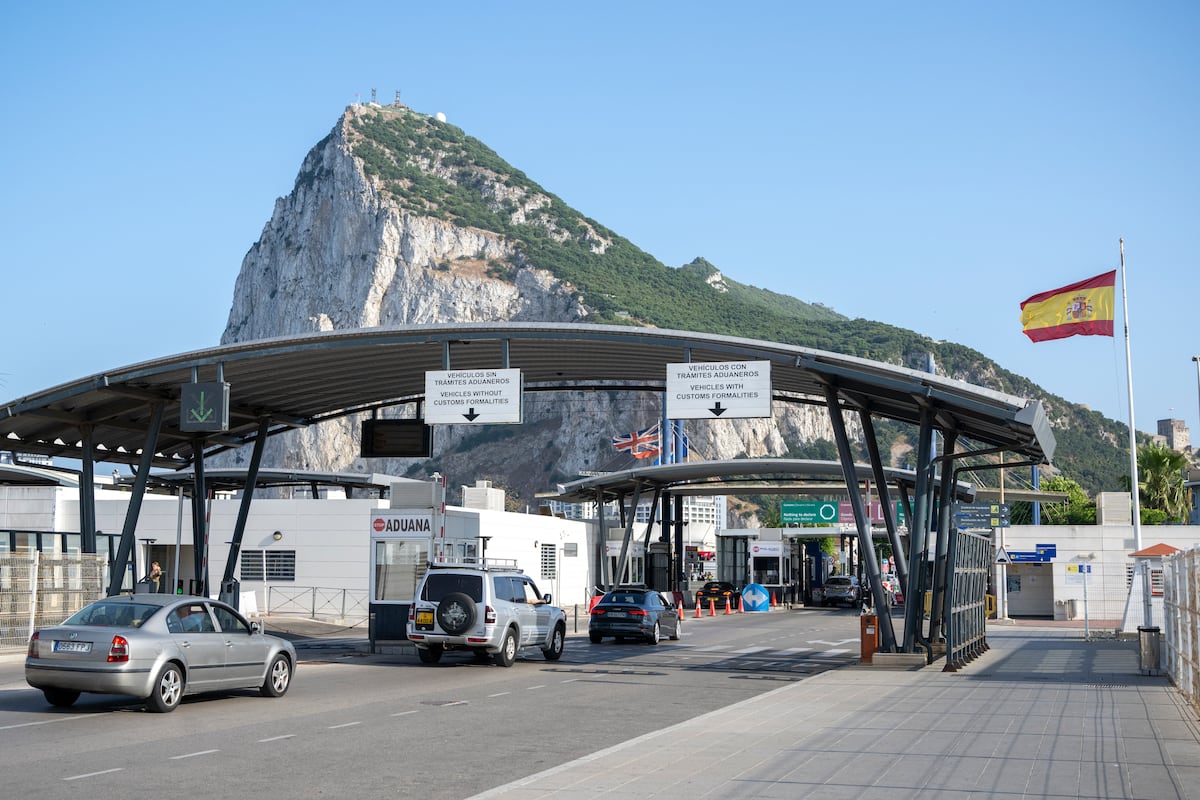
Spain and Gibraltar will be linked by a dense network of political, legal, commercial, economic, institutional and social ties when the treaty between the European Union and the United Kingdom that regulates the relations of the British colony with the EU comes into force after the Brexit. The treaty, of 336 articles and 46 annexes in English, to which EL PAÍS has had access, provides for the demolition of the Fence that has separated the British colony from its Spanish surroundings for more than a century and creates an area of free movement through the so-called Schengen area (25 EU countries plus Iceland, Liechtenstein, Norway and Switzerland). As a counterpart, it establishes a double key system by which the Spanish authorities will not only have the right to veto the entry into the Rock of travelers from outside the EU, but also when granting or renewing the residence permit in the colony, when they allege that the applicants pose a risk to security, public health or international relations. As it is a treaty between the EU and the United Kingdom, the text must be legally endorsed by the European Parliament and the British Parliament, although Gibraltar will also submit it to a vote in its assembly, but not by the Congress of Deputies. In the absence of the final text being known, finalized at the beginning of the year, the Minister of Foreign Affairs, José Manuel Albares, has held half a dozen meetings with the Junta of Andalusia and the mayors of Campo de Gibraltar to inform them of the progress of a negotiation that has lasted for four years.
These are the highlights of the treaty that is scheduled to be made public this Thursday:
Cooperation and Sovereignty. Article 1 of the text states that its objective is to promote shared prosperity and establish close and constructive relations between Gibraltar and its neighboring Spanish territory; although it warns, in its article 2, that none of its provisions affect the respective claims of Spain and the United Kingdom regarding jurisdiction and sovereignty nor can they be used as a basis for raising future claims.
Demolition of the Fence. “All physical barriers will be removed in application of the plan contained in the administrative agreement between the United Kingdom and Spain regarding Gibraltar,” proclaims article 7. One of the first acts planned when the treaty comes into force and the one with the greatest symbolic force will be precisely the demolition of the Gate.
Cooperation Council. A Cooperation Council is created, co-chaired by a European commissioner and a British minister, which will meet once a year and will be responsible for implementing and developing the treaty by adopting decisions and recommendations. It will have specialized committees on free movement, economy and trade and aviation.
Police control at the airport. All passengers arriving in Gibraltar by air or sea will be controlled by the Spanish and Gibraltar police. The controls of both police forces will be successive and will be carried out at the airport, where passengers arriving at the port will be transferred, thus preventing the Spanish agents, armed and in uniform, from walking around the neighborhood, which raised suspicions. Control of residents in Gibraltar and EU citizens will be done by automated means, avoiding queues and crowds. The Gibraltarian authorities may refuse entry into the Rock of travelers from Spain, while the Spanish authorities, in application of the Schengen code, may veto the entry into Gibraltar of citizens of third countries, including the British, except for those from states belonging to the European area without borders and residents in the colony. EU citizens will be able to enter Gibraltar without a visa for a maximum of 90 days in a period of 180. Conversely, residents of the Rock will also be able to do so.
British military excluded. Members of the British Armed Forces or other countries visiting Gibraltar will not have to undergo entry controls and will only need to present an identification document and an order from the British Ministry of Defense at border control. Through the liaison officers, the United Kingdom will inform Spain of the entry and exit of these military personnel, as well as their families and civilians who work for the Department of Defense.
Residence permits in Gibraltar. Before issuing or renewing a residence permit in the Rock, the British authorities will notify the Spanish authorities, who may oppose the granting if, in accordance with the Schengen acquis, the applicant is considered a threat to security policy, public health or international relations. In that case, the British authorities will not grant the affected person the permit and will indicate to the affected person that they can file an appeal with the Spanish authorities, who will have a period of 28 days, extendable to 42, to resolve.
Joint use of the airport. A joint venture formed by the United Kingdom and Spain will manage the Gibraltar airport, built on the isthmus, whose sovereignty is disputed. The future Spanish-British company, whose headquarters will be in a third EU country, will put out to tender the daily operation of the infrastructure and will be in charge of supervising its operation. The contract will set out the applicable law and appeals may be brought before both the UK and EU courts.
Cross-border workers. The 15,000 workers who cross to Gibraltar every day – among them, 10,000 Spaniards – will have the same treatment as the British. They may not be discriminated against in employment, remuneration or working conditions, as well as in social benefits and taxes, except access to housing, according to the treaty.
Customs Union. Gibraltar joins the EU customs union, of which it was not part until now, eliminating controls on the free movement of goods and merchandise between the Rock and Spain. In one of the annexes to the treaty, the location of the centers for the control of products originating or destined for the Rock is established in the towns of La Línea, Algeciras and Sagunto, with the possibility of opening another in Portugal on a subsidiary basis. European authorities will be able to carry out inspection visits to the Rock to ensure that the single market is not put at risk and to reimpose controls in the event of distortions.
New Gibraltar VAT. Starting next April, Gibraltar will introduce a tax on goods and merchandise equivalent to the VAT that is applied in the EU called Transaction Tax. According to an annex to the treaty, the standard tax rate cannot be lower than the minimum VAT rate applied by an EU State. During the first year of validity, the TT will be 15%, the second 16% and the third 17%. The reduced rate may not be less than 5%, although there may be a super-reduced rate for some taxed products.
Stop tobacco smuggling. Putting an end to tobacco smuggling from Gibraltar that floods the neighboring territory due to its lower price is an objective long pursued by Spain. One of the annexes to the treaty aims to solve the problem through progressive tax harmonization on both sides of the border. Gibraltar will impose a special tax on tobacco that will not be less than 115 euros per 1,000 cigarettes. “The price difference (between the Spanish and Gibraltarian markets) resulting from the application of the special tax will not exceed 0.80 euros or 15% per package, whichever represents a smaller difference,” the text states.
Hot pursuit. The treaty provides for a qualitative leap in police cooperation between Gibraltar and the EU, especially with Spain. Spanish or Gibraltarian police officers who are pursuing an individual who has participated in one of the crimes covered by a list of offenses may continue surveillance or pursuit when they cross the border. It is also planned to carry out joint police patrols and operations, with express authorization, and to strengthen collaboration with Europol and between the respective courts.
Ecology. In environmental matters, the treaty is not very ambitious, although it proclaims the commitment of the United Kingdom and the EU in the fight against climate change. The agreement commits Gibraltar to maintain a level of environmental protection similar to that of the EU and to establish a pricing system for carbon emissions equivalent to that applied by the community club. On the other hand, it does not mention the practice of gaining ground by filling in the seabed nor does it refer to bunkering, the supply of fuel through floating gas stations in the waters of the Strait, a high-risk activity.
Cohesion fund. Article 299 of the treaty provides for the creation of a financial mechanism to promote cohesion between Gibraltar and the Campo de Gibraltar, with investments in matters such as training or employment, but it does not say what its amount will be or how much each party will contribute, only that measures will be adopted to prevent fraud and other illegal activities, which reveals distrust in its operation.