


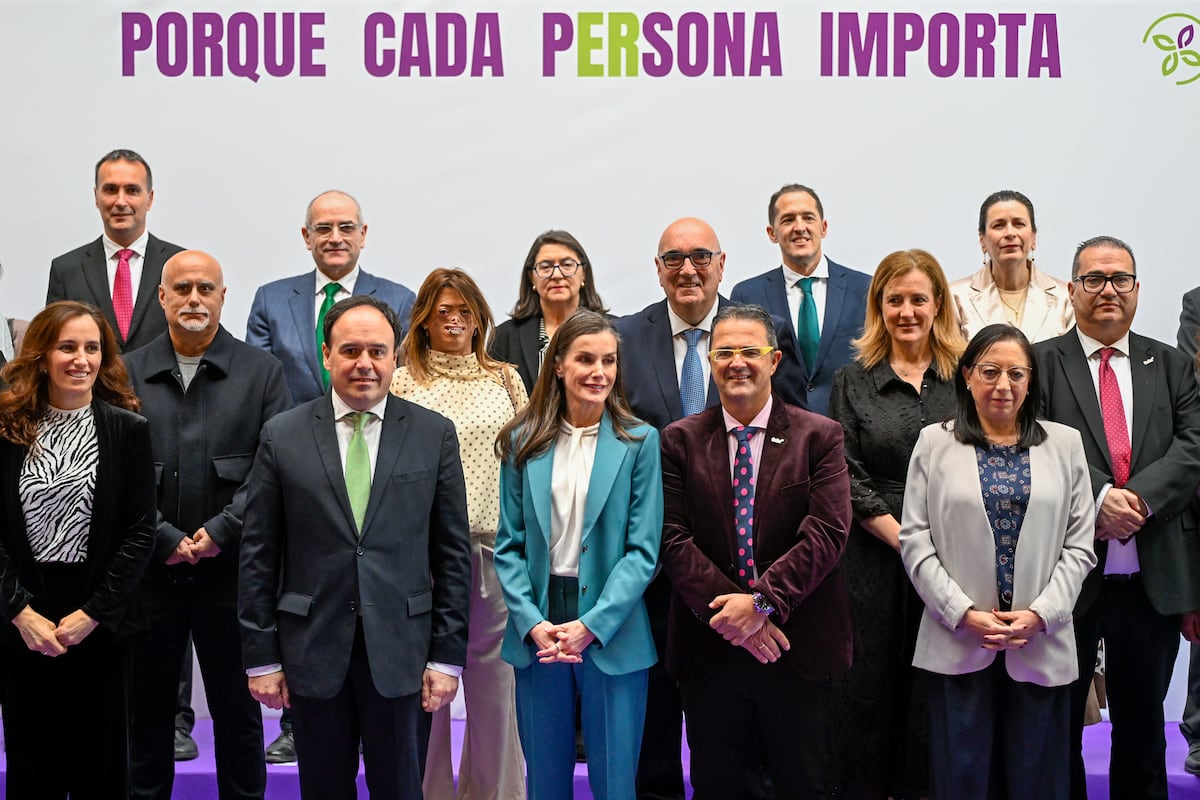
This Tuesday, Queen Letizia put a face and name to the stories that, like that of Elena or her mother, Marta, are behind each of the 3.4 million patients with one of the more than 6,000 rare diseases in Spain and their families. He has also claimed the importance of diagnosis – with an average delay of six years -, research and fair access to treatment, at a time when only 6% of all rare diseases have it specifically. These have been the axes of the Queen’s intervention in the official event organized this Tuesday in the Auditorium and Congress Palace of Castellón by the Spanish Federation of Rare Diseases (Feder), of which she is honorary president, on the occasion of the international day.
On her first visit to the capital of La Plana as Queen, which she arrived with the Minister of Health, Mónica García, Mrs. Letizia addressed her first words to Elena, a 21-year-old Asturian girl with Sanfilippo syndrome. “I met her in Valdesoto (Asturias). She was in her wheelchair. She didn’t see me, but her mother, Marta, did.” A mother who knows what it is like to begin “the long pilgrimage toward a diagnosis” for her daughter. Elena has demolished all statistics for a disease whose life expectancy barely reaches adolescence. “Today is late for Elena, but let’s work so that there are no more cases like hers, nor like that of Lucía or Celia” and to move towards a “society with values that embraces the will to transform things, the lives of people with a rare disease,” he highlighted.
Honoring Feder’s 2026 campaign motto, Because every person mattersQueen Letizia has been blunt: “We agree that what is crucial is that there is equity in treatment, because when inclusion is consolidated in structure, equality becomes a right.”
“Thank you for remembering that behind every diagnosis, there is a life to protect,” added Juan Carrión, president of Feder and its foundation, which brings together 442 entities, more than 40 of them based in the Valencian Community. Precisely, La Fe Hospital has been recognized with one of the awards given annually by Feder, in the regional category.
“Equity is not rare. It is a right,” Carrión highlighted in the same vein as the Queen. “Inequity impacts the present of people with rare diseases, searching for a diagnosis, their families and caregivers. People who live from the first moment with thousands of questions about the health, but also social, educational, work or economic aspects that surround the disease,” he said.
Feder’s president has projected his speech from that “common place for us” such as the “hallway of a hospital”, where “everything is questions, concern, and struggle on the part of health professionals trying to find answers.” There begins, he said, that path towards diagnosis, which is complex given the genetic origin and the heterogeneous, degenerative, chronic and unknown profile of most rare diseases. A diagnosis that, “although it is not everything, it does change everything, because it is the gateway to possible treatment,” to social and health resources.
According to Feder, the average time to access a diagnosis in Spain exceeds six years and, in 20% of cases, it is necessary to wait more than a decade. “Living without a diagnosis means not knowing the name of the disease you have or that your family member has, not knowing how it will evolve or what will come next. It means dealing with the consequences of not obtaining a diagnosis, which seriously impacts people who live with the suspicion of suffering from a rare disease, and also on their family, since the person does not have adequate treatments or therapies,” the institution states.
The celebration of World Rare Disease Day 2026 lands in the middle of the debate to finalize a European initiative that aims to create a binding framework for these ailments that allows obtaining a diagnosis in 12 months, guaranteeing the early detection of rare diseases.
It is one of the challenges, as is continuing to delve deeper into the research. “Today we know more, more research is done,” said Carrión. In Spain, “decisive steps” have been taken, such as prenatal screening. Progress to which is added support for research, with 9 million euros contributed by Feder for this purpose.
But there is still a way. “Only 20% of rare diseases are being investigated,” recalled the Feder president. “And it is the root from which everything is born.” The pulse towards that diagnosis and towards that treatment for which this Tuesday the voice was raised in Castellón.