


A little more than 1.38 million tourists spent their holidays in 2024 in the Tenerife municipality of Arona (almost 88,000 inhabitants), where tourist towns such as Playa de Las Américas, Los Cristianos or Costa del Silencio are located. Far from the maritime landscapes of the coast and the smell of sunscreen, a group of residents from the upper part claim that up to 20,000 residents of Arona Alta have been living without sewage for more than 20 years. “We are between a health crisis and an ecological crisis,” says Davide Cortellino, president of the Sara neighborhood community. “It’s not just our street,” he explains in a telephone conversation. “It is in the entire neighborhood of La Camella and in other neighborhoods such as Valle de San Lorenzo, Cabo Blanco… When it rains, all this is the Venice of sewage.” The City Council – governed by a coalition of PP, Canarian Coalition and Vox, although between 2015 and 2023 the PSOE was the party in power – hides behind the fact that the urbanization works “have not been completed and have not been welcomed”.
Starting at the turn of the century, with the tourist boom, thousands of families moved to live in the south of the island, causing municipalities such as Granadilla de Abona or Arona itself to grow rapidly, often without basic services. The La Camella neighborhood, in the latter term, is an example of this growth that forced improvisations. Thus, starting in 2003, the Government team – then controlled by the Canarian Coalition – granted the license to build, despite the fact that the urbanization works in that area (sewerage, lighting) had not been completed. The building where Cortellino resides was built in 2007, and its 72 families have lived in the property since then. 19 years later, the City Council admits that the urbanization works “have not been received.” That is, the municipal administration has not verified, accepted and assumed the ownership and maintenance of these works.
“When the City Council gave construction permits,” Cortellino recalls, “the absorbent well was accepted as a temporary alternative that, theoretically, in five or six years should be replaced by the sewer. We formed our families with that promise,” he explains. Twenty years later, there is no sewage system and no one knows when they will do it. And meanwhile, the wells have reached the limit of their capacity: they have swallowed waste for two decades for which they were never designed.”
The consequence, he says, is that there are more than 20,000 people who daily pour sewage into absorbent volcanic wells. This fact has, in his opinion, a double consequence: “There is human waste that is dispersed throughout the territory and we do not know if it reaches the beach, the coast, the crops or if the land is becoming contaminated.”
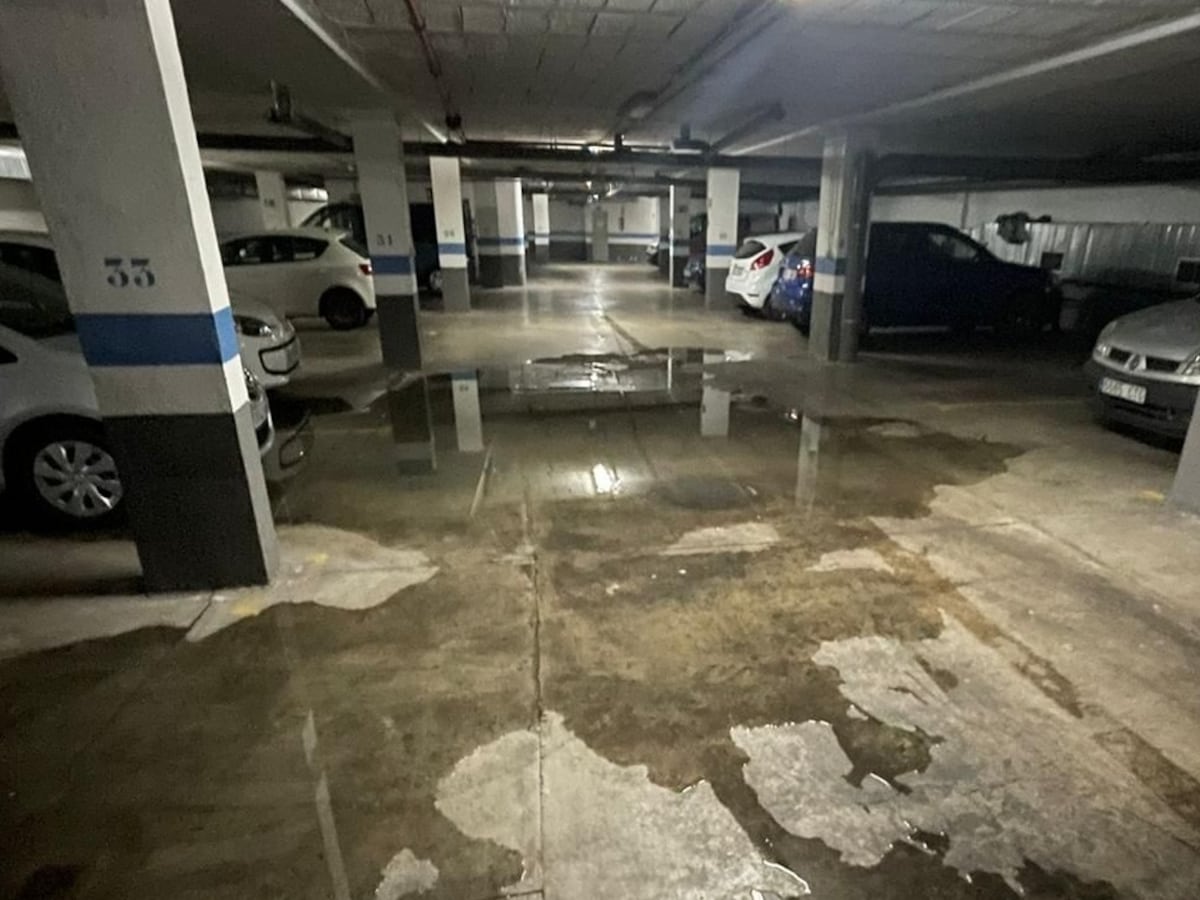
On the other hand, there is the health aspect. “Every two or three months, when it rains, the community garage becomes a Venice of sewage.” The only thing we can do is call the vats and empty. Each operation costs them about 2,000 euros, he says. “Imagine 72 families with sewage entering through their garages: there are human remains under their shoes, risk of salmonella and other pathogens. And what happens underground, without knowing where it goes, is even worse. But, above all, they denounce that “a residential community cannot replace a basic service of the City Council.” Given the situation, the neighbors have submitted a petition to the European Parliament to supervise compliance with community directives.
The City Council’s response to questions from this newspaper has been limited to the press release issued on the 4th. “The existing problem has its origin in the urban situation of the building,” the note states. “As the urbanization works have not been received by the City Council, the possibilities of municipal action in this area are currently very limited, as it is a situation of special administrative and urban complexity.” The City Council admits that this situation “does not exclusively affect this property, but also occurs in other parts of the municipality.” The communication reiterates its “willingness to dialogue and joint work”, and argues that the resolution of the problem “requires time, processing and legal certainty.”
The neighbors do not accept the explanations. In the community, the spokesperson assures, all the elements exist that, “in accordance with the jurisprudence of the Supreme Court, determine a tacit reception of the urbanization.” As an example, he cites that residents regularly pay the Real Estate Tax (IBI), “which implies municipal recognition of the consolidated urban character of the properties”; the fact that there are official fords on the front street of the community; or the existence of municipal public lighting on the side streets.
“The jurisprudence of the Supreme Court is clear in this regard,” maintains Corradino: “When an Administration has allowed and tolerated the occupation of an urbanization, has granted licenses, collected taxes and provided public services in it, the tacit reception of the urbanization works is understood to have occurred, with the City Council assuming all the responsibilities derived from the conservation and maintenance of the infrastructure.”
This is not the first problem of this nature that the Corporation has faced. In another of the municipality’s neighborhoods, Cho-Parque la Reina, a few kilometers from La Camella, there is an urbanization built in the eighties that is also not received. Their neighbors have also reported in the past the lack of connection to public sewage and not being able to receive basic municipal services.
The demographic explosion in Tenerife has caused repeated episodes of fecal contamination in towns such as El Médano (Granadilla de Abona) or Puerto de la Cruz (in the north of the island), episodes that have caused the closure of beaches for long periods.