

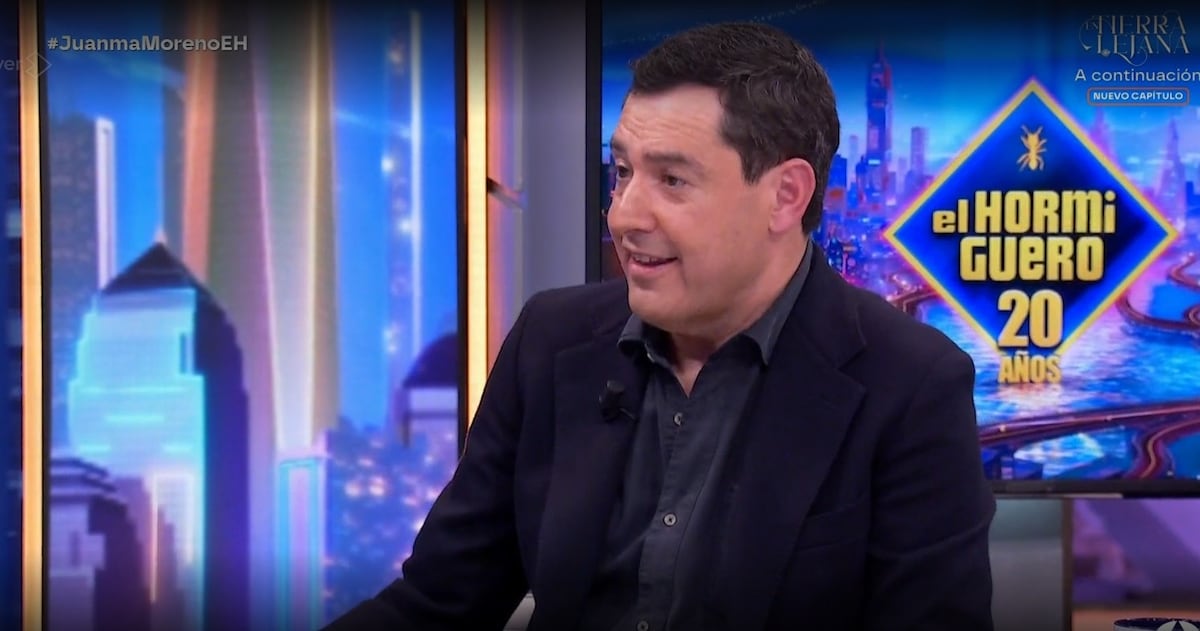
The president of the Junta de Andalucía, Juan Manuel Moreno, has recovered calm and political control after the screening crisis, which eroded his image and put his management in check, and once the Adamuz railway tragedies and the storm train have passed, which have allowed him to recover his presidential profile. He is relaxed and has made it noticeable in the program El Hormiguero, which he attended for the first time. In addition to shoring up his moderate position – in counterpoint to Vox or his counterpart from the Community of Madrid, Isabel Díaz Ayuso – he has dared to imitate the former presidents of the Government and the PP, José María Aznar and Mariano Rajoy.
The relaxed atmosphere of the Trancas and Barrancas puppets has not confused the Andalusian president enough to reveal when the elections will be held in his community – he has reiterated that they will be in June “when Holy Week, the Seville Fair, other fairs in the provinces and pilgrimages” pass – but, aware that the absolute majority that is close to the polls is in the hands of whatever Vox grows, he has taken advantage of Pablo Motos’ questions, to mark differences, something that he also usually does in the regional Parliament. After acknowledging that no one has the key to how to stop the rise of the extreme right – “no one agrees,” he said – he has maintained that “Vox cannot be permanently put at the center of the political agenda. We cannot have a rearview mirror and permanently look at what Vox is doing.” “A minority cannot drag the positions of a central party towards its own, because then we lose the essence,” he stressed. And he has contributed a personal note: he has asked his eldest son, who is 16 years old, not to open social networks until after the Andalusian elections.
Moreno has also not shied away from the comparison with who for many is his political nemesis within his own party, Díaz Ayuso, something that also benefits him when it comes to highlighting that moderate profile, essential in the community he presides to hold on to the votes of the disenchanted left. “Sometimes we have different visions on the same problem,” he acknowledged to defend that divergence is good within the same party. “I may have a different special sensitivity on some issues than Isabel Díaz Ayuso has,” he remarked.
Three months before the elections, Moreno has barely referred to his opponent in the PSOE, the first vice president of the Government, María Jesús Montero – except to assure that both she and Santiago Abascal keep him awake at the same time, and that the popular leader suffers from insomnia – but he has taken advantage of all the mentions of President Pedro Sánchez, to question his policies and his way of governing. “Sánchez is obsessed with being the second longest-serving president (behind Felipe González), to surpass Aznar and to lengthen the electoral process as much as possible so that the general situation favors him,” he assured in reference to the open judicial cases. Even so, he has challenged him to make the general elections coincide with the Andalusian ones: “If you want to come with me to the elections, come, because the citizens of Andalusia will surely not vote for you.”
In the most personal part of the interview, Moreno has given free rein to his imitative vision, first parodying Aznar, to remember one of the first times in which he met him and did not understand what he was asking, due to his very closed way of speaking, which he has emulated quite successfully. He has also imitated Rajoy when he recommended that if he did not like what the newspapers said about him, he should read others – an anecdote that the Andalusian president also includes in his book of memoirs. “I read the Mark“, the popular baron has parodied. Although the ants have asked him, Moreno has resisted doing the same with Sánchez, but he has generated expectations: “When I come back, I will do something to you.”
In addition to the friendlier part of the program, Moreno has also addressed the screening crisis, to ensure that when he was asked about the communication failures at the press conference on October 1, “I didn’t know what they were talking to me about.” The Andalusian president has recognized that it was an “unforgivable mistake”, to ensure that the screening system has been “reinforced and has more guarantees”. He also recalled the Adamuz accident and how the first images of the tragedy and contact with the victims affected him. With a broken voice – although without breaking as in his Andalusia Day speech – he acknowledged that the situation has “created a harsh emotional impact on him to the point of going to a specialized psychologist.”
Watch the full interview on Atresplayer.