

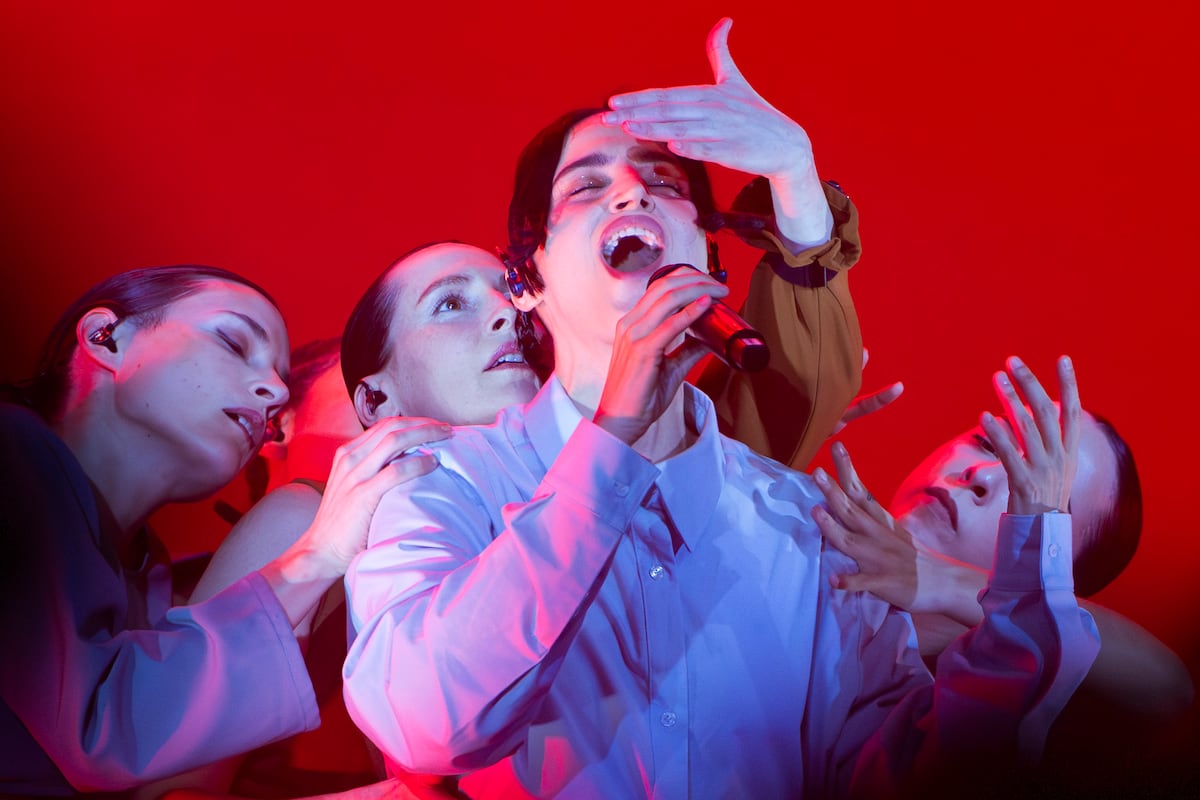
It happened like a miracle, and as such it had healing effects on the audience that filled Paral·lel 62 at the premiere of Or, Maria Arnal’s first concert with the album already released, which is repeated this Sunday. As if music evokes a state of mind that helps heal wounds, that it does, as if music creates community, that creates them, as if music were that thread that links us to a reality, to some feelings, to a state of mind. With Maria Arnal on stage that happened and more, because there is a feeling of a woman whose translation is not necessary for men, and her entire audience arrives plain, with no other tool than the songs themselves. Women on stage, dancers, women’s stories, a relative who died when she was still young, women that Maria has known throughout her life, with Sappho at the helm, whom she vindicated before concluding her concert with the joyful Tictac driven by that electronic pulsation that is the pulse of their music. Tick tock, time has brought another Maria Arnal album. Or It’s called, ama is the acronym of the name of the family member who died before her time, ama is love and ama is mother in Basque, where mothers are the soul of a society. matriarchalist.
It is often said that Maria is an avant-garde artist, and perhaps her work on the AI voice through the synthesis of sounds and the texture of its rhythms is, but the delivery of such works and advances seems easy, understandable, plain, a story that even seems to have been told to us and to which adds sensitivity, spirit, power and fragility. If avant-garde is associated with formal difficulties, in Maria it is a facilitation of the twinning of pop, organ sounds, polyphonies and the aftertaste of a popular song that sews with a voice full of strength, a beauty that flies over creaks, remnants of rhythm or the simple absence thereof, overshadowed by that voice that guides everything, that unites everything. It is the plot of Or, his first solo album and the focus of his concert, which he completed with songs like Ferrite Meteoritefrom his time with Marcel Bagés or with that nana-saeta that, as he recalled on stage when presenting it, lost a Goya as part of the film The red virgin A little more than an hour to inflame the public with that caress that denies, if at this point it were necessary, that electronics, processed voices and digital constitute cold tools. The most digital can be as warm as the most analog can be icy.
With the punctual display of plastic choreographies, no gymnastic postures, oblivious to vertigo, weighted in her dynamism and elegant in her displays, Maria was from Madrigal almost without rhythm Mirrorwith a soft dembow in the background, passing through sighs, with that hesitant beginning that evokes Meitei or the delicate If we assumewith a beautiful staging using a laser opening on the stage between the voices, or that metallic ringing, like a percussive saucepan of domestic industrialization that sounded in Or. A songbook that unfolded like a litany of irrevocable beauty that also approached the sounds of popular songs with mine, the closing piece of the album, a kind of rubric to indicate where we come from despite our fascination with the future. That future that is already here, that shapes our music and whose language is no longer incomprehensible to filter even into our lullabies. Maria Arnal is part of that present that sits between yesterday, today and tomorrow.