

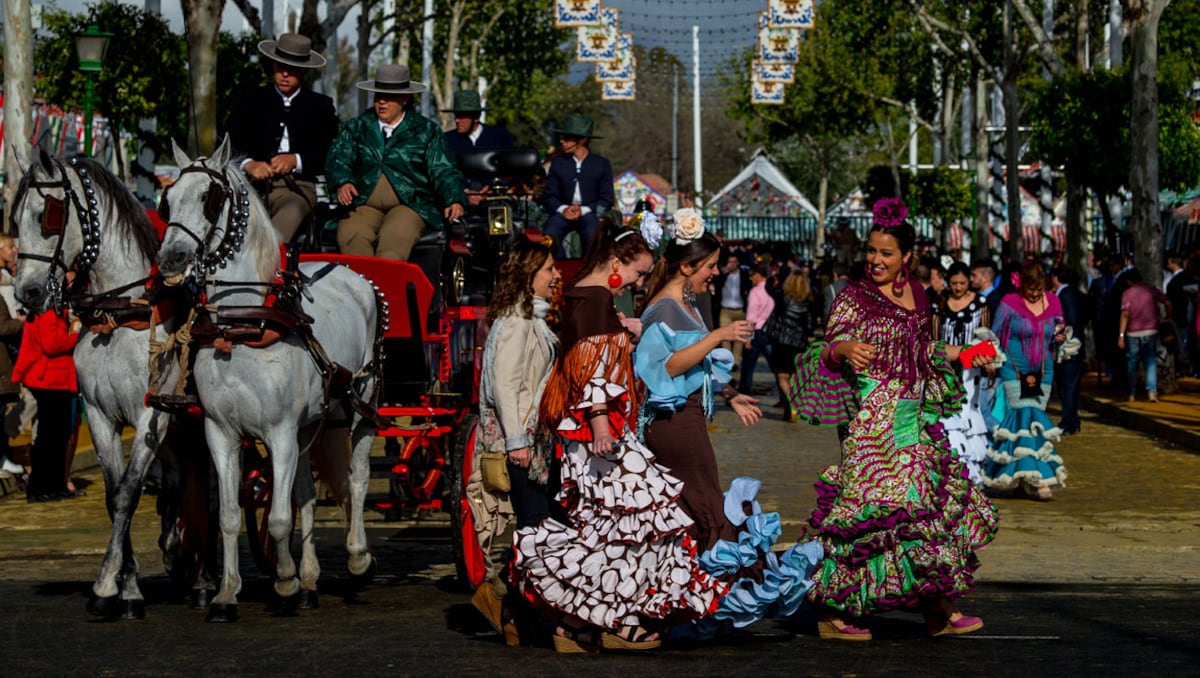
Madrid will no longer have its own April Fair. Or at least not this year. The organizers of Madrilucía, the great Andalusian fair that would be held in the capital from May 20 to 31 at the Iberdrola Music venue, have announced that they are canceling the celebration “due to certain technical and administrative circumstances unrelated to the project,” according to a statement released on the event’s social networks. However, they assure that those who want to put on a flamenco dress, rent booths or ride a horse in pure Andalusian style but without leaving the capital, will be able to do so in 2027.
Madrilucía was already born surrounded by controversy, with the residents of Villaverde (where the fairgrounds are located) and Getafe complaining about the celebration of yet another macro event that ends up hindering the coexistence, rest and mobility of the surrounding inhabitants. They referred to MadCool, the great music festival in Madrid. But their complaints, and those of the opposition parties in the city council led by José Luis Martínez Almeida, did not deter the organizers or the municipal administration.
However, the Madrid-style April Fair underwent a modification because it coincided with the San Isidro festivities, the most important at the regional level. Initially, it was going to be celebrated for almost an entire month, from May 9 to June 7, but the organizers had to postpone it and shorten it so that it did not coincide with San Isidro. The team offered refunds on tickets and booth reservations. At the beginning of March, the Madrilucía organization announced another change, and informed the Madrid City Council of the reduction in the number of booths by half, from about 200 to 100, and the reduction in the duration of the event to two weekends, from four planned. Just a few days later, it has been cancelled.
“During the last few months we have worked intensely on the development of Madrilucía,” they say in the statement announcing the cancellation of the fair this year. “We especially want to thank all the people, entities and institutions that have shown their support and enthusiasm from the beginning.” Several promoters from Madrilucía had appeared on social networks about the event to praise it. “I am fulfilling a dream,” said Rafa Coto, CEO of Iberdrola Music and promoter of this festival, in a video posted on networks. In another publication, the Andalusian Paco de Paula, one of the promoters of another Madrilucía that existed four decades ago and of which nine editions were held, spoke of how celebrating the festival in the capital “was not copying” that of Seville, but rather opening its culture to the world.
The experience wanted to emulate in all aspects what is experienced at the real April Fair. There would be 200,000 square meters of booths, attractions and food stalls distributed in five different areas, but it would also bring its exclusivity. Those interested could reserve booths starting at 55,000 euros per week, awarded “on a first-come, first-serve basis.” You could also obtain a membership pass for 1,999 euros, which gave preferential access to Madrilucía’s own booth, eight access bracelets for five days and “a recognizable and desired social experience within the fair.” With the definitive cancellation of the event in 2026, the organization has announced that it will “fully” refund the money of those who had already made purchases or reservations.
“Our commitment has always been to create a unique cultural experience with the quality, safety and dimension that this great project deserves. With this objective, the team continues to work with enthusiasm to present a memorable first edition in 2027, living up to the expectations that Madrilucía has generated,” the organizers added on their website.
The Madrid PSOE, after hearing the news, assures that “what starts badly, ends badly.” “From the beginning we warned that the chosen location did not seem appropriate, nor the space the most appropriate, and that a project of these characteristics should not have been proposed without taking into account other municipalities such as Getafe,” say sources from that party. And they add that they have always defended that this type of festival “cannot be built at the cost of emptying consolidated events in other cities of their content, such as in this case Seville” and that, while waiting to know all the details, they do not rule out that “the project has not had the success or economic viability that its promoters expected.” “The City Council has offered to support this type of initiatives while, on many occasions, the same support for Madrid traditions and festivals that are part of the cultural identity of our city is lacking,” they criticize.
A few weeks ago, the spokesperson for the Madrid PSOE, Reyes Maroto, and the spokesperson for the party in Seville, Antonio Muñoz, met with the mayor of Getafe, Sara Hernández (PSOE), in the Senate to criticize the “trivialization” of the Sevillian fair. Hernández insisted on the mobility problems that these macro events create for this neighboring municipality.
José Luis Nieto, councilor of Más Madrid, assures that the Madrid PP “did a disservice to Andalusian folklore with Madrilucía, a fair fake that did not have the support of the cultural and artistic community.” “Enough of unplanned occurrences every other day, we said it when this fair was announced, that the neighborhoods, in this case Villaverde, were going to see the April Fair before the vocational training institute that it needs and that the neighbors have been demanding for years,” he points out.