





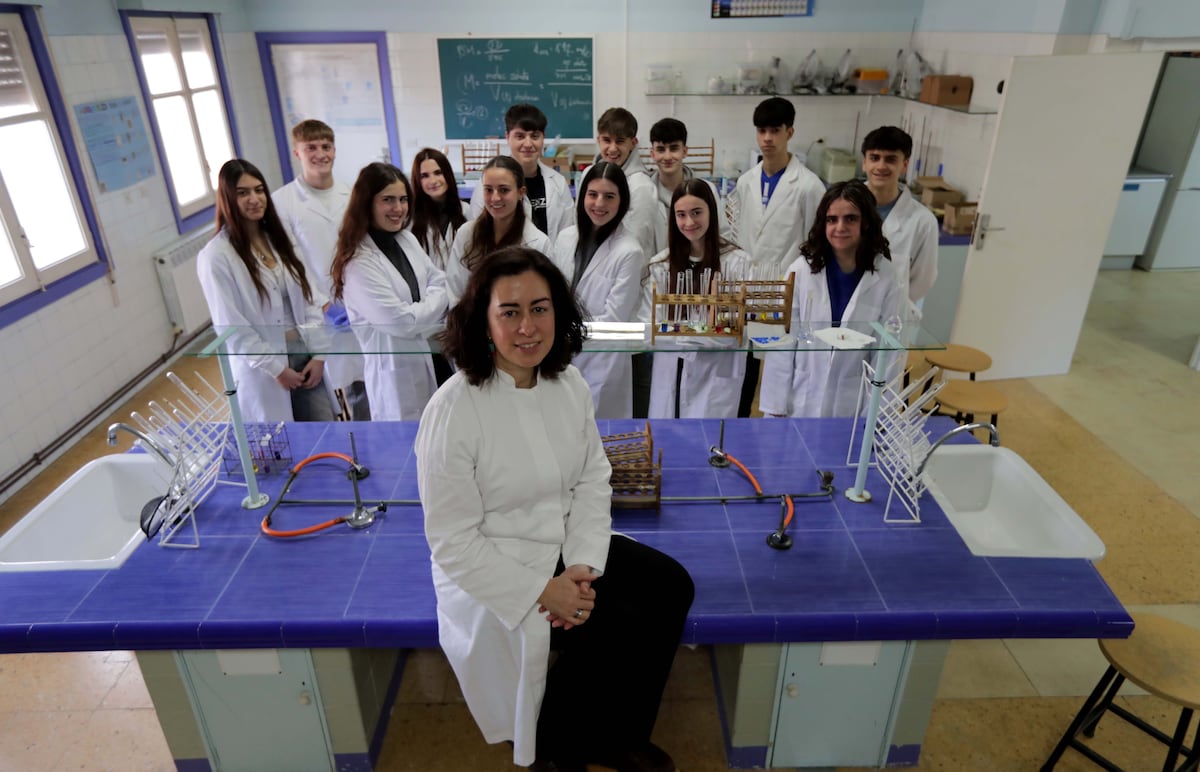
Silvia Vega is in a laboratory but it is not her laboratory. His laboratory is more than 1,400 kilometers away, in another country, in Germany, where a few months ago he made a hopeful scientific discovery in the fight against some of the most aggressive cancer tumors. But now—mid-January—this 48-year-old scientist, born in Villanueva de la Peña, a small town in Cantabria, is in Vitoria. In a more modest laboratory, that of the Carmelitas School, with second-year Baccalaureate students, in a stay of a few days to inspire vocations among students who have the Ebau just around the corner and live as best they can with the pressure of making one of the, apparently, most important decisions of their lives: which university degree to study next year.
“You are already experts at pipetting, who’s up for it?” Vega asks a dozen kids dressed in white coats to whom he offers a pipette with which to finish the electrophoresis practice, a common technique in laboratories for DNA analysis. In the class, there are students who want to follow in his footsteps. “I have always been clear that I wanted to do some research,” explains Kira, 17, who is going to opt for a degree in Chemistry, with a more accessible average entrance grade than Biochemistry, the career she would have liked to undertake. In Biochemistry, precisely, Ane, also 17 years old, is going to try it: “I don’t like dealing with patients as much, I like helping from the laboratory more.”
Just one year before, in the first year of Baccalaureate, there are many more doubts than certainties. “I have looked at careers like biomedical engineering or psychology but, in the end, I am considering a lot of things,” says Mikel. “I like research, the thing is that I’m not very clear about it,” adds Luca. He and Mikel, like many other students, have gone through a tutorial with Vega. Some have told him that the Baccalaureate has overwhelmed them, others ask him about what his day-to-day life is like, there are those who ask him for advice on choosing a career. She tells them that if they are not clear, “nothing happens”, that when she had to choose in high school whether to go for science or literature, she did not know which decision to make either. He explains to them that you have to go look for opportunities, that it is better to study something that you are passionate about because “careers have no exits, what has exits are people.” He gives them more practical advice: never finish a class with doubts and take a look at the notes that same day. And when curious people ask her about her profession, about scientific research, to try to unravel if this could be the future they want for their lives, she responds that it is a job that is “not at all routine” but that at certain times it can be very absorbing and require “many hours.” And he recommends his profession for many reasons, because “at some point, it will help someone” or because in few professions you can say “I am the first person in the world who has seen this.”
Indeed, Vega, biologist and biochemist and director of the Autophagy in Cancer group at the Institute of Cellular Biology of the University Hospital of Essen (Germany) has seen things that no one has seen before, or that at least no one has published and patented as in the case of her latest research, released last year. “We propose a new treatment for a series of tumors that arise in different organs, but which have in common that they lack the protein BAP1, a tumor suppressor factor, which causes low levels of autophagy,” he details. Autophagy is a cellular regeneration process typical of the human body, vital in its development and that helps fight infections and diseases. In this specific case, with weakened autophagy, tumors have an advantage: “If you do not have this protein, tumors are more aggressive, more metastatic.”
The first discovery was to relate the absence of this protein in tumors with an inhibited autophagy that does not work well. The next step was to find a remedy. “What we have done is propose a treatment in which we increase autophagy through two different routes, and what we have seen in cell lines, also in xenograft models and in tumor samples from patients in culture, is that the treatment works very well because the tumor no longer grows, and not only that, but the combination of both treatments does not have an additive effect but a synergistic effect.” An effect greater than the sum of the two treatments separately. Silvia Vega’s team—together with the Translational Genomics group of the Ophthalmology Department of the Essen University Hospital with which she is promoting these scientific findings and led by another Spanish researcher, Samuel Peña-Llopis—is undertaking experiments in mice and hopes to be able to begin clinical trials in patients as soon as possible.
These advances have focused on ocular melanoma, in addition to other types of specific kidney or lung cancers. The absence of the BAP1 protein—which can be identified with a very simple laboratory technique—is currently used as a means to determine the prognosis of the disease: without this molecule, tumors have a worse evolution. “But now we can use it as a method to determine the treatment, not just the prognosis,” says Vega. A more precise therapeutic approach.
The Institute of Cell Biology where Vega works is within a public ecosystem of hospitals and research centers in Essen that facilitates contact between doctors and scientists. “The advantage of this type of organization is that collaboration with doctors is usually very fluid,” he explains. And to this we must add that the financing of scientific research in Germany “is much greater than in Spain, both by the Government and foundations.” His pioneering research on cancer has been largely funded by the equivalent of what would be the Spanish Cancer Association and the German Research Foundation. The budgets in Spain are much tighter, he maintains. “I would like to live in Spain, there are people who are doing great research, but you have to count the euros and cents because you are over budget, in addition to other bureaucratic problems, instability and precariousness in general.” She earned her doctorate at a CSIC center in Valencia and worked in the United States for more than a decade. She wanted to return to Spain but “there weren’t very good opportunities” and since 2017 she has settled in Germany. Silvia Vega also tells it to the students who ask her for advice. Now it’s their turn to make the decision.
