



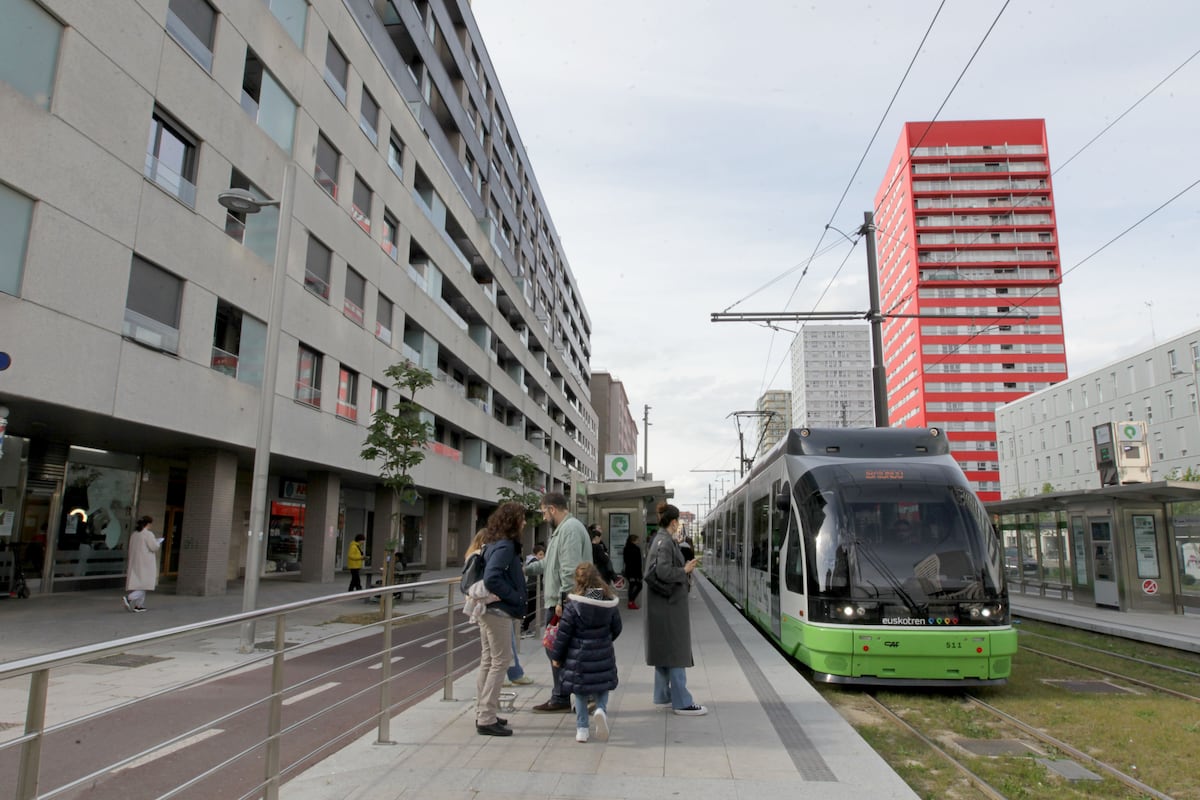
When Vitoria won the title of European Green Capital in 2012, the European Commission highlighted the green ring that surrounds the city and the fact that the vast majority of citizens lived within 300 meters of open green areas. He also gave merits to the bicycle lane network, the reduction of water consumption and the protection of biodiversity. The foundations of the Green Capital —as Vitoria has been known since then— were solid, but there was one subject for which the jury did not give a good grade: the excessive consumption of land. The expansion of Vitoria was disproportionate to the population growth of the city. The leaders of the time responded to the jury that they were working to correct it and the final thesis of this change of course has arrived in 2026 with the entry into force, after years of studies and processing, of the new General Urban Planning Plan (PGOU), the urban plan that designs the Vitoria of the coming years. After two decades of wasteful land consumption, its urban planning has a new motto: growing inward.
“We came from an expansionist model, where the city had grown much more in land than in population: in Vitoria, between 2003 and 2023, the consolidated urban land had increased by 40% compared to a population growth of just 10%,” explains Borja Rodríguez (PSE), councilor for City Model and Urban Planning of the Vitoria City Council. During those years, Vitoria expanded to the east and west, building buildings in areas far from the urban area; Neighborhoods with a very low density and more dependent on the car were built (for which public transport solutions are still being sought today, as in Zabalgana). And more recently, the Goikolarra neighborhood has spread towards the foothills of the Montes de Vitoria, the southern green border of the city and one of Vitoria’s environmental jewels.
Vitoria only has a density of 57 homes per hectare, far from what is desirable to achieve a compact city. “And that has a direct impact on public services, in the end a city that is much more dispersed has much more structural spending on cleaning, transportation, maintenance, lighting, and that has meant an increase of approximately 50 million euros per year in the provision of those municipal services,” adds Rodríguez. Vitoria has promoted several redensifications in recent years to regroup residential growth in already urbanized areas, and is now seeking to consolidate a more cohesive and sustainable city. The new PGOU has the support of PSE, PNV and Elkarrekin (Vamos, IU, Equo and Alianza Verde). EH Bildu has abstained, among other reasons, because it denounces that the new doctrine of not consuming more land is not complied with in the operation of more than 3,000 homes that have been maintained in Errekaleor, at one of the ends of the city. For the PP, which has opposed, the plan harms the middle class’s access to housing.
But what does the motto of “growing inward” that is expressly included in the new urban roadmap and repeated by the councilors translate into? The Vitoria City Council has declassified land in 25 sectors in which, if the land reclassified to expand the Mercedes factory is added, some 3,200 homes were planned that had not been developed in the last twenty years. It is fundamentally agricultural land that is no longer developable on the margins of the urban area and in more than 50 rural centers that orbit around the city. Some 922 hectares that are recovered to contain “predatory urbanism”, an expression that is usually used in the City Council to describe the previous PGOU which, for example, provided for a 135% increase in single-family homes in towns in the municipality, of which very few have seen the light.
The plan speaks of the “non-colonization” of new lands. The new strategy, more greeninvolves building housing within the city instead of further expanding the borders of cement and, according to the City Council’s plan, there is land for this: 21,000 homes can be built in the neighborhoods of Salburua, Zabalgana, Goikolarra and Lakua, 75% of them protected and valued. Another of the pillars is the rehabilitation of the old working-class neighborhoods of the city to guarantee the longevity of their buildings and avoid the donut phenomenon: the population emptying the central neighborhoods to go live in the periphery.
But this new philosophy has angered the city’s real estate developers and builders with properties on land that is no longer developable. Especially in two parts of the city, in Alto de Uleta and Elorriaga, where some of the most important builders in Vitoria aspired to build nearly 600 homes, most of them chalets or townhouses, although they never managed to promote them when they could still do so. Only in the case of Alto de Uleta, the builders began to move when the City Council showed its cards at the start of the processing of the new PGOU. In fact, in 2022 they tried to start the development of a road in the sector, but the City Council prevented it (even sending the municipal police to stop works considered illegal).
The landowners opened a court battle in which the City Council has the advantage. In the municipal government it has always been considered that the final intention of the builders has been to try to gain position in the face of a future lawsuit for damages. “They only intend to start the works to obtain compensation when they have not done so for years and when they are already aware that such works will be contrary to the new PGOU and, therefore, to the general interest,” stated a ruling favorable to the council. Ana Oregi, Councilor for Urban Planning in the previous municipal term, was one of the main promoters of this urban planning “to defend the common good” that confronted the interests of the developers in Alto de Uleta. In 2023, after numerous skirmishes with builders and internal friction in her party, the PNV, Oregi left politics and returned to her position as an official in the City Council.
SEA-Uneca, the Álava construction employer, presented allegations to the General Plan, but they were not addressed. The builders oppose the declassifications of Alto de Uleta and Elorriaga because they will cause “an increase in housing prices by limiting competition.” Now those floors are rustic again. In an interview on SER, the developer Carlos Fernández de Nograro has denounced the legal uncertainty that arises with this change: “People from outside come to invest and have bought some land, and now they tell you, you can’t build. Who is going to come to invest in Vitoria?” Nobody rules out future negotiations between the promoters and the City Council, but the owners of these declassified lands have agreed to appeal the General Plan before the Superior Court of Justice of the Basque Country. The judicial fight is intensifying, but, for now, what Vitoria needs to do is grow inward.
