


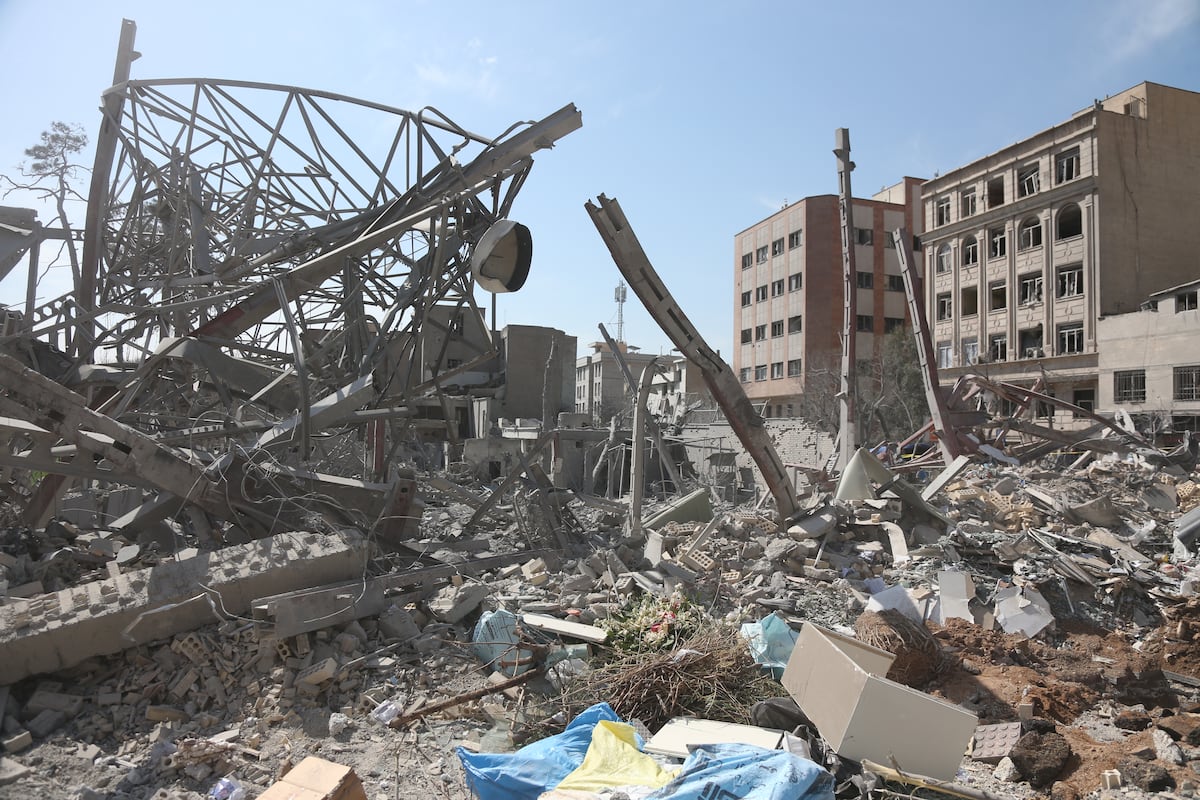
A group of 22 Spaniards have left Iran by land and are now safe after having crossed the Azerbaijan border, from where they will travel by plane to Madrid via Baku (Azerbaijan) and Istanbul (Turkey), as announced by the Minister of Foreign Affairs, José Manuel Albares. The head of Spanish diplomacy has assured that they will expectedly arrive in the Spanish capital tomorrow, Thursday. The operation has been especially complicated since the group has had to travel more than 500 kilometers, about eight hours of travel by road, through a militarized country that has been subjected to continuous bombing by the United States and Israel since last Saturday.
The Spanish Embassy in Tehran remains fully operational, reduced to its essential staff, with its ambassador at the helm, Albares stressed. According to Foreign Affairs, 131 Spaniards remain in Iran. In June of last year, 40 left the country in a first evacuation. Albares has also announced the reinforcement of the staff of the Spanish embassies in Saudi Arabia, Oman, the United Arab Emirates (USA) and Bahrain, to support the evacuation of Spaniards who want to leave the region. “We are not going to leave any Spaniards behind,” he promised.
The Spaniards evacuated from Iran are now safe.
We continue working to protect the rest of the Spaniards in the Middle East and ensure that all who wish to do so can return home as soon as possible. pic.twitter.com/uIzotuOpCV
— José Manuel Albares (@jmalbares) March 4, 2026
An Airbus 330 plane of the Air and Space Army left this morning from the Torrejón de Ardoz base (Madrid) and arrived this afternoon in Muscat (Oman) to repatriate Spanish citizens trapped by the war started last Saturday by the United States and Israel against Iran. Although it is not known how many passengers will be repatriated on this flight, the military transport plane has capacity for about 250 passengers. In addition to the crew, from Group 45 of the Air Force, personnel from the Air Deployment Support Squadron (EADA) travel on the device, so as not to depend on airport aid.
The evacuation, prepared by the Ministries of Foreign Affairs and Defense, consists of two phases: departure by land from the United Arab Emirates (USA) to Oman and return to Spain from Muscat by military flight. Foreign Affairs has chosen this land route because the distance from Dubai and Abu Dhabi to the capital of the sultanate, about 500 kilometers, is half that to Riyadh and there are fewer guarantees of being able to use the Saudi airport.
In addition, the Air and Space Army has more planes ready to send to the region as soon as there are more groups of Spaniards ready to be repatriated. Albares has estimated that there are 31,000 fellow citizens who are in the conflict zone, which has expanded to the entire region with Iran’s retaliatory attacks against countries that have US bases, although many of them have been residing in the region for years and do not wish to return. More than 40% of Spaniards, about 13,000, are in the United Arab Emirates, where they have been trapped by the massive cancellations of flights at the airports of Dubai and Abu Dhabi, two important connection nodes between Europe and the Far East.
In statements to TVE this Wednesday morning, Albares assured that “one of the most difficult and most delicate operations of the entire evacuation that we are going to carry out is currently underway and, from what I have been told, it continues to go well and, if everything concludes happily, in a few hours we will be able to give good news”, in reference to the departure of the 22 Spaniards from Iran. Although he did not want to provide details, claiming that there are “tremendously delicate situations”, he has advanced that different evacuations are being carried out in different countries. The minister has specified that all means are being used: land, the sending of military aircraft and conversations with airlines so that, when the airspace is opened and flights resume, Spaniards who already had a return ticket and saw their flights cancelled, can board the planes. What is impracticable, he specified, is evacuation by sea due to the Iranian threat to traffic in the Strait of Hormuz.