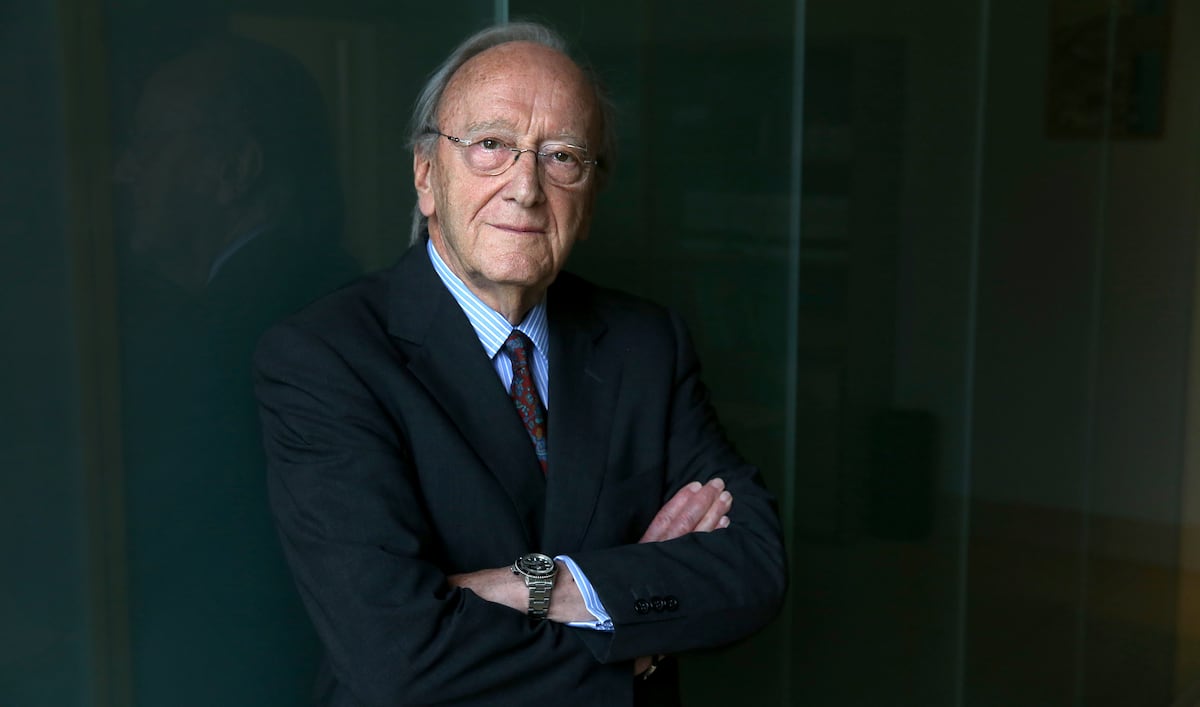

Courteous, affable, smiling, but also a relentless negotiator, Carlos Westendorp, who died this Monday at the age of 89, did a lot: as Foreign Minister; MEP; ambassador… But above all, he has been, for decades, the decisive oracle of Spanish diplomats. A huge contributor, often in complicity with his co-pilot Javier Elorza, to the Spanish strategy. And to the advances of today’s European Union.
A member of the accession negotiating team since the late 1970s – the famous Trinity group – he brought experience in dealing with the outside-from-the-outside. Then, as the first ambassador-permanent representative to the Communities since 1986 and Secretary of State from 1991 to 1995, he handled with ease the difficult implementation of the accession agreement, when this country was still new to the intricacies of Brussels.
He was a protagonist in the forge of the European legend that we Spaniards were the “South Prussians”, in his most relaxed, pactist and ironic personal version. That legend carried doctrine: perseverance, transparency, pedagogy, teamwork and primacy to consensus.
With outsiders, he placed the country’s interests in the generals’ basket and thus made them more understandable and acceptable, a method in which President Felipe González would become a master. With those inside he tuned in to the MEPs of all acronyms, whom he summoned to explain progress and problems: today, something impossible.
It left its mark on the Maastricht reform, to which Spain proposed incorporating the cohesion fund. When Jacques Delors’ Commission wanted to dilute it into a virtual declaration, it was decided: either they would consecrate the fund in a binding manner, “or there would be no Treaty.” And he knew how to be “hard as steel,” as Elorza described him.
And it sponsored social innovations for the Treaty of Amsterdam, consumer skills, the environment, public health, that harmony with the new Scandinavian partners: without it, the EU would not have been able to respond, years later, to the pandemic.
For your skillful listening and grouping, Charliewestas he was nicknamed, earned enormous respect – for himself and for his country – among members. He was helped by that conjunction of surnames, Dutch (Westendorp, town in the west), and Spanish (Cabeza), which aroused curiosity in the face of an impassive appearance doubled with passionate ability to execute.
That is why he was entrusted with the Inform Westendorp, on the options for reform of the Treaty, in 1995. Or a relevant role in the Report on the future of the Unionfrom the Group of Wise Men chaired by González, from 2010. They still encourage valid suggestions.
Another great legacy of Westendorp – his last electoral political commitment under separate socialist acronyms – was his performance, from 1997 to 1999, as high international representative in the Bosnian conflict; position that he duplicated, an unusual case, with that of the same title but commissioned by the EU. There he hired a young Pedro Sánchez, whom he taught the “culo di ferro” technique, never abandoning a negotiation. But above all, when he was the first baby of his young wife and great lady in the theater management Amaya de Miguel, he learned to go from the office to the trench, his least known lesson.
As international viceroy, he calmed the Bosnian crisis. With decisions such as daring to remove the president of the insurgent Republika Srpska, Nikola Poplasen, for being a coup plotter. “We spent an hour calibrating the risks of the decision, in detail, as he liked, but once it was made, he applied it without hesitation,” recalls the great community jurist Marta Arpio, who was his chief of staff in Sarajevo. And so he learned to travel dangerously in an open-door helicopter, with escorts armed to the teeth with machine guns. He always flew high, but never so difficult.