


40 days before the Andalusian elections, with the parties starting their pre-campaign, the CIS published this Tuesday a survey that names both the party and the candidate who have everything to win: the party is the PP and the candidate is Juan Manuel Moreno, whose pull explains the leadership of the popular ones. In a survey carried out between March 12 and 26 with more than 6,000 interviews and focused on the “attitudes and demands” of Andalusians after the serious flooding in the community, the CIS introduces several questions that allow us to see where each group and headliner is at the start of the electoral race. The main one is: “Which party or coalition would you vote for?”
The clear winner is the PP, with 32.1% of direct voting intention, which means that almost one in three respondents affirms that they will put the ballot of the main right-wing party, which has been in power since 2019, in the ballot box. Behind them are the PSOE, with 22%; Vox, with 8.8%; Forward Andalusia, with 7.7%; For Andalusia, with 5.8%; The Party is Over (SALF), with 1.3%; and Podemos, with 0.5%. The survey was carried out before Podemos united to run under the same electoral brand for Por Andalucía.
What these percentages reflect is not the estimate of the vote, which the polling houses — including the CIS — prepare taking into account answers to many other questions, but only the declared intention to vote. There is also no estimate of seats. However, even by itself voting intention is a relevant indicator. And what it shows in Andalusia is a clear advantage of the PP of Juan Manuel Moreno over the PSOE of María Jesús Montero, but also a clear advantage of the PSOE over Vox – far from the forecasts of those who predict that the extreme right led by Manuel Gavira can approach second place – and a possible overtaking on the alternative left from Adelante Andalucía, the party founded by the former regional leader of Podemos Teresa Rodríguez, to Por Andalucía, even adding the half point of Podemos to the coalition led by Antonio Maíllo.
It remains to be seen how Podemos’s agreement with Por Andalucía impacts that space. What 0.5% of the purple party already shows is that Ione Belarra’s formation was very weak when it decided to join the coalition of which IU and Movimiento Sumar were already part. The Party is Over (SALF), the party of far-right agitator Alvise Pérez, with only 1.3% of direct voting intention, starts with poor prospects in its third attempt to get into an autonomous parliament after the failures in Aragón and Castilla y León.
The survey is disturbing for Vox. In Cádiz and Seville, Adelante Andalucía is the third force in voting intention, ahead of Santiago Abascal’s party. In Córdoba and Granada, the third force is Por Andalucía. Although we will have to see how these data translate into vote estimates, the distance of more than 23 points between the PP and Vox in direct intention is striking, when in theory Santiago Abacal’s party is fighting to compete head-to-head with Alberto Núñez Feijóo’s party. With the data from this survey in hand, it does not seem that it will be achieved in Andalusia.
Moreno overwhelms in valuation
The Andalusian Government surpasses the Spanish Government in management, according to the perception of those surveyed. The percentage of those who consider that carried out by Moreno at the head of the Board “good” or “very good” is 40.2%, compared to 23.3% who think the same about that carried out by the Executive of Pedro Sánchez. Regarding the response to the February floods, those who rate the Junta favorably (59%) also far exceed those who approve of the central Government (33.6%).
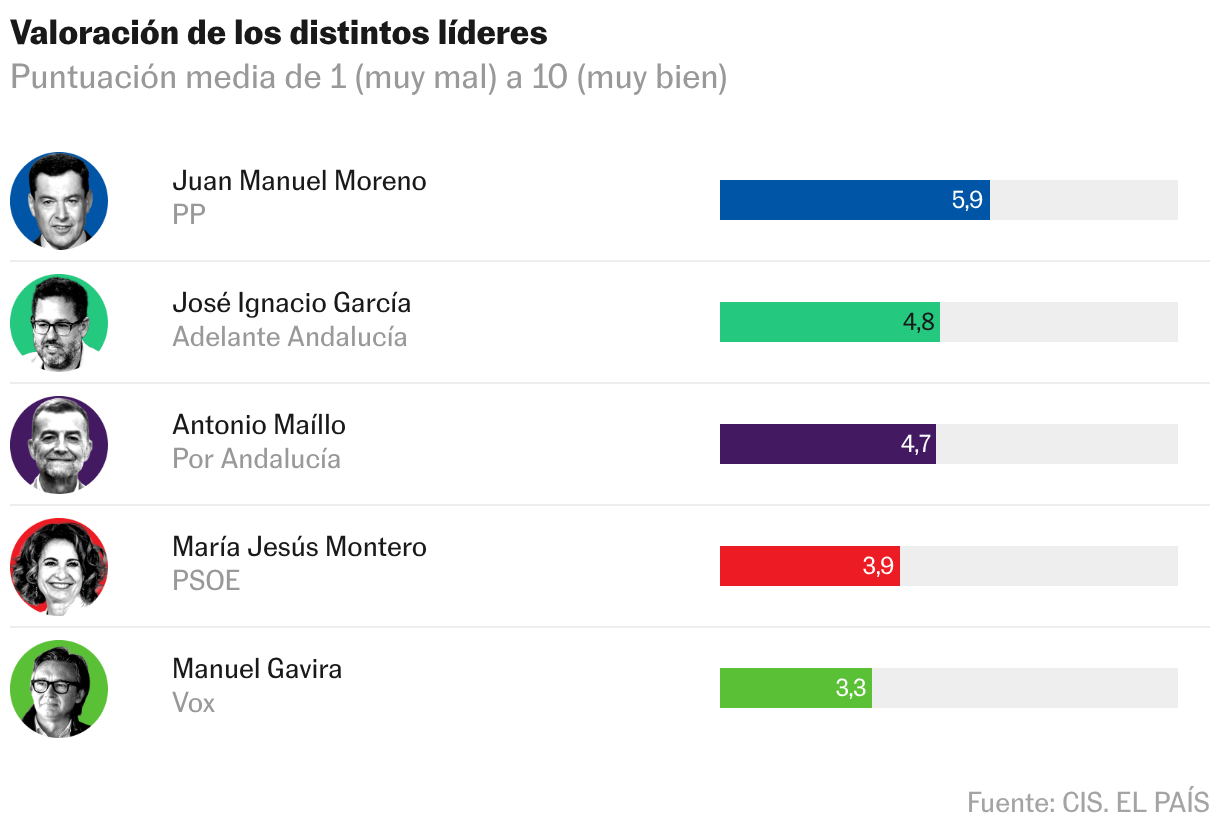
Moreno sweeps the rating. Not only is he the only candidate whose rating exceeds 5, but also the one that the highest percentage of Andalusians consider the most “sincere” (40.2%), “reliable” (42.3%), “honest” (39.5%), “prepared to govern” (45.7%) and “dialogue” (47%), always far ahead of María Jesús Montero, the PSOE candidate, who only exceeds 20% in the question about preparation to govern. Among those who mention a specific leader when answering, 52.9% say the name of Juan Manuel Moreno when asked who they prefer to be the president after the elections, compared to 22.6% who name María Jesús Montero. There are more than 30 points difference.

Those surveyed also see the PP as the party that “best defends the interests of Andalusia”, that “best represents people like you” (that is, like the interviewee), that “inspires you more confidence”, that “has a better leader in Andalusia” and that “is more capable of governing the community”, with percentages of those who think this way ranging from 30.8% to 48.6%, always with clear differences with respect to the PSOE. The good news for socialists is that the party of the fist and the rose continues to be the one for which a greater percentage of those surveyed declare they feel more “sympathy.”
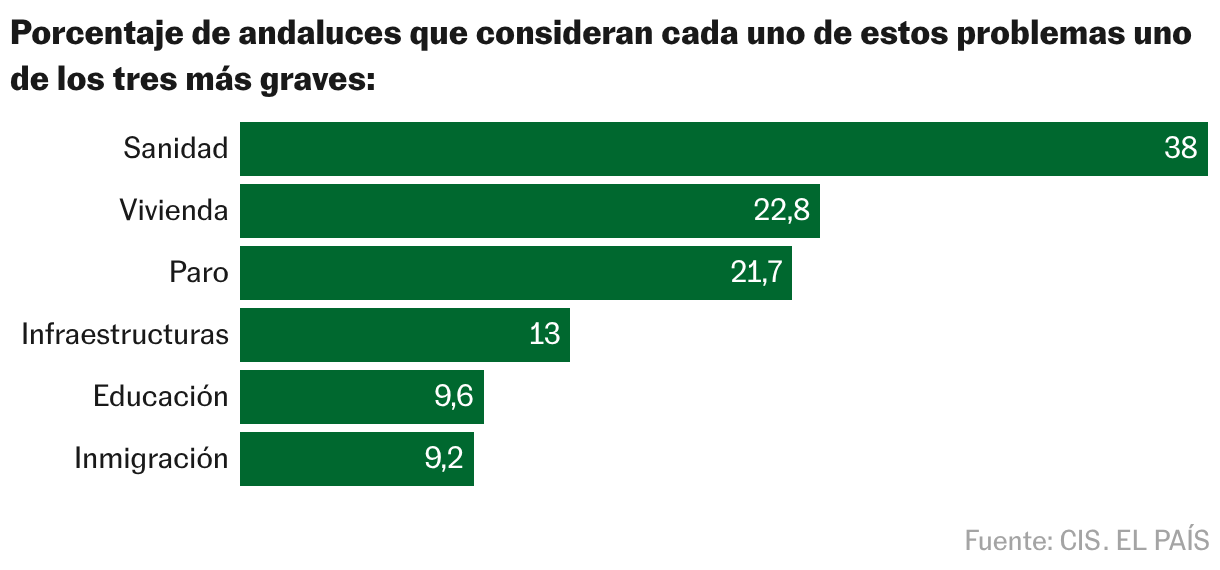
The main reason for concern for Moreno is health. Up to 38% of those surveyed consider it one of the three main problems of the community, far ahead of the second most disturbing issue, housing (22.8%). This information must be put together with that offered in March by the Health barometer from the CIS, which showed how Andalusians are the ones who show the least satisfaction with the functioning of the health system, which is the responsibility of the Board.
Because of data like these, the PSOE candidate, María Jesús Montero, insists that the May 17 elections must be “a referendum on public health.” Health is also cited by more than 40.7% of those surveyed as one of the three problems that most directly affect them. That is to say, it is not a problem that one hears about on television or reads about in the media and on the networks, it is a problem suffered directly by a large percentage of Andalusians. 26.5% of those surveyed believe that health is the issue on which it is most “necessary” for the Andalusian Government to act, more than double that of the second, disaster management (12.6%).

On a scale in which 1 is extreme left and 10 is extreme right, Andalusians are at 5.06, further to the right than the population as a whole (4.71). 62.4% consider themselves Catholic, almost 10 points more than in Spain as a whole (52.8%). In the community with the lowest GDP per capita in Spain, society is mostly perceived as middle class in its different variants (53.9%), much more than working class (15.3%) or lower class (13%).