
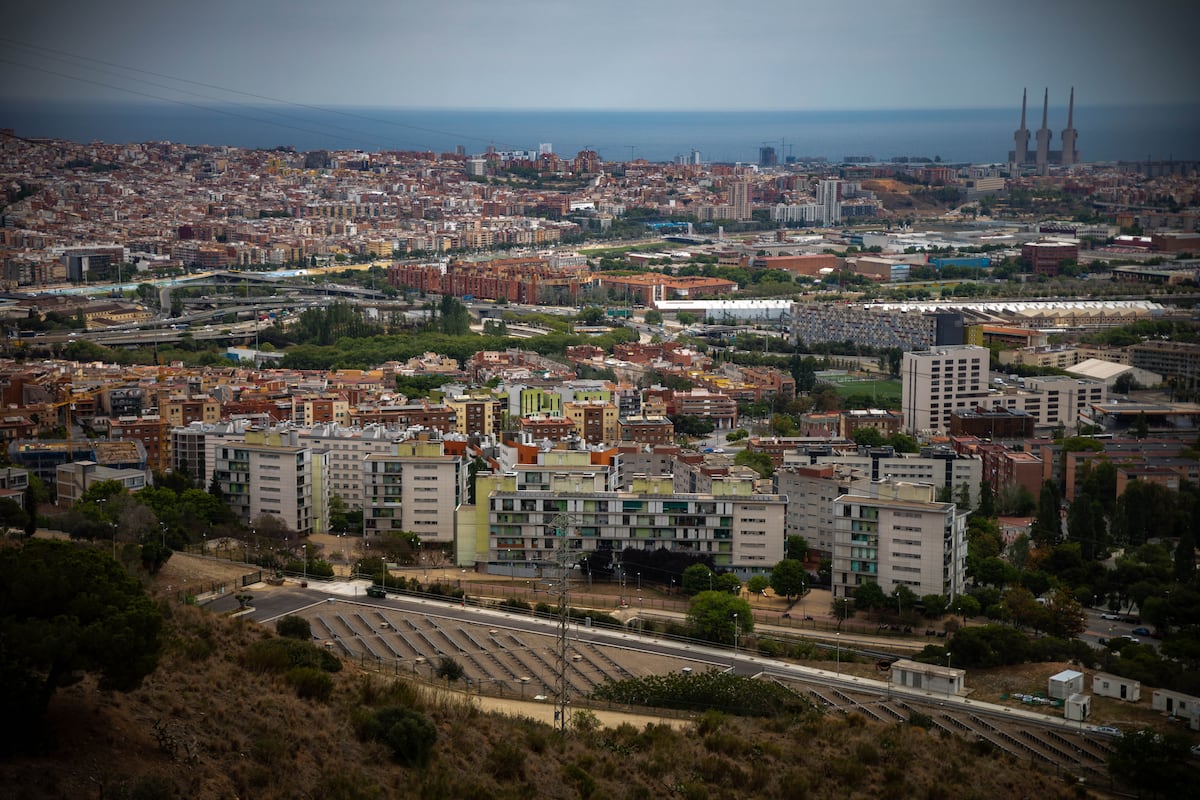
Poverty falls in the city of Barcelona while it grows in the surrounding municipalities. It is one of the issues that the Metropolitan statistics of living conditions 2024-2025 published this Tuesday by the Metrópoli Institute from the Living Conditions Survey of the INE expanded by Idescat in Catalonia. On average, the risk of poverty in the municipalities of the Barcelona Metropolitan Area (AMB) is 19.4%, slightly lower than two years ago. But if you put a magnifying glass on it, you can see how poverty has fallen since then in the Catalan capital (from 19.7% to 16.4% of the population), while in the rest of the AMB it has risen from 19.8% to 22.4%.
Vulnerability, furthermore, cannot be explained without taking into account the living conditions of the foreign population: it affects 32.8% of the population born outside of Spain, compared to 14.8% of the population born in Spain. If we talk about minors, poverty is especially intense in the age group from 0 to 16 (31.4% are at risk of poverty). There are 148,000 children who are at risk of poverty and, of these, 70% are of foreign origin. When we talk about risk of poverty, there are once again differences between Barcelona and its surroundings: foreigners from the first ring at risk of poverty are 39.5%, compared to 26.3% in Barcelona city.
The survey also shows that, despite the improvement in general poverty rates, the perception of not making ends meet is growing: a feeling expressed by 23.1% of those surveyed compared to 21.5% two years ago. The data also indicate the impact that the housing crisis has on the metropolitan population: 77.4% do not find it easy to find housing suitable to their needs in their neighborhood or municipality, 23% have changed their home in the last five years and 24% have moved for economic or forced reasons.
Urban cohesion data show that the risk of poverty or social exclusion rate (ARPOE) follows the same pattern when we talk about Barcelona city and its surroundings. In Barcelona it has fallen between 2022-2023 (from 25.% to 21.1%), while in the rest of the AMB it has risen (from 26.9% to 27.7%). This rate measures people who are in one of the following situations: risk of poverty, severe material and social deprivation, or low work intensity at home. When asked if the capital spins poverty into its surroundings, the head of the Social and Urban Cohesion Area of the Metrópoli Institute, sociologist Sergio Porcel, points out that it is a phenomenon that “has been studied, debated and is intuited”, but argues that “there is no adequate data to measure the phenomenon, there is a lack of evidence.” Porcel, who is the director of the study, points out factors that would explain the differential: “The composition of the population profiles in Barcelona is more favored by economic dynamics and the presence of foreigners with higher incomes than the local population, while in the first ring there is more presence of unskilled migration.” The cost of housing also especially affects the migrant and lower-income population, as the Metrópoli Institute itself has warned in other works.
The impact of the public and a notable increase in income
The report confirms once again how social transfers from the public system (whether in the form of benefits, aid and pensions) contribute decisively to reducing poverty. In the period 2024-2025, after the transfers, the metropolitan population at risk of poverty is reduced from 41.6% to 19.4%. In other words, without this public intervention, poverty would double.
Another striking fact is the increase in the median annual income: in Barcelona households it increases by almost 12.5% compared to the previous survey and stands at 46,048 euros. Compared to 2020-2021 (pandemic years), the increase is 32%. An increase that the director of the study attributes to the current cycle of economic growth: it increases salaries, reduces unemployment, and adds to measures such as the successive increases in the Minimum Interprofessional Wage (SMI). Another reason could be the presence of highly qualified foreign workers in the city with jobs in international companies, but it is not clear that their reality is reflected in living conditions surveys.